Lexus takes on Germany's top saloons
Can the new GS 350 can match the Germans in performance?
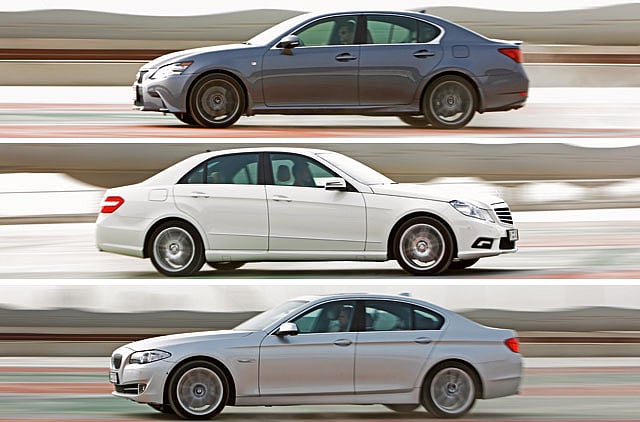
Ever since Eiji Toyoda's aspiration to "challenge the world's best" with a new luxury brand brought it into the world, Lexus has ruled the premium saloon market in the States. Agreed, it's probably got a lot to do with the fact that luxury in America is perceived as a sofa with built-in cup holders and the Japanese company excels in providing an insomniac-curing ride, coupled with build quality and reliability to match the aerospace industry. But now, Toyota's premium badge has seriously turned its sights on the three Germans with the new GS 350 F Sport.
Unfortunately for this first-ever Middle East test of the GS 350 F Sport versus its rivals, it had to be the two Germans — simply because the new Audi A6 isn't available in the GCC yet. And we just couldn't wait.
Right from the onset, Lexus has one huge advantage, or burden, depending on how you look at it: the word ‘Sport' in its moniker. And that's really the keyword. Lexus reckons the GS 350 is its first model that can out-drive the BMW 5 Series and Mercedes-Benz E-Class on something other than a dead-straight highway. The first task is simple. Is the new GS 350 F Sport actually sporty? In a word, no.
Even that, though, depends on your point of view. For a Lexus, this is a roll-caged, semi-slick tyred, straight-through exhaust-ed, bucket-seated, time attack beast. Yet next to the Germans, it's still just a very cushy, relaxed Lexus. However, to its credit, it must be said that Lexus has certainly managed to narrow that gap with the Germans. But we'll get to the sporty and not-so-sporty bits in a minute.
First up, the looks. Lexus wins in the styling department unanimously, as far as the wheels boys are concerned. The Lexus GS 350 with the F Sport kit looks like it was carved by a katana, sliced up like sashimi. It's interesting. There are contrasting themes going on yet making up a fitting whole. There's nothing interesting on the German cars except for the Merc's doggie-going-number-one rear fender crease.
The new spindle grille matches the busy, aggressive front bumper like on no other Lexus so far, and the outer air intakes suggest there's some serious cavalry hiding underneath the bonnet, which in itself is heavily sloped to lower the frontal area for better aerodynamics and, of course, just look straight-up menacing.
At the back the F Sport kit brings with it a unique lower valance and an integrated diffuser with centred aero fins, which actually function as aids for underbody airflow. A subtle lip spoiler kinks up off the boot, and the C-pillar plays host to a smorgasbord of curvy lines, suggesting this thing can handle the esses. There's a lot going on, is the point.
Looking at the Germans, we don't really have much to say. The BMW has a, er, kidney grille, and the Merc wears a three-pointed star. Japan 1, Germany 0.
We then start checking out the interiors of these three cars, and begin from the back moving forwards. Straight away it's not looking good for the Teutonic pair. The Lexus clearly affords its passengers the most rear room, as well as their luggage, since the boot is 25 per cent bigger than before. The GS 350 actually has the shortest wheelbase here (Will that be good for directional sprightliness?), so the airy interior is purely down to clever packaging. Its premium feel is also exemplary, shaming the Mercedes, and getting even with the BMW. The steering wheel is padded and flawlessly stitched, while the dashboard impresses with its microscopic panel gaps. While the BMW feels the most sturdy inside, and likely to outlast the other two here, its clumsier egress and ingress and low room for rear passengers count against it. The Merc is as loaded with toys as the others, but it wears the most dated cabin design, slab-sided panels, and the lowest quality in terms of feel, with the raspiest plastics and shaggiest carpet.
Lexus has another trump card up its cabin, and that's the 12.3in display, large enough to support split-screen viewing, and embarrassing most laptop screens. It could be a deal clincher, if it wasn't for the idiotic ‘mouse' that controls it. The pursuit of engineering and design perfection of the Japanese firm is commendable in the GS 350, but they obviously got carried away with the mouse. Instead of revolutionising the infotainment control systems in this class, as Lexus probably expected, it's become one of the few blunders of the GS since you can't take your eyes off the screen to actually get anywhere within its otherwise intuitively laid-out menus. Not the best thing to do at highway speeds. BMW's iDrive and Merc's Comand systems are infinitely easier to get around (and safer, since you can keep your eyes on the road) even if they are in their fundamental design actually more complicated. Let's call this one a draw and move onto the dynamics and performance.
Since we have the flagship GS 350 here (at least if you don't take the GS 450h hybrid into account, which nobody will buy in the region), the correct thing to do is challenge it with the BMW 535i and the Mercedes-Benz E 350. These three cars are eerily similar in specification.
The BMW's twin scroll turbo six-cylinder is one of the pinnacles of internal combustion, developing 306 horsepower and 400Nm of torque from pretty much idle speed. It'll get you to 100kph from rest in a tick under six seconds thanks to a ZF-sourced eight-speed automatic gearbox, with imperceptible shifts and the uncanny talent of making eight ratios feel like just the right number.
The Merc's naturally aspirated unit somehow feels even smoother than the force-fed BMW, boasting a torque line as if drawn with the help of a ruler and pointed straight up the page. It makes as much power as the Bimmer, but less torque with a figure of 370Nm, and although it doesn't sound like much, the difference is perceptible. The Merc's engine may be more elastic and responsive, but it's just not as eager as the Munich bruiser. The E-Class has a silly column-mounted shifter, which takes a while to get used to, but Mercedes' own seven-speed gearbox is as silky as the best that ZF can do.
With a power figure equalling the Germans' 306bhp, it's looking good for the Lexus. Its torque figure slots in neatly between the Germans, with 375Nm, but the Japanese spent most of their energy getting the 3.5-litre V6 to sound just right. And that's why this unit endears itself to you the most. Below 3,000rpm the engine purrs and hums like any Lexus engine should, but call on the (not very responsive) Electronic Throttle Control System with Intelligence (yes that's what they call it, and there is an abbreviation: ETCS-i) and the V6 rasps and roars like it came out of Turin, not Tahara.
Once again, the Lexus is edging into the lead…
Benefiting from a considerable 50kg weight advantage over the 5 Series, and a little less than that over the Merc, logically the Lexus should score highly in the handling test as well. But it doesn't. The rear-wheel drive chassis of both the BMW and the E-Class have been honed to perfection for years, and their taut, composed behaviour makes both cars feel lighter than they are. Whereas the Lexus doesn't hide its weight at all, with softly sprung suspension, that ETCS-I thing, steering that's just as electronic and just as uncommunicative, and rear wheels that steer for safety reasons rather than faster apex speeds.
Switch everything to Sport mode and hold the traction control button down for a bit and the electronic fakery does take it down a notch. The rear will even swing out if you really step on it, but it's never a controlled slide, rather a clumsy, inconsistent moment of being simply out of control.
The Lexus never seems to take the same corner with the same composure twice, lumbering through in different moods each time. That might sound harsh, but it is true, when right next to it we have two of the best handling saloons on the planet.
The Merc is the softer of the two German machines, and even it behaves as precisely as one of the company's roadsters or coupés.
The BMW's rear-drive chassis will smoke the tyres willingly, and tuck the front end into corners with the eagerness of the previous generation M3. No wonder that the new M5 based on this thing is so astoundingly good.
We can only hope the Lexus GS F — rumoured to be arriving with the same glorious Yamaha-tuned 5.0-litre V8 that powers the IS-F — will find plenty of scope for improvement in the chassis and suspension.
Looks like it's a draw once more.
Verdict
To look for sporty credentials in the GS 350 F Sport just because Lexus' marketing department swears it's there would be missing the point. The GS isn't as sporty as any of its rivals, but it's better in everything else. It looks more interesting, it has a more modern, more exciting interior while managing to be completely logical (except of course for one thing), and most of all it behaves like a Lexus all of the time, which is to say it's always more comfortable, quieter, and more cosseting than the Germans. They, in turn, are sportier for a few minutes on the weekends. So, although the Lexus fails fundamentally in its main mission, it manages to win in this ultra-competitive segment regardless.
Sign up for the Daily Briefing
Get the latest news and updates straight to your inbox
Network Links
GN StoreDownload our app
© Al Nisr Publishing LLC 2026. All rights reserved.