Yoga positions of strength
Heads-down postures offer a host of benefits such as working the muscles
"There lies a silence at the other end waiting to engulf you in its large embrace. All you do is invert yourself to reach it."
Inverted postures are those in which the head is lower than the heart, the reverse of our usual upright orientation. These postures require a lot of physical and mental effort.
Inverted postures provide special benefits. Since the body is in a position it is not accustomed to, the focus and the concentration increases. For many people, one of the first responses to inverted postures is fear. Being upside down doesn't feel safe and it is easy to doubt how steady one will be in such a position. But it has some important offerings. First, these are strengthening postures. The shoulders, the back, the abdomen and the legs learn to work against gravity. Being part of the musculoskeletal system, strengthening these areas helps. The upside-down poses also stimulate circulation, since everything moves in the opposite direction. Inverted postures are particularly good for digestive troubles of any sort.
As we develop the strength for these postures, some of the effort is lessened and we begin to feel the more subtle effects of these poses. Inversions are calming and energising. Art instructors use this technique to help a beginner learn to draw.
Research shows that the human brain, because of years of conditioning, does not register details since its already cluttered with preconceived notions about how something should be done. When a picture or an object is turned upside down, the logical mind takes a while to adjust to the re-orientation.
Besides, the creative side of the brain is enhanced. It notices details and definitions it normally would not have before.
Things to remember:
• Practise these postures only on empty stomach.
• Avoid when menstruating and if you have high blood pressure.
• Be gentle with your movements; relax between postures.
• Take time to go from one posture to another.
Sharnagat Mudra
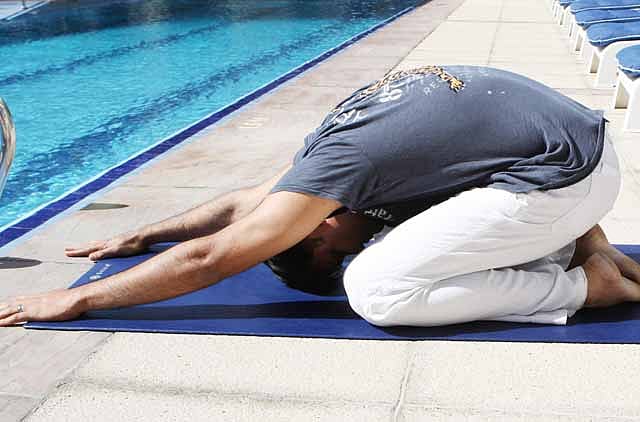
• Sit on floor. Bend right knee and place under hips. Bend left knee and place under hips. Intercross big toes of feet so you sit on feet. This is called Vajrasana.
• Raise hand and spine as you breathe in. While exhaling, drop body downwards with hands in front of body. Hold for about a minute.
Parvatasana
• Sit on all fours — hands and knees.
• Slowly raise knees off ground and stretch hips upwards, as high as possible.
• Try placing feet and heels flat on floor.
• Hold for about a minute.
Vipreetkarniasana
• Lie on back with hands by sides.
• Raise legs.
• Bring them to a 90-degree position.
• Lift hips and support with hands. • Breathe normally and hold for 10-30 seconds.
Sarvangasana
• Lie on back with hands by sides.
• Slowly raise both legs to an angle of 45 degrees from the floor.
• Raise to 90 degrees from the floor and keep both legs together.
• Slowly raise hips upwards, supported by palms.
• Hold ribs as high as possible so the body, from chest to toes, forms a straight line. Your chin will automatically touch chest.
• Hold for 15-30 seconds (for beginners).
• Return to start position slowly, supporting hips and lower back.
Halasana
• Lie on back with hands by sides.
• Slowly raise legs.
• Bring them to a 90-degree position.
• Lift hips and support with hands.
• Gently start dropping legs behind the head, trying to touch the floor with feet. If you have cervical pain, avoid going all the way down — drop legs only to where it is comfortable.
• Hold for 15-30 seconds and return to start position.
Sign up for the Daily Briefing
Get the latest news and updates straight to your inbox
Network Links
GN StoreDownload our app
© Al Nisr Publishing LLC 2026. All rights reserved.