A 21-year-old diagnosed with bilateral septic necrosis of femoral head, bilateral total hip replacement
PARTNER CONTENT
Region’s centre of excellence for advanced surgical specialty care and treatments
Burjeel Hospital for Advanced Surgery provides highest level of services to its patients
Last updated:
5 MIN READ
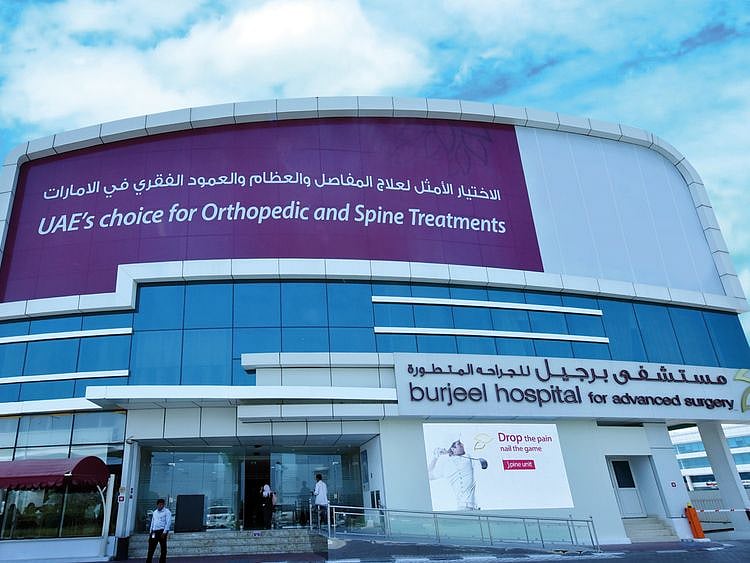
The hospital was founded in 2013 with over 100,000 Out Patient Departments
Supplied
Highlights
- The first 3D knee replacement hospital in the GCC
- Top centre in the UAE for minimally invasive scoliosis surgery
- Go-to centre for revision and re-revision of complex orthopaedic failed cases
- Hospital of choice by referral clinics and centres for complex orthopaedic and sports injuries
- Expert in scoliosis and other paediatric orthopaedic surgeries
- Versatile services in all lifestyles and age
- Preferred orthopaedic medical partner by corporate entities
- Sports medicine hub in the region
- Preferred partner hospital of local and internal sports clubs
- Intensely subspecialised care for hand and foot disorders
Burjeel Hospital for Advanced Surgery (BHAS) is a super-specialty Joint Commission International (JCI)-accredited institute, which is strategically located in the heart of Dubai. It boasts a state-of-art facilities aimed at providing world-class, evidence-based treatment for various orthopaedic disorders, joint replacement, spine surgery, paediatric orthopaedics and sports medicine.
The hospital was founded in 2013 with over 100,000 Out Patient Departments (OPDs) and more than 11,000 joint replacements and advanced orthopedic surgeries have been carried out until today, which is the largest yearly number in the UAE. The hospital has several accolades to its name for advanced orthopaedic surgeries. It is the first 3D knee replacement hospital in the GCC and a top centre for minimally invasive scoliosis surgery. It’s also known as a go-to centre for revision and re-revision of complex orthopaedic failed cases.
Minimally invasive scoliosis surgery saved a teenager's life
Burjeel Hospital combines its expertise in the areas of patient-care, and academics in order to provide the highest level of specialised services to its patients. It has a team of highly skilled, dedicated and internationally acclaimed knee and joint replacement surgeons, who have trained extensively in their respective fields while adopting the most cutting-edge procedures, which include the latest non-surgical and minimally invasive arthroscopic techniques to speed your recovery, manage pain, treat sports injuries and all orthopaedic conditions through protocol-based care.
It has three thriving operation theatres catering to all its specialties. In its 30-bedded facilities, highly trained specialists treat each case with utmost care, and tailor a specific recovery plan for every individual according to their needs.BHAS hosts a state-of-the art radiology department, which is equipped to provide advanced MRI, x-ray and ultrasound services and a full-fledged physiotherapy department that provides optimum inpatient and outpatient physical rehabilitation services.
3D printed customised total knee replacement for a 61-year-old patient with bilateral severe knee osteoarthritis
The hospital also offers supporting services such as neurology, cardiology, endocrinology, plastic surgery, internal medicine, and 24/7 emergency walk-in clinic
Besides, it does customised knee replacement with 3D printed, customised knee with a natural fit and quicker recovery and conducts minimally invasive scoliosis and other complex spine surgeries.
“Most children need very simple treatment”
In conversation with Dr Gavin Malcolm Spence, Consultant Paediatric Orthopaedic Surgeon, Burjeel Hospital for Advanced Surgery
Dr Gavin Malcolm Spence, Consultant Paediatric Orthopaedic Surgeon, Burjeel Hospital for Advanced Surgery
Have you seen any trends with regard to conditions in children?
Ever since we got to grips with X-rays about 100 years ago, we have largely understood the conditions we treat now. We are dealing much more with complicated genetically mediated conditions, and congenital conditions. Often children who have them have other congenital problems with heart, kidneys and so on. Paediatric doctors are enabling these children to live longer and have a better quality of life. We see technology changing, which is very exciting. We have more advanced instruments to work with, which allow us to do complicated procedures that are less disruptive to children. Imaging has become better and 3D printing is allowing us to build a kit to do an operation that is specific to just that child, and this technology is becoming cheaper.
What are the most common injuries to children?
There are often minor injuries sustained when they are playing and many of them heal with very simple measures. However, there are some important exceptions. The problem with children, particularly those with elbow injuries, is that sometimes a major problem can look innocent on an X-ray. Therefore, you need some expertise to deal with it. Children’s injuries are different from those of adults as their bones are more pliable. Moreover, as they are still growing we have to consider what effect the injury will have on the growth. Fortunately most children need very simple treatment.
What is the situation regarding early care for children?
Children should be assessed and brought to the attention of people who have expertise in the field. When they are very young, they may look like they have something to worry about, for example, walking with their feet pointing in, or bowed legs. Often this is part of normal development, but it is important to see someone who can either recognise that and offer reassurance, or identify a genuine problem if there is one. Because often, the earlier we identify a problem, the simpler it is to treat — hip dislocation is a good example.
Birth defects are more obvious and are even diagnosed on ultrasound before a child is born. There can be a lot of concern about a limb deformity, but kids cope amazingly, and go on to lead happy, fulfilling lives. A child’s mobility often depends as much on development of the brain as the legs, and modern orthopaedic treatment offers many options for limb problems.
Over the course of your practice, what major changes have you seen in the field of orthopaedics?
My area of interest is correcting deformities and that’s where technology has really made the difference. Previously, and even today in 50 per cent of our cases, we still have to use equipment called external fixators, which go outside of the limb and are very versatile. We’ve refined these techniques over 50 years and we are pretty good at using them but they can be difficult for families to manage. The big difference is the shift towards using rods implanted inside the bone, which enable us to correct deformities and to lengthen the limb without the need for an external frame. 3D printing of equipment has allowed us to do complex operations more simply, but more accurately.
Sign up for the Daily Briefing
Get the latest news and updates straight to your inbox
Network Links
GN StoreAbout Gulf NewsTerms & ConditionsReach by GNSitemapContact usPrivacy PolicyGN FocusHave your sayWork with usAdvertise with usGulf News epaperPrinting Services
Download our app
© Al Nisr Publishing LLC 2026. All rights reserved.