Inspiring a chain of organ donations in India
Father Davis Chiramel set off a chain of kidney donations in his native Kerala by donating one of his kidneys to a total stranger
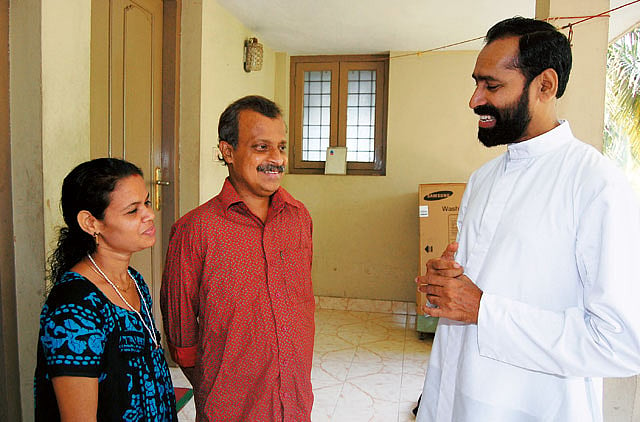
Forty-three-year-old Gopinathan Chakkamadathil had given up hope. The electrician from Vadanappally in Thrissur district, Kerala, suffered from renal failure and was watching life ebb away. The small single-storeyed Chakkamadathil House was shrouded in misery. Gopinathan’s wife, Anita, had started searching for a job. “She had started moving on, she had our two small children to look after. I was on the verge of being bed-ridden, but for me her acceptance [of the situation] was like a seal on my future. I started giving up hope.”
But the father of two boys had good friends who were not willing to give up. They launched a drive to raise funds to pay for his medical treatment; they were even prepared to buy a kidney from a stranger who was willing to sell one. Since kidney donations are still not common in India, many well-to-do patients seek the help of agents who arrange for organs at an exorbitant fee.
With a market devoid of supply, in many Asian countries, including India, gangs have taken over and turned kidney transplants into a business and a criminal activity. There have been reports of kidneys being harvested from unsuspecting illiterate people and these organs are then sold for exorbitant prices, as high as $15,000 (Dh55,000).
But when Gopinathan’s friends told him there was no other way to save his life, Father Davis decided he would give one of his own kidneys to him.
News of the spur-of-the-moment decision caused a stir in Kerala and made headlines in all the local newspapers and TV channels as it’s rare for a stranger to volunteer to donate a kidney free of cost to a patient.
When the opposition from my family began to increase, he gave them an ultimatum. “I said, ‘if the newspapers and television channels ask me why I didn’t keep my word, I’ll have to tell them that you people did not allow me to’,’’ he says.
That was when they came around, he says. “Gopinath was blessed, for I thought I would not be able to give my kidney!”
“This was the first time in my life that I was being hospitalised,” says Father Davis. “If you are a voluntary donor, you have to be cleared by the local police station, sign on a stamped paper that should be attested by a judicial magistrate, and then again certify that you are not a drug addict. You also have to undergo several medical tests.”
He explains that all the vital organs such as the heart, the lungs, the pancreas and the kidneys have to be tested. Then blood, urine and cholesterol are tested.
There will also be a psychological test to determine if the donor is in the right frame of mind. Only on passing all these tests is someone eligible to be a donor.
The operation itself lasts around three hours, under general anaesthesia. “It requires just three days hospitalisation, and you can resume normal activities in two or three weeks,” says Father Davis. “A donor doesn’t have to be restricted in any way. You can eat your normal diet and pursue any physical activity. On the other hand, I guarantee you will be filled with a huge amount of positive energy as you have contributed to [saving] a life.”
I realised it was important to form a trust to facilitate kidney donations.’’ So was born the Kidney Federation of India.
Practising what he preaches
Father Davis has always believed in leading by example. “How could I ask anybody to donate their kidney when I had not?” he asks.
“I immediately sold my car and donated the Rs100,000 it fetched to her through the great Indian singer, KJ Yesudas, who’s now an ambassador of the Kidney Federation,” he says. “The reason I sold my car and spoke about it was to serve as an example. I had to first donate myself before I could ask people to donate.”
Father Davis wanted the singer to hand the money over so it would get more publicity and would reach more people. When the priest donated the money to the woman, 10 people came forward to donate Rs200,000 each at the end of the function, which helped cover the medical costs and post-operative care. “That was the power of suggestion,” beams Father Davis.
Keen to know the extent of the problem in Kerala, about four months after donating his own organ Father Davis undertook a trip from Kasaragod in the northernmost part of state to Thiruvananthapuram in the south. Along the way, he arranged to meet all the registered kidney patients awaiting kidney donation. He met them individually at their homes and offered words of hope and encouragement.
At the end of the trip hundreds of them pledged to donate their kidneys.
“Another thing I was able to do was initiate cross-donation. If a husband’s kidney did not match that of his ailing wife, and there was a similar situation in another family, I urged them to donate across the families. Thus, people started cutting across blood relations and religions to donate kidneys for the needy. So it was not only a journey of extending lives, it also allowed us to foster good relations among different religions.”
So far, Father Davis has initiated five such cross-donations.
Setting off a chain reaction
That trip was a huge success with 350,000 people coming forward to pledge their organs after death.
“People still talk about it in Kerala,” he says. “I am told this is the first time so many people have pledged their organs together anywhere in the world.”
“Just as I was about to leave for Kanjirappally to attend the award function, I was told about a woman named Girija, a widow, who was preparing to donate part of her liver to her son who was suffering from a liver condition, in nearby Thrissur. She also had a daughter who was a kidney patient and desperately needed money to pay for the medical bills.
On the way to the function Father Davis stopped by a friend’s house. “When the man learnt about my mission, he promptly gave me Rs100,000 and asked me to give it to Girija. This is how people are being inspired to help.”
The chain reaction, as Father Davis is fond of calling it, continued. “I was invited on stage with Mr Kalam where I told him that the money would be donated to Girija. So happy was he that he shared the story with the reporters who were covering the function and the next day all the local newspapers and television channels reported the story.
“Within three weeks, Rs10 million poured in from people all over the state. The reason I believe this happened is that we all stood as examples for them. If we had just paid lip service and sought donations, I’m sure we’d have been able to collect probably just 10 per cent of the sum.”
Father Davis’s chain reaction was now on a roll. Inspired by his example, Kochouseph Chittilapilly, 60, a successful businessman and founder of V-Guard Industries, decided to donate his kidney to a stranger named Joy on February 23, 2011.
“Kochouseph gave his kidney to Joy, whose wife Jolly in turn gave her kidney to another patient, Arulraj. Arulraj’s mother Leela kept the chain going by donating her kidney to Muralidharan, whose wife Meena gave her kidney to Unnikrishnan. The chain ended there because Unnikrishnan is a blind person with no children. He’d already lost Rs200,000 to a tout who promised him a kidney for transplant and disappeared. So, we didn’t want to burden his family further.”
Father Davis who came to Dubai recently for a ceremony to honour him arranged by the social organisation Dubai Kairali Kala Kendram saw an opportunity to encourage cadaver transplants in the UAE too.
Father Davis sees a great change happening in society. “People are learning how to make life more meaningful. It’s not how much money you earn, but how much goodwill you earn. If you are willing to donate your organs after death what can make your life more meaningful at the end of it all? It would be like a football player scoring a goal at the last moment, who wins the game just before the referee’s final whistle.”
Now, Father Davis is concentrating on getting people in India to agree to cadaver donations. He sees another good thing coming out of this. “With cadaver donations taking off, sale of organs is likely to come down as the demand will become less,” he says.
Sign up for the Daily Briefing
Get the latest news and updates straight to your inbox
Network Links
GN StoreDownload our app
© Al Nisr Publishing LLC 2026. All rights reserved.