Bend it like powell
The first woman coach of England’s women’s football team swims against the tide — and wins
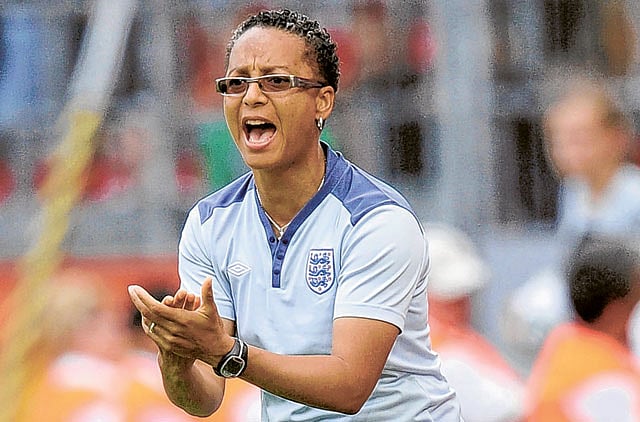
Could there be a better name for the coach of England's women's football team than Hope? Perseverance, perhaps. Or True Grit. But, given the circumstances of the women's game, the battles it has faced to just exist, and cultural limitations on what you can and can't call little girls, Hope, as in Hope Powell, is as perfect as it could be.
Because the story of women's football is a story of hope in the face of overwhelming odds, of hard-up players desperate to follow their true love — football — but being thwarted at every turn, and of determination in the face of indifference. If this were a film, it would be a low-budget film that would reach its apotheosis when, on no money and almost zero public interest, they pull off the ultimate coup: winning the World Cup.
It's a dream, of course. Or at least, the cinematic ending is, for now. Three months ago, Powell and the England squad beat US, the top-ranking team in the world, in a 2-1 victory. This is a rare England team: one which is in with a chance.
Worlds apart
The game has nothing to do with men's football. They're more than worlds apart, they're generations apart. The women's game, played by semi-professionals, is more akin to how football was in 1932. When Powell, now 44, started playing for England at 16, it wasn't just that there was no money in the game, but "we had to pay subs. I had to buy my boots and my kit. Everything was a real struggle."
Forget high-performance cars and Caribbean yachts. One of the players, Casey Stoney, says when she was at Arsenal Ladies the women were so far below the men in the pecking order, they actually washed the men's kit. "I used to work in the laundrette to earn money. The men just have it all on a plate."
Why is there such a lack of interest in the women's game? Powell says: "It doesn't get the recognition that it deserves. And it's not just football. Women in sport work as hard as any man. But we're seen as very second class."
And yet when I go to watch a game — the England-US friendly at Leyton Orient's ground — I'm surprised by how much I enjoy it. There's a tiny crowd, but it means you're right up close to the action, can hear the ball thwack, and it's a win. That's the other difference between the men's England side and the women's: the women are good.
First among equals
Powell says it was good but it's not the time to take anything for granted. I wonder if they teach such things at football-coach school, because in 2003 that's where she went, becoming the first woman in Europe to earn her Uefa pro licence, studying alongside the likes of Stuart Pearce and Sammy Lee. The first woman manager of a national football team, she started the job in 1998, and has outlasted Glenn Hoddle, Kevin Keegan, Sven Goran Eriksson, Steve McClaren, and since he's due to go next year, there's every likelihood she'll outlast Fabio Capello too. But then the difference is that she wins games. At the 2009 European Championships, she achieved what no male manager has done since 1966: her team got to the final of a major championship.
If sport is about grit, Powell has had it in spades. She had natural talent, but above that she has always had a drive to succeed. "I wanted to be a professional footballer," she says. "Right from when I could walk."
And yet at that time there weren't any female professionals; she carved her path. She was capped 66 times for England, and even though she didn't apply for the job as the England coach, it's not hard so see why the FA picked her. Or how and why she has managed to fight for the game, for resources, for funding, and succeeded.
"I will not be bullied," she says. "And I won't compromise. Not even for this job." What has made Powell a passionate advocate for the game, and why she won't take no for an answer, is that women's rights aren't just something she believes in. She feels it too. Football is the biggest women's participation sport in Britain. Twenty years ago there were 10,000 registered players; now there are 157,000.
The squad went to Germany to play for the World Cup, but, sadly, didn't fare so well. They returned home to their jobs: as care assistants, coaches, and whatever else they could find to help pay the bills. Yet, Powell doesn't lose hope.
"We're always breaking through," Powell says. "We have this attention when there's a championship, and then it dies down. And then we have it again, and then it dies down again. But we live in hope."
Sign up for the Daily Briefing
Get the latest news and updates straight to your inbox
Network Links
GN StoreDownload our app
© Al Nisr Publishing LLC 2026. All rights reserved.