Alfa Romeo’s magical 4C driven in Italy
It's latest mid-engined 4C sportscar is a driver-focused piece of magic
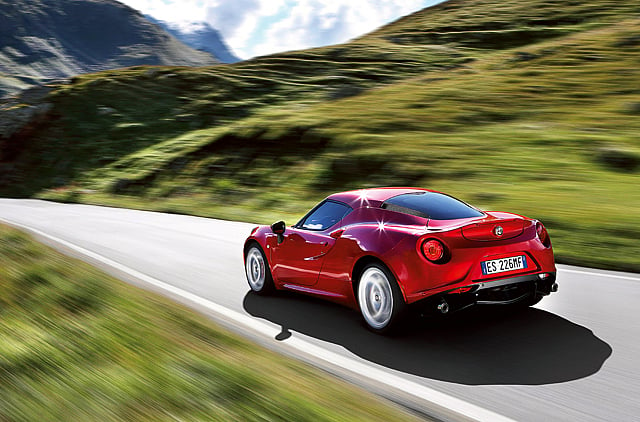
Mercifully the driver is ready and waiting in the morning and we’re off to Balocco, Alfa’s iconic test facility smack in between Turin and Milan, two hotbeds of Italian industry and the homes of Fiat and Alfa Romeo respectively. The province of Lombardia is much too flat and I fear a procession rather than a proper flog of the most important car Alfa’s built in decades.
Immediately past the heavily secured Balocco gates — complete with ‘strictly no photography’ orders although nobody seems to mind my DSLR hanging off the shoulder — I realise there’s no need to worry. Alfa’s created a lush, rolling nature reserve penetrated by twists and climbs everywhere and populated by disguised Jeeps, Chryslers and Giuliettas.
And then around the bend there is a red 4C with a ‘Middle East’ sign in the windscreen and finally some actual, live Alfa employees welcoming me like a beloved long-lost cousin.
The ensuing presentation takes way too long, especially because my patience is tested since I caught a glimpse of the road map in the driver’s seat, and what stood out was a red highlighted route that was very squiggly indeed. We’re heading about 30km away towards a high ridge, which we’ll be climbing up, because it’s there. In the meantime the Giuliettas and Jeeps will have had their morning runs on the track, leaving Balocco clear for us and the 4C.
The Alfa 4C uses no power assistance. Yes, a completely unassisted rack, which makes parking a mission but pays off on the move. On the long straight runs towards the mountain the steering needs initiation because it’s so quick and keeps skipping in your hands, constantly playing with the road surface. It’s really alive, and in no time the 4C comes across as such a focused machine.
The 4C shouts when it whispers, in true national character. Its 1,750cc engine — an important figure in Alfa’s glorious history — is the same as the Giulietta Quadrifoglio’s turbocharged four-cylinder, but made entirely of aluminium to save 22kg. There’s 240 horsepower and 350Nm of torque between 2,100rpm and 4,000rpm, the sweet spot for enthusiastic road progress. Peak power is at 6,000rpm though, so it pays to persist and let the rev-limiter signal an up-shift rather than some red blinking lights.
And I couldn’t help but think of the immense challenge of beating a Porsche Cayman leading up to this drive, but really the Alfa 4C is much more of an Italian Lotus Exige. It’s not a ‘full’ or complete car like a Cayman. That’s because the 4C is defined by essentiality. There is nothing in here, or out there, that’s unnecessary. Except for the achingly pretty looks... They aren’t entirely necessary, but then again it is Italian, and it is an Alfa. Even so, the composite body’s contours simply embrace the oily bits underneath. In this colour it’s almost as if a 4C running chassis is still standing displayed on a show stage, with a satin red veil draped over it.
Anyway, it’s much too small for any talk of Porsches — almost 400mm shorter than a Cayman but wider and significantly lower. Naturally inside there is very little room with that 2,380mm wheelbase (well shorter than a Yaris wheelbase for example) especially if you’re a passenger. The seat adjusts provided you carry an Allen key everywhere and have plenty of time before departure. The driver’s seat moves fore and aft but, again, needs a mechanic for height adjustment. So sort it out for once and never touch it again — this also gives you a valid reason to refuse your taller/shorter friends a go, but you’re out of excuses if they’re the same size as you. Choose your friends wisely.
So a car that weighs about a tonne with fluids and a dieting driver, with such compact dimensions and a stiff carbon tub and 240 horsepower, has no right to disappoint with its performance. You expect absorbed, engrossed driving focus, and the Alfa 4C does all that. I swear it turns in quicker and firmer than a Cayman, and up high on that ridge with some damp hairpins it finds good camber where you thought none existed, and twists into a corner rather than turns. It’s almost like it’s an articulated vehicle. Seriously, it requires orientation.
The chassis, that 40:60 front-to-rear weight balance, such resistance to body roll and imbalance that it’s quite difficult to manipulate it and shift its weight around the axes; those are all strands of the 4C DNA. And yet the latter bit isn’t counterproductive: you soon gain so much trust in the 4C’s grip that you just go flat-out everywhere.
It’s the same story at Balocco. From the outside the car dives quite obviously under hard braking, but from behind the wheel it’s all extremely linear and predictable once you accept the 4C’s rawness; that bizarrely great steering and the front end’s hunger for apexes.
Sign up for the Daily Briefing
Get the latest news and updates straight to your inbox
Network Links
GN StoreDownload our app
© Al Nisr Publishing LLC 2026. All rights reserved.