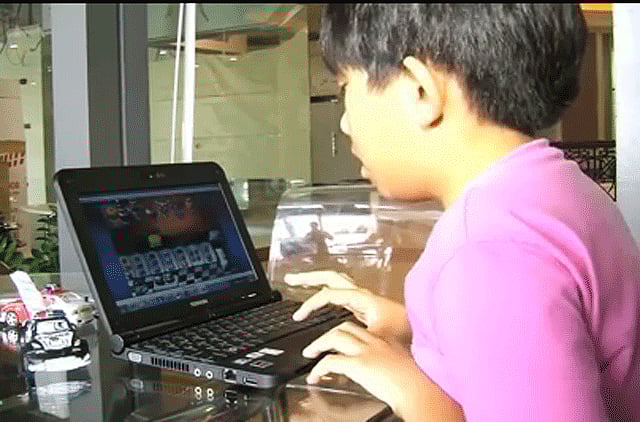
Dubai: Passive playing involving digital gaming, internet surfing and social media interactions is eating into the quality physical play time that children enjoy in the GCC countries, suggests a new survey.
Nearly one-third of the play time of children in the UAE and other GCC countries is spent on passive play habits, which is creating a definite imbalance in their development pattern, said respondents.
The UAE has the lowest average of active free play time, with nearly 30 per cent of children’s play time being dominated by passive play that includes television watching, android games, social media and net surfing.
The findings were revealed in the third consecutive Children’s Play Index (CPI) released by Fun City, based on observing the play activities of more than 1,000 children and interviews with their mothers, belonging to different nationalities, in UAE, Qatar, Oman and Bahrain.
The CPI for 2014 is more exhaustive, incisive and insightful based on the scientific aspects of children’s play time that involves a quantitative as well as qualitative index grouped into three stages inspired from psychologist Eriksons’s stages of psychological development into age groups of2-3, 4-6 and 7-12. In the first stage more emphasis was placed on activities that enhanced the physical development of the child. In the next stage focus was on the emotional development of the child and the third stage looked at play time activities that contributed to the intellectual development of the child.
The study conducted by IPSOS also interviewed school counsellors and psychologists apart from mothers and is in line with the Knowledge and Human Development Authority’s (KHDA) mandate to identify learning opportunities and reform the education sector as well as based on 30 years of research that has identified the early childhood period as the foundation stage for health, well-being and development of personal and social skills of the individual.
Child psychologist and parenting expert to Fun City Amnah Hussain said, “Children of all age groups need to indulge in free play that is not too structured and over-monitored by helicopter parents. They need to play with basic toys such as a ball, building blocks, clay models, with sand, that involve their hands, their imagination. The younger children learn about shapes, colours, motor co-ordination, balance, etc. The older children when left to free play establish their own responses to risk taking, executing a job during role playing, failing, trying again, establishing positive skills based on their interplay with other children, learn to negotiate and reinforce positive behaviour, among other things.”
Silvio Liedtke, COO of Landmark Leisure that commissioned the research, said: “We need to educate parents on effecting a qualitative difference in the child’s play time by providing a stimulating environment that will help children forget passive play with android games and also insist on better quality time that parents spend interacting with their children. Nothing can replace or substitute the time that a child spends interacting with parents during play time and that should not be limited to watching a television or video together, but physical activity, board games and role playing that involves other children as well.”
Log on to ww.funcity.ae to calculate individual CPI.
Sign up for the Daily Briefing
Get the latest news and updates straight to your inbox
Network Links
GN StoreDownload our app
© Al Nisr Publishing LLC 2026. All rights reserved.