Fatima Al Kaabi
GN FOCUS
Emirati women are powering the UAE's next leap in innovation
Pioneering Emirati women are driving progress through science and purpose-led innovation
Last updated:
9 MIN READ
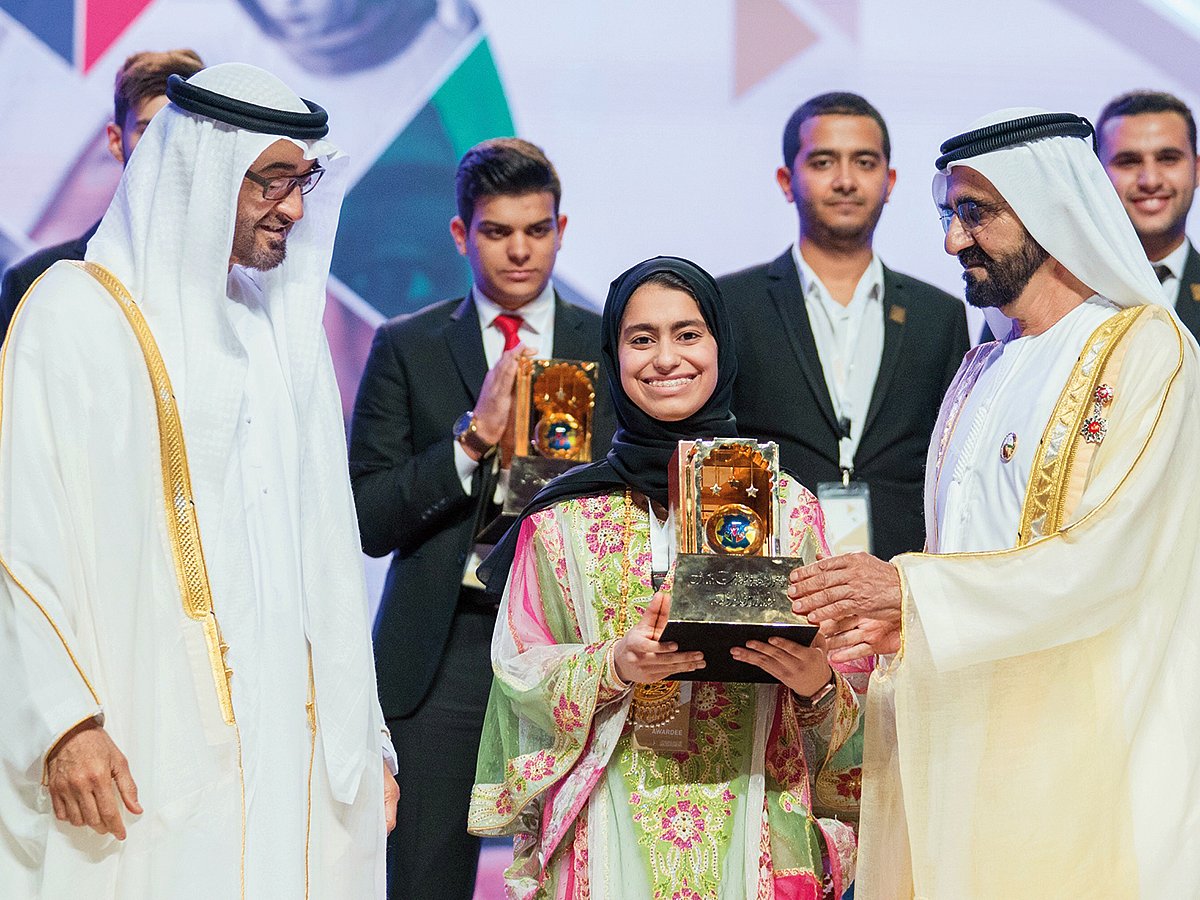
President His Highness Sheikh Mohamed Bin Zayed Al Nahyan and His Highness Sheikh Mohammed Bin Rashid Al Maktoum, Vice-President and Prime Minister of the UAE and Ruler of Dubai, present the Sheikha Fatima Bint Mubarak International Arab Youth Award to Fatima Al Kaabi for excellence in science.
In the UAE, innovation isn’t just a buzzword, it’s driving the country’s next era. With national strategies targeting AI, space, biotech, and advanced manufacturing, technology is woven into the country’s future.
Emirati women are actively contributing to that future, leading research, building technologies, and developing solutions that matter. Their work is strengthening the UAE’s knowledge economy, improving how industries operate and positioning the nation as a growing hub for science and innovation.
In the UAE, the drive behind this progress begins much earlier, often long before a career even takes shape. Whether it’s a student experimenting in a school science room or an engineer developing an idea into a viable concept, the UAE’s ecosystem is built to support that first spark ¬ funding it, mentoring it, and giving it opportunities to grow.
This layered encouragement keeps the country’s innovation engine moving and empowers women to push boundaries across every frontier of technology.
Here, we spotlight five inspiring Emirati women in science, engineering, design and research who bring skill, determination, and fresh thinking to the UAE’s innovation landscape, turning ideas into practical solutions that move the nation forward.
Fatima Al Kaabi: Inventing with purpose
Emirati inventor Fatima Al Kaabi stands out as a clear example of what the UAE’s science, technology, engineering and mathematics (STEM) ecosystem makes possible. She represents how early encouragement, national support, and a strong innovation culture can shape young talent into creators who contribute meaningfully to the country’s growth.
Long before graduating from Virginia Tech University in the US in computer engineering, Fatima had already captured the UAE’s imagination as a young inventor building robots, smart tools and assistive devices.
Her approach to innovation has always been rooted in empathy. “What drives me most is the desire to make life easier and more meaningful for people,” Fatima tells GN Focus. “Curiosity for me is about empathy.”
That purpose-driven mindset has shaped her journey from her first robot photographer to the smart steering system she designed to prevent drivers from texting.
She chooses her projects with a simple but powerful filter. “I always ask two questions before I start: who will this help? and can technology make this experience safer or more inclusive?”
Innovation can be both functional and emotional, “My goal is to leave the world a better place with my inventions, not the other way around,” she says.
Her path also reflects the UAE’s ambition to empower young inventors and women in technology. Fatima speaks often about the support she received from a young age.
“Every time I build something new, I feel I am contributing to a larger story, a story where Emirati women are at the forefront of innovation,” she says.
Studying abroad broadened her vision further, exposing her to new cultures and ideas that sharpened the way she builds, codes, and collaborates. “This phase has taught me that invention is not just about technical ability but about understanding people and context,” she says.
Graduating in 2023, she continues to balance global exposure with a deep sense of identity. “Living and studying in a new environment has challenged me to think more globally while staying rooted in my Emirati identity.”
Today, Fatima’s work blends AI, storytelling and design, while she’s exploring how AI can retell and reimagine Emirati folklore through digital art, animation and interactive experiences.
“I believe the future of innovation in the UAE lies in combining advanced technology with our cultural identity. I want to contribute to that future by building technologies that reflect who we are and share our stories with the world.”
Alia Al Mansoori: Fuelling the space economy
From staring at the night sky in the desert to engineering microbes for space mining, young Emirati scientist Alia Al Mansoori is fast creating a place for herself in the UAE’s growing innovation ecosystem with a mix of curiosity, grit and purpose.
Alia’s passion for science started early, shaped by a home where asking questions was encouraged. “As a child, I asked so many questions. Even if my family didn’t know the answers, they would help me look for them,” Alia tells GN Focus.
Alia Al Mansoori
She clearly remembers that feeling of connection whenever she looked up at the stars. That curiosity eventually turned into a drive to connect “the big picture and the vastness of space with the nanoscale biology and DNA expression.”
Her breakthrough moment came at 15, when she won the Genes in Space UAE competition. Watching her experiment lift off on a SpaceX rocket from Florida’s Kennedy Space Center was simply life-changing. “I felt a deep sense of gratitude. Everything that I worked so hard for was on that rocket hurtling out of our atmosphere.” The experience taught her resilience and intention. “Being a scientist in this field is risky. The failures don’t decrease, your tolerance for them just increases.”
Today, Alia is researching in the field of engineered biology. After completing her undergraduate degree in molecular biology at the University of Edinburgh, she is now pursuing a PhD at Cornell University in Biological and Environmental Engineering. Her research focuses on genetically engineering Gluconobacter Oxydans – microbes that can extract metals from rocks.
Alia Al Mansoori
“This will help facilitate the mining of space resources such as lunar regolith, to sustain life on the moon, or asteroids to build space structures without relying on earth’s materials,” she says.
Alia sees this work as a direct contribution to the UAE’s ambitions. “I see my field contributing to fuelling the UAE’s space economy,” she says, especially as the country accelerates efforts in advanced space technology and scientific research.
Her long-term vision is rooted firmly at home. “After getting my PhD, I hope to come back to the UAE and start my own biomining company.”
For young girls following her journey, her advice is simple: “Don’t be afraid to try new things. You don’t need to be naturally smart to be a scientist, you need to have the perseverance to keep going even when things get rough.”
Marwa Al Mamari: Advancing aviation safety
As the UAE accelerates towards a tech-driven future, Marwa Al Mamari is helping prepare the next generation of engineers and innovators who will define it – all while advancing her own impactful work in aviation safety and aerospace research.
For Marwa, Aviation Safety and AI Specialist, and Professor at NYU Abu Dhabi’s Engineering Department, stepping into aerospace wasn’t a childhood dream. It began, as she says, as a personal challenge, a deliberate decision in her final year of school to push beyond what felt familiar. “I wanted to step outside my comfort zone and pursue a field that demanded both intellect and courage,” she says.
Marwa Al Mamari
That leap set her on a path that moved from engineering design and manufacturing to aviation safety and accident prevention, where she established and led the Accident Prevention & Safety Recommendations Unit at the UAE’s General Civil Aviation Authority. Her work focused on turning lessons from accidents into proactive national safety strategies, contributing to the UAE’s Family Assistance Plan and its Safety Recommendation Management Framework ¬ systems that continue to strengthen the country’s safety culture.
“The early years were very challenging. Being the first Emirati aerospace engineer meant stepping into a field with few local role models. I had to continuously prove not only my technical competence but also that Emirati women could lead and innovate in such a complex domain,” she says.
Marwa Al Mamari
Today, as she pursues a PhD in AI and human-machine interfaces in aviation, Marwa is looking towards the future. “I am exploring how integrating AI into safety systems can enhance human decision-making and operational resilience.”
Alongside her research, she is deeply committed to shaping future engineers. At NYU Abu Dhabi, Marwa teaches aviation safety with a hands-on, real-world lens. “My approach goes beyond theory,” she says. “I emphasise human factors, ethical responsibility, and the power of innovation to prevent accidents before they happen,” she says, adding. “My goal is to empower students not only as engineers but as thinkers and leaders who can carry forward the UAE’s vision for safety and sustainability in aviation.”
Her message to young learners is simple and empowering: “Curiosity, resilience, and integrity.” And to young women entering STEM, she adds, “You don’t need to fit into existing systems, you can redesign them.”
Meera Mansour Al Blooshi: Engineering a smarter future
For Meera Mansour Al Blooshi, Assistant Innovation Engineer at Al Gharbia Pipe Company, her interest in engineering unfolded gradually, driven by a growing curiosity about the systems that power our everyday life. While in school, she found herself drawn to science clubs, environmental activities, and anything that let her tinker, explore, or understand how things worked.
The real shift, she says, came when she made an unexpected academic choice. “The turning point came when I joined engineering instead of a pure science programme. That decision opened a whole new world for me and started my journey in engineering.”
Today, Meera is completing her degree in Electrical Engineering at Abu Dhabi Polytechnic, a programme that blends theory with hands-on training. Courses like power electronics and system protection strengthened her understanding of complex electrical systems, while her recent graduation project pushed her into deeper interdisciplinary work. “The autonomous vision-guided robot for object collection brought together electrical and AI concepts in one system. It involved designing a robotic arm that detects and collects objects using camera vision and precise motor control.”
Meera Mansour Al Blooshi
Her relationship with Al Gharbia Pipe Company began during her internship, where she gained real exposure to automation, industrial systems, and the fast-paced nature of an advanced manufacturing environment. That experience naturally evolved into her current full-time role, which centres on engineering innovation and continuous improvement. “My role focuses on improving production efficiency, enhancing automation, and supporting new ideas that make operations smarter, safer, and more sustainable.”
This mission aligns closely with the UAE’s national priorities, from advanced manufacturing under Operation 300bn to the drive for sustainability, industrial efficiency, and digital transformation. Meera sees this connection clearly in her day-to-day work. “Every project we embark on, from automation to improving energy efficiency, supports the UAE’s goal of a smarter, more sustainable future.”
Working in a highly technical, industrial space has brought challenges, of course, but Meera views them as necessary stepping stones. “Every obstacle becomes part of evolving as an engineer. The most rewarding part is seeing my ideas turn into real results, and every successful project reminds me why I chose this path,” she says.
It’s also why she feels strongly about encouraging the next generation of Emirati women to join STEM fields. “We have every opportunity today to lead in science and technology because the UAE believes in us. So, be bold, stay curious, and don’t let fear stop you from building something that lasts.”
Asmaa Fahad Alameri: Building a net zero UAE
Asmaa Fahad Alameri is part of the growing generation of Emirati engineers powering the UAE’s technological and sustainability ambitions. As a Research Engineer at the Siemens Energy Innovation Center in Abu Dhabi, her work sits at the centre of some of the country’s most urgent priorities – cleaner industries, smarter energy systems, and the road to Net Zero 2050.
For Asmaa, engineering is not confined to theories. It’s hands-on, practical, and built around solving problems that matter today. In her role, she works on technologies designed to cut emissions in sectors that traditionally rely on high heat, such as steel and cement.
“At Siemens Energy, our work supports the UAE’s Net Zero 2050 strategy by developing technologies that help reduce emissions in the sectors that need it most,” she explains. Asmaa points to cleaner heating systems, waste-heat recovery, and advancements in carbon capture as examples of innovation that can “help accelerate the UAE’s energy transition.”
At the Innovation Center, her team focuses on technologies that are close to commercial deployment. “Our work goes beyond concepts – we work on innovations ready for real-world integration and test them in real operating conditions,” she says.
Asmaa Fahad Alameri
Patent applications and pilot projects serve one purpose: helping industries understand the cost, benefit, and practicality of switching to cleaner systems.
Representing Siemens Energy at global platforms has strengthened her belief in the impact young people can make. “Representing Siemens Energy at COP28 was a powerful experience,” she says. Co-leading a youth workshop showed her how quickly curiosity can turn into action when students are given the space to explore.
“I saw how quickly young minds grasp clean energy when curiosity is nurtured.”
Her journey began at Khalifa University, where she discovered how engineering could tackle pollution and make industrial systems more efficient.
“This experience taught me that engineering is not just technical – it’s a powerful tool to solve global challenges.”
Today, she hopes more young Emiratis, especially girls, feel encouraged to follow similar paths. As she says, “Building confidence and providing meaningful opportunities are key,” and the UAE’s innovation ecosystem is ready for the next wave of talent.
Sign up for the Daily Briefing
Get the latest news and updates straight to your inbox
Network Links
GN StoreAbout Gulf NewsTerms & ConditionsReach by GNSitemapContact usPrivacy PolicyGN FocusHave your sayWork with usAdvertise with usGulf News epaperPrinting Services
Download our app
© Al Nisr Publishing LLC 2026. All rights reserved.