Saira Awan Malik, President of TCS Group
GN FOCUS
Logistics & Manufacturing: Pakistan's backbone of trade
Government takes lead, partners with DP World to develop state-of-the-art logistics hub
Last updated:
7 MIN READ
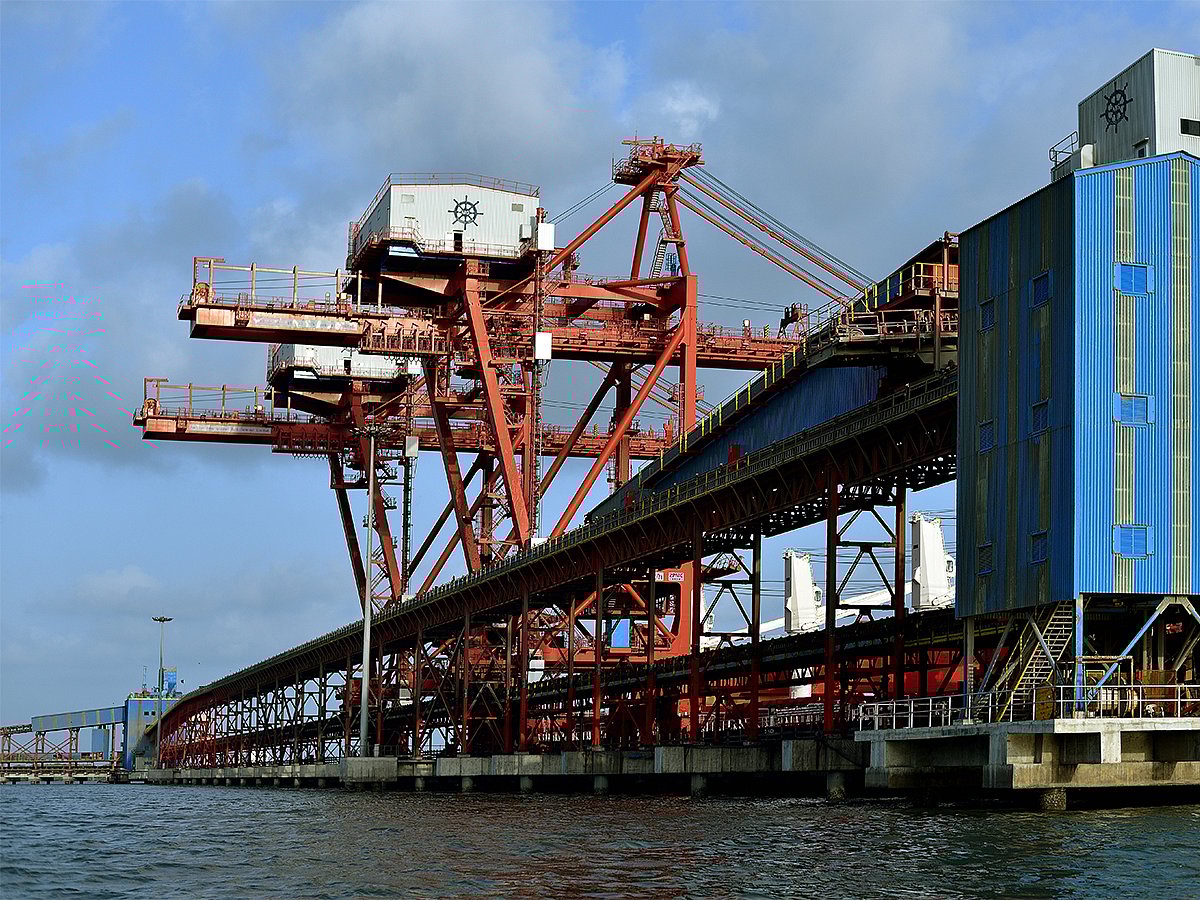
Port Qasim, Pakistan International Bulk Terminal (PIBT)
A critical enabler of economic activity, Pakistan’s logistics sector generates an estimated 15.6 per cent of GDP. However, its fragmented nature and disproportionate reliance on road transport, which accounts for around 94 per cent of cargo movement, create the risk of structural bottlenecks. Coupled with rising demand, driven by population growth, an expanding economy and rising e-commerce, moves to enhance the sector have taken on new momentum.
The government is taking the lead, partnering with DP World to develop a state-of-the-art logistics hub at Pipri, near Karachi, aiming to improve efficiency in cargo movements from the city’s ports to inland markets. This is supported by rail freight modernisation efforts under the Main Line-1 initiative, which will upgrade the nation’s main north-south rail corridor and further boost cargo efficiency from Karachi Port. And in October 2025, Pakistan and China agreed to establish a joint business logistics consortium to strengthen long-term trade flows and infrastructure investment.
These initiatives reflect calls from business leaders for a joined-up agenda to support industrial output. “What Pakistan needs most is policy consistency. Long-term industrial frameworks of 15 to 20 years are essential to unlock investment, ensure sustainability, and allow industries to plan with confidence,” says Ali Asghar Jamali, CEO, Toyota Indus Motor Company.
Supporting the government’s response, logistics providers are taking up the baton. Industry leaders are adopting digitally enabled platforms that enhance visibility, integrate data and improve efficiency, while strengthening links with Gulf and regional markets to further leverage Pakistan’s strategic location.
TCS Group CP
Pakistan’s logistics sector is evolving, with TCS Group at the forefront for both scale and innovation. With over 1,000 express centres and coverage reaching 95 per cent of the population, the company sits at the intersection of retail deliveries and national connectivity, supporting document flows, parcels and e-commerce with speed and efficiency.
“We were able to lay the foundations for the distribution networks within this country. With our physical network, every single part of the country is reachable in 24 to 48 hours,” says TCS Group President Saira Awan Malik.
That network feeds into an integrated platform spanning express and e-commerce delivery, overland trucking, warehousing, distribution and freight forwarding. It is a model built for both walk-in customers and complex supply chains, with TCS serving industries from banking and FMCG to manufacturing, pharmaceuticals, textiles and education. “We like to call ourselves a third-party logistics provider, offering end-to-end services on the logistics front,” says Malik.
TCS is a leader in traditional express services, holding around 65% market share, while remaining a force in the e-commerce arena, where it holds a 30 per cent to 35 per cent share. The company is also pushing into digital enablement, from process digitisation to inventory visibility, warehouse management systems and cashless transactions.
For UAE-based investors, the company offers a strategic entry point. TCS has maintained a UAE hub since the late 1980s, aligned with Pakistani demand, and now frames the Gulf as a launchpad into broader corridors linking Pakistan with Central Asia, the Middle East and Africa. “Our presence in the UAE offers us an important logistics gateway to the rest of the world," Malik adds.
Ministry of Industries Pakistan
The Ministry of Industries & Production (MoI&P) is Pakistan’s principal industrial policy body, responsible for enabling large-scale manufacturing, SME development and sector-wide reform. Acting as a facilitator, it works with regulators and investors to modernise industry, strengthen value chains and improve export competitiveness.
Haroon Akhtar Khan, Special Assistant to Prime Minister for Industries & Production Division
Under the leadership of Haroon Akhtar Khan, Special Assistant to Prime Minister, MoI&P has advanced reforms across priority sectors. These include a national gemstones policy targeting $1 billion in exports, phased reductions in automotive tariffs to support car manufacturing and the development of a local lithium-ion battery production framework to support energy industries.
Port Qasim Authority
Handling 51 per cent of Pakistan’s seaborne trade across 18 berths, Port Qasim Authority has become a cornerstone of the country’s industrial and energy ecosystem. For Chairman Syed Moazzam Ilyas, the mandate is macroeconomic in scope. “Pakistan has set a national ambition: to become a $1 trillion economy. To achieve this, efficiency at our ports is critical,” he says.
Energy remains a defining strength. As Pakistan’s primary hub for LNG and coal imports, the authority has cut export tariffs by 50 per cent and LNG handling charges by 15 per cent, lowering logistics costs and boosting competitiveness.
Syed Moazzam Ilyas, Chairman Port Qasim Authority.
Alongside the port, a 6,000-hectare industrial zone offers UAE investors seamless access to import and export routes. “Opportunities are clear,” Ilyas notes, “and the returns will be strong.”
Pakistan International Bulk Terminal (PIBT)
Pakistan International Bulk Terminal (PIBT) operates Pakistan’s first dedicated dirty bulk cargo terminal at Port Qasim. Developed with an investment of $305 million, partially financed by the IFC, the hub is backed by experienced management. “I have been developing and managing cargo-handling terminals in Pakistan for about 30 years," says CEO Sharique Azim Siddiqui.
PIBT's mechanised systems allow it to discharge vessels carrying up to 68,000 MT within 48 hours or less, marking a shift from legacy practices. The terminal has also handled clinker exports and is developing 50,000 tonnes of cement silos – the only such capacity in Pakistan. “A major player could use our facilities to expand exports," says Siddiqui.
As a listed company, PIBT offers international investors direct equity access and project-level participation. Looking ahead, the terminal is preparing for mineral exports, linked to Pakistan’s copper and gold projects, expected to begin in 2028–29.
Biafo Industries CP
Since commencing production in 1994, Biafo Industries has emerged as one of Pakistan’s two market-leading explosives manufacturers, supporting the country’s petroleum, infrastructure and industrial development for more than three decades. The company operates a major manufacturing facility in Hattar, Khyber Pakhtunkhwa, originally acquired from South Korea’s Hanwha and built on DuPont’s Tovex technology. “We have innovated and improved extensively; our products are preferred in the global market,” says Anwar Moin, CEO of Biafo.
A leader in the domestic explosives market, Biafo currently holds an estimated 35 per cent to 40 per cent share. Under Moin's leadership since 2019, the company has recently focused on modernisation, market share expansion and exports, while maintaining a central role in national infrastructure.
Biafo supplies explosives to Pakistan’s leading petroleum producers, including OGDC, Mari and PPL, as well as seismic contractors. In infrastructure, its footprint spans major projects including Basha Dam, the Dasu Hydropower Project, Mangla Dam and Tarbela, alongside work on the Karakoram Highway. The company also now supplies 100 per cent of the cement sector’s explosives demand following recent regulatory changes.
Aligned with large-scale initiatives across the country and growing interest in copper, gold and rare earths, a strategic shift is underway toward mining. The company has established a dedicated subsidiary, Biafo Mining, to deepen its participation in the sector. “With the mining sector expanding beyond small-scale marble and limestone operations, major projects like Reko Diq are opening up opportunities,” Biafo’s CEO says.
Exports to Sudan, Bangladesh and Sri Lanka have become a key growth driver, supported by general rising sales and a dedicated export division. The company is now targeting the Middle East and Southeast Asia. “Regarding investment into Pakistan, the explosives and mining sectors are expanding,” Moin says. “We welcome joint ventures, particularly with UAE partners.”
Lucky Cement Limited CP
How has Lucky Cement evolved under your leadership?
By the time I succeeded my father in 2005, I had nearly 15 years of leadership experience across different geographies and industries. Lucky Cement was already executing major expansion projects, which were completed by 2007 and doubled our capacity.
We became the largest cement company in Pakistan, and scale matters in this industry. Once you reach a certain size, you gain efficiency, resilience and the ability to play a leadership role in the market.
Muhammad Ali Tabba
How do you balance growth with financial discipline and sustainability?
From 2005 to 2019, our revenues grew nearly tenfold; that growth was never accidental. We rely more on equity than debt – it has been central to our stability.
Another cornerstone is sustainability, an embedded part of our strategy. Our green portfolio includes more than 150 MW of waste heat recovery, solar and wind capacity.
In any business we enter, we want to be among the top three players.Muhammad Ali Tabba
What defines Lucky Cement today?
We are a family-owned business, blending entrepreneurial spirit with professional management. The family provides vision, values and agility, while professional managers bring expertise, governance and operational excellence.
In any business we enter, we want to be among the top three players. Domestically, we are the largest cement producer, with over 15 million tonnes of installed capacity. Internationally, we operate in Iraq and Congo, where we are also a leading player.
Why should international investors consider Pakistan?
Pakistan offers fundamentals that are hard to ignore. We are a nation of 250 million people, with over 60 per cent under the age of 30. We are also blessed with natural resources and a geographic position that connects South Asia, Central Asia and the Middle East.
Whether it is agriculture, mining, tourism, information technology or manufacturing, Pakistan has sectors that are still underdeveloped but hold massive potential.
Crescent Steel and Allied Products Limited (CSAPL) CP
Crescent Steel and Allied Products Limited (CSAPL) has emerged as one of Pakistan’s foremost industrial groups, with diversified operations spanning engineering, textiles, capital markets and power. Incorporated in 1983 and publicly listed, the company employs more than 700 people and operates five independent business units, anchored by its flagship steel segment.
Ahsan M. Saleem, CEO and Managing Director of Crescent Steel & Allied Products Limited
“The engine for growth in Pakistan lies in the engineering sector," says CEO and Managing Director Ahsan M. Saleem.
The steel division is a major contributor to national infrastructure, having supplied 4,783 kilometres of line pipe to Pakistan’s gas transmission network over three decades. CSAPL specialises in large diameter submerged arc welded helical pipes, with manufacturing capability ranging from 8 to 120 inches, and holds API certification from the American Petroleum Institute.
“Our idea was to build a company that would operate at the level of the top 5 per cent of manufacturers in the world," says Saleem.
Sign up for the Daily Briefing
Get the latest news and updates straight to your inbox
Network Links
GN StoreAbout Gulf NewsTerms & ConditionsReach by GNSitemapContact usPrivacy PolicyGN FocusHave your sayWork with usAdvertise with usGulf News epaperPrinting Services
Download our app
© Al Nisr Publishing LLC 2026. All rights reserved.