Educators call for greater focus on skills and lifelong learning
AI puts pressure on universities to develop well-rounded, career-ready graduates
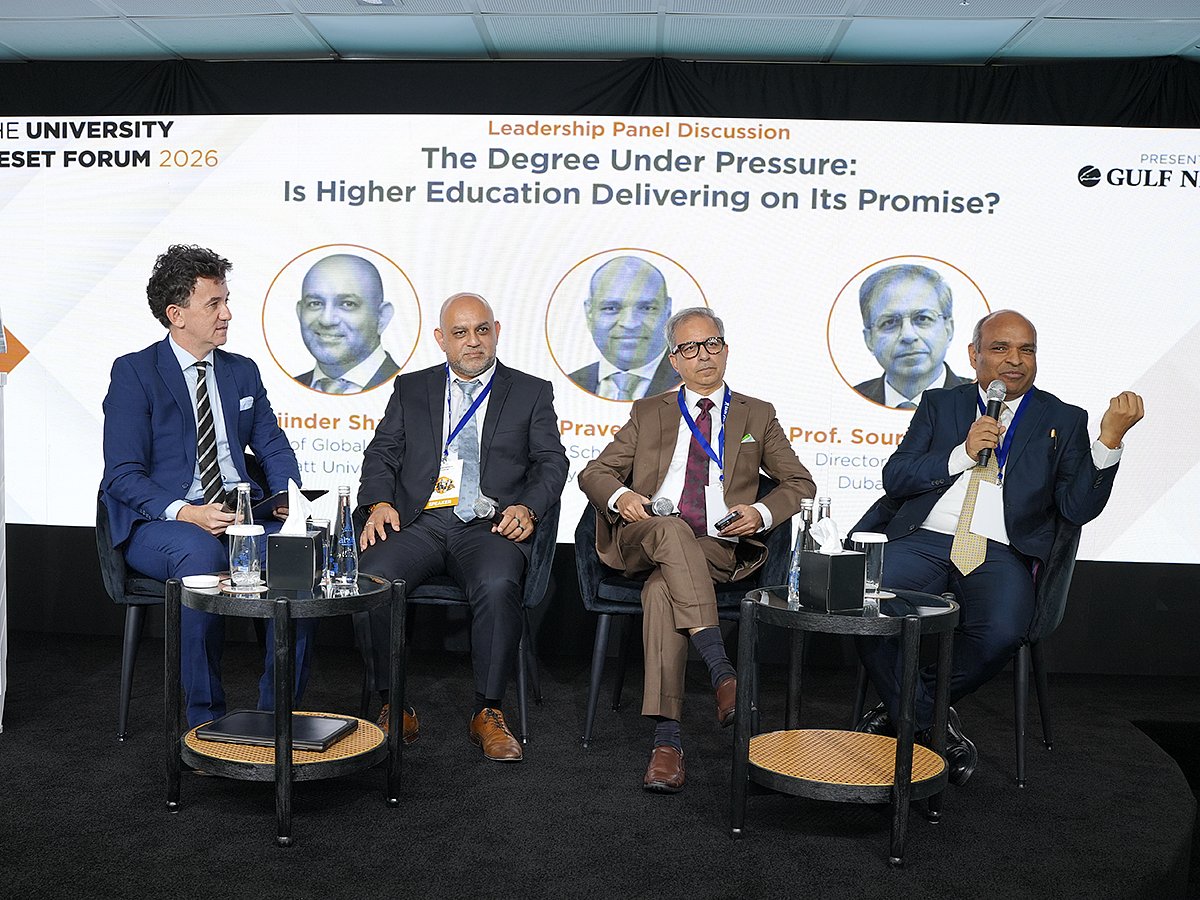
Practical experience, industry exposure and skills such as critical thinking and adaptability are as critical as subject knowledge as graduates enter a workplace where AI is changing the demands across professions. Universities must develop well-rounded graduates who can apply their knowledge and respond effectively to unfamiliar challenges, said educators during a panel at the University Reset Forum 2026.
With AI putting pressure on entry-level jobs and the rising cost of higher education prompting questions about the value of a degree, universities need to reconsider what they teach, how they assess students and how they prepare them for careers that could span multiple industries.
“We are possibly training students today for jobs that do not yet exist, which is why agility is extremely important,” said Dr Praveen Gupta, Dean, School of Business, Amity University Dubai.
Drawing on his own experience of studying engineering before pursuing a career in banking and subsequently moving into academia, Dr Gupta explained how the value of a degree extends well beyond the discipline a student chooses.
“The value of a degree lies in how we train our students, helping them develop self-discovery skills, soft skills, adaptability and the ability to learn new skills.”
With AI making subject expertise alone insufficient, he stressed the importance of developing T-shaped skills.
“We need to develop T-shaped skills, which means having a broad range of capabilities across different areas, combined with depth of expertise in one or two subjects. This is where soft skills become particularly important, including the ability to interact and work with people.”
Make employability central to education
While universities cannot fulfil every employer’s requirements, stronger industry partnerships and a greater emphasis on professional development throughout a degree can help ease graduates’ transition into the workplace.
Rajinder Sharma, Head of Global College, Heriot-Watt University Dubai, said universities and employers share the responsibility of bridging the skills gap.
Students must also take ownership of their personal and professional development early in their academic journey, building capabilities such as independent learning, presentation skills, adaptability and resilience.
“Rather than treating employability or soft skills as an add-on, we need to provide opportunities throughout the programme. This requires redesigning not only the curriculum but also the way we assess students,” Sharma said.
Assessment methods must also encourage collaboration, independent thinking and practical problem-solving, said Prof. Souri Banerjee, Director, BITS Pilani, Dubai Campus.
“We can design our curriculum and assessment methods so that groups of five or six students work together, define a project and deliver results independently, with a faculty member acting as a supervisor,” he said.
As universities integrate AI into teaching and learning, maintaining academic rigour and encouraging intellectual curiosity are equally important.
“AI is here, and it is important that we embrace it rather than resist it. I strongly believe that AI should be used as a tool. What is most important is how we integrate artificial intelligence with human intelligence,” Prof. Banerjee said.
BITS Pilani is establishing an AI-focused campus in India, with its first batch of students set to join in August 2027. Its Dubai campus has already introduced AI in areas where it can improve efficiency and accuracy.
Prof. Banerjee also stressed the need to create multiple pathways for students, whether they aspire to enter industry, pursue higher studies or undertake academic research.
Rethink the value of a degree
With skills becoming obsolete faster, educators called for a broader understanding of the return on investment in higher education, looking beyond immediate employment outcomes.
“We have to build students’ capabilities to move from one job to another, advance in their careers and progress professionally. That is where the real value lies,” Sharma said.
Dr Gupta said that the traditional model of completing a degree in early adulthood and relying on that education for decades of employment is becoming increasingly unsustainable.
Shorter degrees, stackable microcredentials and executive education could make higher education more flexible and affordable, allowing professionals to return to universities at different stages of their careers to acquire new capabilities.
However, the success of these models will depend on universities instilling curiosity and a willingness to learn throughout life.
“What we need to communicate in the classroom is the importance of becoming lifelong learners. Learning will never end. Students will have to keep returning to education, refreshing their skills and acquiring new capabilities throughout their professional lives,” Dr Gupta said.
Sign up for the Daily Briefing
Get the latest news and updates straight to your inbox
Network Links
GN StoreDownload our app
© Al Nisr Publishing LLC 2026. All rights reserved.