Uluru rocks
Australia’s Ayers Rock offers immense beauty, lessons in geology a peek into legends. And then there’s the bliss of the trappings of luxury
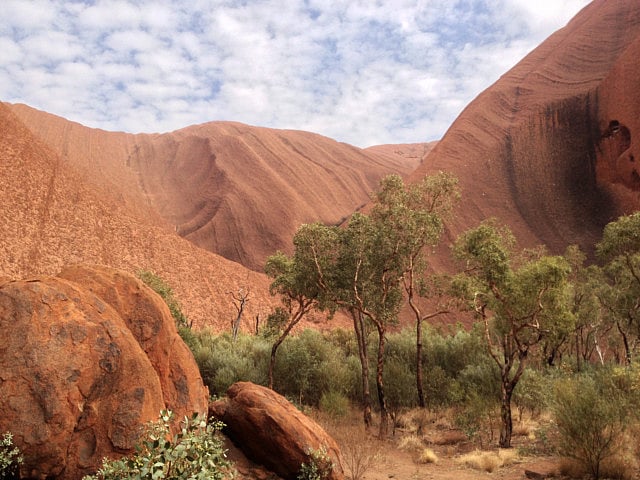
To the Anangu people of Australia’s Red Centre, it is a deeply spiritual place. To overseas travellers, it is a geological wonder and high on the list of must-see sights. In fact, Ayers Rock — or to give it its proper name, Uluru — is the most-visited attraction in Australia after Sydney Harbour and its famous “Coathanger” Bridge.
Uluru is in the middle of nowhere: 2,954km from Sydney; 1,785km from Cairns. The nearest neighbouring town is Alice Springs, a mere 428km, 4.5-hour drive. But such is the attraction of the Rock that a township has sprung up around it and a wealth of accommodation is available, from camping sites to Sails in the Desert, the premier hotel at Ayer Rock Resort.
On the day I fly, the air is tinged red, the aftermath of a dust storm the previous evening, and the view of the Rock is hazy. On the ground, however, and a ten-minute drive away, the hotel is easily recognisable by the white sails that soar over its roof. The building has just undergone a $30 million (Dh110 million) renovation and its new décor, in shades of white, sand and ochre, reflects the colours of the desert and the art of the Aboriginal people. Indigenous artworks line the walls of the cool and bright foyer; local handicrafts are incorporated into many facets of the fittings and furnishings.
I am keen to watch the sun rise over the Rock so, uncharacteristically, I have set my alarm to a pre-dawn hour in order to join the Desert Awakenings tour. Bleary-eyed, about six of us assemble at 5am and are driven to a vantage point in the dunes, where we are given a bush breakfast as we wait for the sun to rise. It’s a simple meal but very welcome: billy tea, tea made in a tin can on an open fire, as early Australian settlers would have made it, fried eggs and damper, a traditional soda bread.
We watch as Uluru appears, at first a collection of misty mauves before strengthening in form and showing itself in solid, ruddy orange. I had been told the Rock has a wardrobe of different colours; now I see it is true. The early start to the day is worth every minute.
From a distance, Uluru looks smooth and featureless; close up, it’s weather-beaten, pitted with holes and gashes, striations, ribs, valleys and caves. Its formation is fascinating: from its origins, 550 million years ago, as part of a mountain range, to submersion and compression under an inland sea, to the Earth’s forces tilting it nearly 90 degrees and presenting the Rock as it is today, laced with iron-bearing minerals that have oxidised to give it its red-orange hue. Some of its caves are especially sacred. It is a revered place of mystery and legend, and outsiders are asked to respect it.
It is still possible to climb Uluru, but it is discouraged, both for safety and cultural sensitivity. If, on the other hand, you want to fly over it, ride a Harley-Davidson around it, view it from atop a camel or simply walk its circumference (at about 10km, it will take two to three hours) then — as the locals would say — just go for it.
Back at the hotel at midday, I plunge straight into the large and inviting pool before indulging my inner artist: two Anungu elders are going to teach me the basics of dot-painting and explain the symbols used. This free-to-guests class is just one of several recently introduced activities. The renovations at Sails in the Desert have not all been cosmetic. Much work has gone into consulting with the Anangu to restore faith in the possibility of developers and local people working together for the common good. Whereas 18 months ago, there were only two Aboriginal people on the staff at the hotel, there are now 180 and plans to double that number within five years. If I wasn’t happily trying to plop uniformly sized, differently coloured dots of paint on to my tiny canvas to make my own masterpiece, I could be trying to throw a boomerang or spear, play a didgeridoo or learn how the local people use bush plants for food and medicine. Sated by my artistic endeavours, I choose instead to watch a display of traditional dancing and refuse all attempts to become part of the performance and imitate an emu and kangaroo.
Dining is a mix of modern Australian cuisine but with reference to local ingredients. I can recommend the hotel’s Smoked Kangaroo Wattleseed Crepe (kangaroo is a high-protein, low fat, flavoursome red meat) and also the Lemon Myrtle Chicken but the most spectacular dinner option is not actually in the hotel. For me, the newly offered Tali Wiru (it means Beautiful Dune) experience beats everything. At sunset, in the company of a small group of no more than 20, I watch Uluru turn yet different colours as twilight falls.
We may be in the middle of the red desert, but white tablecloths contrast with the red earth and we are served a five-course menu under a sky turned milky by stars. For the first time in my life, I see shooting stars — lots of them — and Jupiter glowing pink against the blackness. That’s what I call unforgettable.
Sails in the Desert
The property comprises 228 rooms and suites, staring at Australian $320 (Dh1203) a night for a two-night stay. The hotel also houses Mulgara Gallery that takes you on an exploration through the unique styles and breathtaking stories of indigenous art, Red Ochre Spa and a gumtree-lined heated swimming pool to relax at. Culinary offerings include Mayu’s signature à la carte dining experience, the brasserie-style Ilkari Restaurant and the Walpa Lobby Bar
www.ayersrockresort.com.au/sails/
Sign up for the Daily Briefing
Get the latest news and updates straight to your inbox
Network Links
GN StoreDownload our app
© Al Nisr Publishing LLC 2026. All rights reserved.