Laura Poitras, a formidable force
The Oscar-nominated filmmaker, a crucial ally for whistleblower Edward Snowden, admits surveillance has changed her
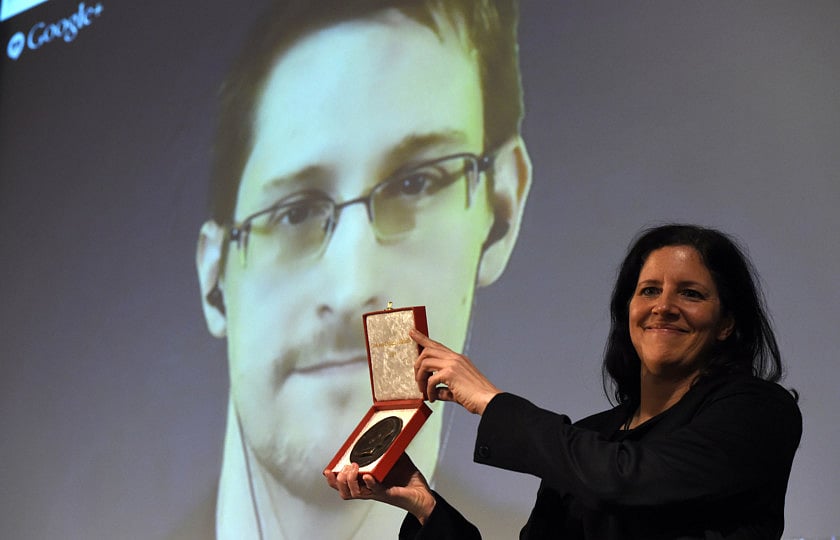
The first time Laura Poitras was stopped and questioned at an airport, she thought it was a mistake. Flying home to the United States from the Sarajevo film festival in 2006, she was paged at Vienna airport and asked to go to security. She was questioned about her trip. She asked: “Why are you stopping me?” The answer: “Well, your name came up on a US government list, and you have a threat score that is really high.”
If it was high then, today it is stratospheric. Poitras has played a key role in the world’s greatest leak of espionage secrets: American whistleblower Edward Snowden’s revelations of a huge US electronic surveillance programme. Poitras is one of only two journalists to whom Snowden last year entrusted his treasure-trove of documents taken from the National Security Agency, the cyber intelligence organisation. She is also the director of “Citizenfour”, a film about her encounter with Snowden, which is tipped for an Oscar as best documentary of 2014.
Poitras now assumes she is under surveillance, night and day. “I am lit up like a Christmas tree behind the scenes,” she says, quite casually. “Which means there is probably a graph, and the graph shows who are the people that I am in contact with.” Speaking in Berlin, where she now lives, she looks younger than her 52 years and gestures fluidly when she talks. If she worries about the perpetual monitoring of her daily life, she does not show it. “The choice is, either I say, ‘Well, I’ll stop doing this kind of work’ because the harassment is really bothersome, or ‘I’ll keep doing it.’”
The incident at Vienna airport occurred soon after she had finished “My Country, My Country”, a 2006 film that followed the lives of ordinary Iraqis under the US occupation after the overthrow of Saddam Hussain. Nominated for an Oscar, it also caused the US intelligence agencies to put Poitras on something she now knows is a “watch list” — a roster of people the US authorities seek to track. Next came another documentary that may have irritated the US government: “The Oath” (2010), about two Yemeni brothers who served Osama Bin Laden as driver and bodyguard, one of whom ended up in Guantánamo Bay.
That first Vienna questioning has been followed by about 40 others at US airports. Poitras has had her computer, notebooks and mobile phone taken away, sometimes for weeks. She says she assumed that when officials realised she was “just a filmmaker”, she would be taken off the list. But it didn’t happen. “And then, I became more confrontational at the airport, you know, taking notes while answering questions, asserting my rights as a journalist.”
When Snowden got in touch last year, she realised his story had the potential to cause a much bigger shock than anything she had done before. “The minute I thought Snowden was real, of course, I was fearful. I mean it was clear this was going to be dangerous — to anger the most powerful people in the world.”
The 31-year-old computer expert had electronic files containing more than 1 million documents Snowden had taken from the NSA, where he worked as a contractor until he fled in May 2013. He decided to hand them over to Poitras and Guardian journalist Glenn Greenwald. Hiding in a Hong Kong hotel, he arranged a secret meeting with them and another Guardian journalist.
As Poitras portrays in “Citizenfour”, Snowden spent hours in his cramped room explaining his secrets and convincing the three reporters. Later she asked Snowden why he had chosen her. He e-mailed in reply: “You asked why I picked you. I didn’t. You did.” He was talking about her reputation: she was the kind of formidable force he needed to make sure his revelations would reach a global audience.
The result was a string of stories published in The Guardian, The Washington Post, Germany’s Der Spiegel magazine and elsewhere, detailing the electronic spying operations of the NSA and its partners in the UK, Canada, Australia and New Zealand. They reported on Prism, a secret programme for eavesdropping on Americans’ Google and Yahoo accounts; on Tempora, a British-run global surveillance scheme, and on XKeyscore, a computer filter for sifting vast amounts of internet data. The stories revealed that agents spied on aid organisations Unicef and Médecins Sans Frontières, and tapped German chancellor Angela Merkel’s mobile phone.
The impact was immediate. In the US, Snowden was condemned by some as a traitor and lauded by others as a hero. The authorities charged him with espionage and accused him of assisting the enemies of the US. Washington wants to bring Snowden back from Russia, where he sought protection a few days after his encounter with Poitras.
However, US president Barack Obama also ordered a review of NSA procedures, which made recommendations to increase court scrutiny. “One of the things that has been interesting to watch about the NSA story is how it has cut across political lines. We have had people from both the Democratic and the Republican parties who have been outraged,” says Poitras. In other countries, support for Snowden has been stronger, notably in Germany, where politicians were furious at the Merkel phone-tap and public opinion is particularly concerned about invasion of privacy.
Little in Poitras’s early life prepared her for this global drama. She grew up in a prosperous home in Boston, Massachusetts. She won’t talk about her family but it is a matter of record that her wealthy parents donated $20 million (Dh73.4 million) for medical research to the Massachusetts Institute of Technology. After school, Poitras moved to San Francisco and worked for a while as a pastry chef before taking up film studies.
She moved to New York, where she focused on documentaries and made her first award-winning film, “Flag Wars”, an account of the gentrification of Columbus, Ohio.
Everything changed for Poitras following the 9/11 terrorist attacks. “Somehow I felt that what was happening in the country was really disturbing and that I wanted to say something about it,” she remembers. She became increasingly concerned about the US government’s response, including the treatment of prisoners at Guantánamo Bay. And she started work on the controversial films that have made her one of the world’s best-known documentary makers.
Despite being a favourite for an Oscar, she says winning awards is not the point — the films themselves are the point. Poitras is not convinced governments have changed much in response to the Snowden disclosures. “There has been a lot of lip service and a lot of recommendations in committees but no real fundamental changes of these policies,” she says. “In terms of concrete policy changes, maybe Merkel’s phone isn’t being tapped right now. But I am not sure how much of a big shift there is.”
So surveillance continues at the same level as before? Poitras thinks there is “probably some reining in” of the targeted surveillance of people who “cannot be suspected of any wrongdoing”, perhaps out of fear of legal action. “I would guess people think twice in the intelligence agencies before they do that.” But she is far more positive about the revelations’ wider impact. “The reporting has changed consciousness and awareness around these issues . . . globally,” she says.
Technology companies, including Google, Apple and Facebook, are “making real big changes in terms of offering privacy for customers” out of a fear that co-operating with the US government could lose them business, she says. “So you have those kind of things in the tech industry that are shifting and I think will continue to shift. They’ll be offering encryption and privacy for customers.”
Poitras is particularly pleased with developments in Germany, where she has lived since 2012, before she began making “Citizenfour”, having decided it would be too risky to work in the US. But she is scathing about Britain, which she has refused to visit, even to promote “Citizenfour”, for fear of arrest.
“My lawyers really were concerned and careful, and so the UK is the one country that I haven’t travelled to.” She adds: “Yes, I go back to the US but the US is different. I mean, the US has the First Amendment that protects the press. It has never happened that the US government has gone after journalists for publishing information that is classified.”
Like Snowden, Poitras believes there are cases when secret surveillance is legitimate — suspected terrorist plots, for example, or nuclear proliferation. “But it shouldn’t be bulk dragnets, suspicious surveillance of entire populations. We live in democracies that have a rule of law, which has been sidestepped in these programmes.”
She admits surveillance has changed her: she is ultra-careful about practical issues, such as encrypting e-mails and having two computers, one for work and one for general use. She re-read George Orwell’s “Nineteen Eighty-Four” when she was getting e-mails from Snowden and was struck by the moment when the hero, Winston Smith, is trying to write a journal without being observed by the all-seeing eyes of the state.
She recalls: “The sort of chilling effect then, when actually he sits down to write, he actually couldn’t express himself. I felt this, not to that extent, but there is this chilling effect where you realise that, well, if I think my computer is infiltrated, then do I really want [to write] personal things on an e-mail? I start using pencil and paper ... those kinds of things.”
But she is proud she trusts all the people involved in the Snowden film — and that most of her closest colleagues were women. When she presented her team at a premiere in Berlin, nine of the first 15 people on the stage were female; she says she chose individuals not because they were women but because they were “absolutely the best people” and that in documentary filmmaking women play a much bigger role than they do in Hollywood. “There are so many prominent women directors in documentary, so I don’t feel what I am doing is unique.”
Poitras sees “Citizenfour” as the third in a trilogy about US power that began with her Iraq and Guantánamo films. She says it is “too soon to say” what she might do next. But she is working on a film-based installation for the Whitney Museum of American Art in New York in 2016 that will address “the same themes but in a different way”.
“The truth is that I am not going to stop caring about these issues. We are 13 years after 9/11 and still have a war in Afghanistan. We still have policies that are really moving us in a direction that I don’t think is right for the country. There is a sort of moral drift away from fundamental principles, of transparency and government.” It is a serious view. But then making Poitras documentaries is a serious business. Snowden chose well.
–Financial Times
Pull quote: ‘I was fearful. It was clear this was dangerous — to anger the world’s most powerful people’
Sign up for the Daily Briefing
Get the latest news and updates straight to your inbox
Network Links
GN StoreDownload our app
© Al Nisr Publishing LLC 2026. All rights reserved.