CMYK community exhibition: Images to tell the story
Chosen from over a thousand entries, the photos stand out in terms of composition, treatment of light, or uniqueness of perspective
The CMYK community exhibition at Gulf Photo Plus (GPP) presents myriad ways to tell a story through pictures. The photographs on display range from stunning landscapes to interesting surrealistic compositions; and from images that tell warm human stories to ones that capture a special moment.
The 65 images in the show were selected from over a thousand entries to a competition organised by GPP, which was open to photography enthusiasts from around the world. The theme of the competition is based on CMYK (Cyan, Magenta, Yellow and Black (Key) — the colour model used in the printing process (Key represents black because in four colour printing cyan, magenta and yellow printing plates are aligned with the key of the black key plate). The show has been divided into four categories based on the dominant colour in every picture.
Miranda McKee, GPP gallery manager says their aim at GPP is to nurture and develop the photography community in the UAE and the region through workshops, seminars and events that encourage learning and skill development.
“Through this show we wanted to put the spotlight on all the photography enthusiasts who have connected with us at our in-house events or online,” McKee says. “It is an opportunity for them to showcase their talent, to interact with the art community here and to talk about their work. We chose the CMYK theme because we wanted a concept that is open to various interpretations and allows participants to express themselves without constraints. And we are happy that we have received a variety of powerful images spanning a wide spectrum of genres including landscape, macro, portraiture and abstract work.”
McKee was part of GPP’s team of experts who selected the images for this exhibition. “Selecting just 65 was difficult because the quality and variety of entries we received was so good. The images we selected stood out for different reasons such as the composition, treatment of light, technical perfection, colours, the way emotions or ideas were expressed, or uniqueness in terms of a different perspective, angle or subject,” she says.
Here are some of the winners, with McKee’s comments on what made them stand out.
CMYK will run at Gulf Photo Plus, Al Quoz till May 31.
Julian John’s picture of Shaikh Zayed Mosque in the Cyan category:
The composition is strong. The photographer has kept in mind the rule of thirds, which makes a picture visually more interesting. He has followed the rule by raising the horizon line to the top third of the image and cropping it to include three arches. Other appealing features are the treatment of light in this evening shot, the element of reflection that lends symmetry to the image, the dramatic gold and blue colours and the story element of the father walking with his sons.
Roland Shine’s picture of a boy on the pier — cyan category:
The lighting is beautiful — the way the sunshine falls on the boy, the dramatic shadows and the reflection of the waves bouncing back up on the boat. The beauty of photography is that it brings your attention to such things that you would otherwise not notice. The different shades of blue of the sea, sky, mountains and the boy’s swimming trunks make the image very tonal and painterly. It captures a nice moment that will perhaps evoke childhood memories in viewers.
Sayed Abd Algalil’s picture of a man in mosque reading the Quran — K category:
This is a great example of story-telling through an image. The stage has been set and the main character’s back is towards us so we can see what he is doing and participate in it. The viewer’s eye is visually led to him by the light coming in through the window. The black and white tones add to the meditative, peaceful atmosphere, which is enhanced by the sleeping figures of the men in the background. Colour in this picture might have distracted the viewers’ attention by highlighting details of the interior or the carpet.
LEAD PIC:
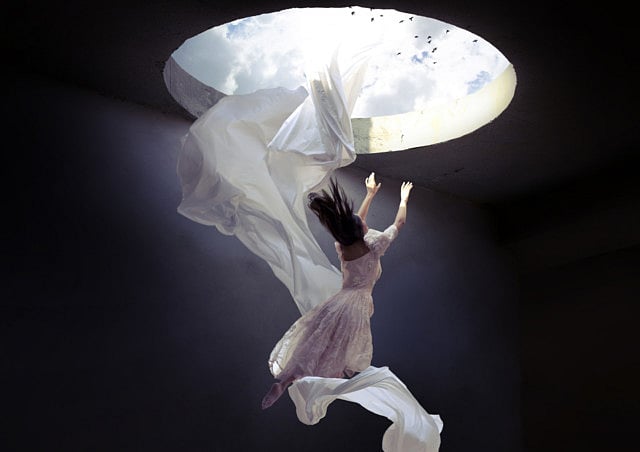
Alaa Kahel’s picture of a woman floating in a dark room towards a hole in ceiling – Cyan category:
This composite image was inspired by a recent workshop GPP hosted by well known American photographer Brooke Shaden. The idea was to create images that appear as if they are from a film or a story book, and that make the impossible possible. This image makes you wonder if the woman is falling down from the hole or floating out of it. The sheet suggests that she maybe dreaming, but the bright sunshine outside offers another angle to the story. It is a creative and fun picture.
Box:
Acid Fields
By Jyoti Kalsi
Lebanese artist Shawki Youssef uses the human body as a metaphor for the human situation in his paintings. The distressed, distorted anonymous bodies on his canvases represent an externalisation of the emotional trauma and inner fears of people and the collective suffering, anxiety and vulnerability of the society they live in.
“I use the human body as a diary that contains the memories, feelings and experiences of what it means to be a body living in the Middle East,” he says.
But unlike his previous series, “Hollow Flesh” and “Fluid Being”, the bodies in his latest work, titled “Acid Fields” are fragmented and almost abstract. The absence of a clear human form reflects the artist’s struggle to depict the emotional and psychological effects of the continued instability and violence in Syria.
A key feature of this series is the reference to maps. A map of the Middle East appears in one painting, while in another the artist has turned the same map upside down, making it look like the figure of a beast. In some paintings the map of Syria appears as a grey shadow among groups of people armed with rifles. And in many of the artworks the artist has used the harsh, geometric lines of the limbs and bones of fragmented bodies to create small spaces or maps within the compositions.
“The political and personal ties between the Lebanese and Syrians are so deep that the border between the two countries is just an illusion. It exists only on maps,” the artist says. “There is no denying that the civil strife in Syria has repercussions across the border in Lebanon and throughout the region. I have no option but to be emotionally affected by what is happening there. I am no longer able to draw complete figures.
“The traces of the body left in my paintings speak about the atrocities that cannot be hidden anymore. I do not know how to deal with the absurdity of the violence and my inability to change the situation. So I resorted to irony and sarcasm and played with the fact that the Arabic word for ribs is the same as that for a border on the map.
“These paintings are about maps drafted with broken ribs, flesh and bones. The unstable borders between the many spaces in my compositions are a reminder of the tragic fact that the situation in this region has been volatile since the time of my great great grandfather. As I zoom out to the big picture of the region, and zoom into the battlefield and further on to the dead body, I invite my viewers to search for some meaning in this turbulence,” Youssef says.
Acid Fields will run at Green Art Gallery, Al Quoz till June 23.
Sign up for the Daily Briefing
Get the latest news and updates straight to your inbox
Network Links
GN StoreDownload our app
© Al Nisr Publishing LLC 2026. All rights reserved.