Afghanistan: Puddles and potholes
International aid started pouring in more than a decade ago, but Kabul’s roads have nothing to show for it
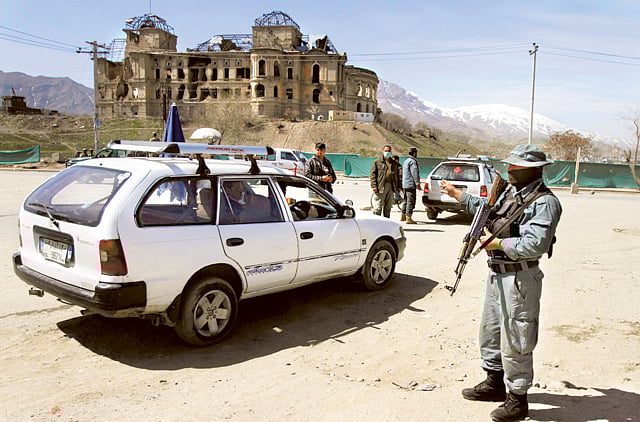
It is a street like most others in the commercial core of this capital: not really a street at all, but a bowl of mud soup thickened with mounds of dirt and loose gravel. Drivers, accustomed to years of navigating Kabul’s wretched roads, slalom through puddles and around potholes. Although the United States and its international partners shovelled billions of dollars into Kabul’s coffers for 11 years, Shah Bobo Jan Street is unpaved — just one small stretch of more than 1440 kilometres of city roads and alleys that remain largely dirt. That is the equivalent of a straightaway running from Washington to Des Moines, Iowa.
The condition of Shah Bobo Jan Street, like the vast majority of streets in this city of 5 million people, is mostly the result of decades of neglect by successive regimes and a civil war in the 1990s that left Kabul in a shambles. But only recently have international donors, including the US, made the capital’s streets a priority: in the past two years, about 193 kilometres have been paved in a city that covers 311 square kilometres.
For many Kabul residents, that provides reason for even more cynicism about a great US-led nation-building venture. In their eyes, it has created a corrupt and indifferent government that leaves the common people literally in the dirt — with roads that generate choking dust in the summer and rivers of muck during winter’s snow melt and heavy rain.
“Fifty percent of the money that came here went into the pockets of specific, powerful people,” said Abdul Wakil, a metal worker who bicycled precariously down Shah Bobo Jan recently. “They can make such high buildings, but they can’t make a road in front of their building?”
As is the case across Afghanistan, though, progress in making Kabul more liveable rests mainly on a negotiated peace with the Taliban. Without a settlement, many analysts foresee the country collapsing again into civil war after the US and foreign troops turn responsibility for security over to Afghan forces by the end of 2014. Economic aid is expected to drop, and development groups would be more likely to leave — including those that build roads.
Betting on peace, international donors have committed $16 billion (Dh59 billion) to Afghanistan over the next four years, but the process for delivering the dollars has become stricter — and slower — given previous waste and chequered returns on investment. In a decade, the US Agency for International Development spent nearly $1.6 billion in Kabul province on wide-ranging programmes — health, education, business development and government reform — much of which benefited the capital.
But American officials say they intentionally focused transportation-improvement elsewhere, building national and regional highways to stitch together the country’s major cities. USAid says it spent $2 billion over ten years to build 1930 kilometres of road in Afghanistan, but not in the traffic-snarled capital. “In Kabul, nothing was done,” said Mayor Mohammad Younus Nawandish, an energetic engineer appointed to office three years ago by President Hamid Karzai. “Kabul is the gateway to Afghanistan, and when international visitors come here, they ask: where went those billions in assistance?” Nawandish added.
At the entrance to Shah Bobo Jan Street, a leaning metal sign is emblazoned with the logos of USAid, Operation Enduring Freedom and Kabul’s municipal government. It states that road “rehabilitation” in that district and others started in May 2012. The work is part of the US aid agency’s $45 million Kabul City Initiative, which aims to improve city functions — basics such as tax collecting and amenities such as parks, trees, sidewalks and streetlights. The initiative also gets support from Japan, the World Bank and the US Army Corps of Engineers, among others.
In 2011 and 2012, the airport road was paved, as were arterial roadways around Kabul — a practical way to route heavy trucks out of downtown. But inside the city, only 32 kilometres of streets are “ready for asphalt”, as Nawandish put it, meaning they will be paved once the weather improves. So how many roads in Kabul, which is about the size of Reno, Nevada, are left to be fixed? “Oh, God, unbelievable amounts,” said Brad Baxter, project chief at Tetra Tech, the construction firm that holds the $45 million contract. “Unbelievable.”
Some streets haven’t been paved in more than 40 years, residents said. And training Afghans who have seen only dirt roads and have no experience with heavy equipment hasn’t always been easy, according to Baxter, a former city manager for municipalities large and small. Tools are stolen, he said. Work is shoddy. “Edge lines and centre lines have been painted with white paint instead of yellow paint,” notes a project report about the paving of one road a little more 800 metres long.
On Shah Bobo Jan Street, things haven’t gone so well either. “We were told to dig ditches in front of our shops to make the water flow, and we did it,” Aziz Khan said from behind the counter of his small sundries store. But because cement culverts weren’t installed, as they have been in other parts of the city, the street is streaked with rivulets, and mud accumulates half a foot high along its edges. The road, which runs about the length of two football fields, appears well-graded and gravelled in a photo from last year, but that didn’t last the winter. The gravel, supplied by the US Army, probably washed away, Baxter said. “It was triage work,” he added. “I’m sure it’s a mess.”
Since 2001, the population of Kabul has grown nearly fivefold, putting stress on roads that were already deteriorating. Along with more cars, there are heavy pickups laden with weapon-toting security forces, and “jammers” — huge armoured military vehicles that circulate to disrupt cellphone signals that might be used to detonate bombs. Hapless cops try to control chaos, while drivers shoot down rutted cut-throughs where the ride feels like a small-craft journey on a choppy sea.
Shah Bobo Jan Street, named after the sister of King Amanullah Khan, who secured his country’s independence from Britain in 1919, connects two important nodes of commerce: the famed Chicken Street bazaar and the Kabul City Centre shopping mall. Merchants selling carpets, handicrafts and other tourist items along Shah Bobo Jan say potential customers avoid the area rather than risk slippery collisions with other drivers or a slog by foot through the mud.
“It’s been six years that we’ve looked for a solution to this, but the city officials won’t do what we want,” said a man who identified himself only as Ayub and said he once served as a neighbourhood liaison to the city government. He gingerly shuffled on and off the sidewalk to avoid mud puddles as he pointed out worsening conditions. “Now water is going inside the homes,” Ayub said. “Thirty years ago, this was a beautiful street. There were trees. It was green.” And the street was paved.
Until two years ago, the city had no functioning streetlights, according to Nawandish and other residents. When the electricity went out — as it still does — shopkeepers relied on kerosene lanterns after dark. “It was like something out of the 14th century,” Nawandish, 56, said as he sat in his comfortable office decorated with awards. Nawandish is known to personally supervise pothole repairs and once showed up at 2am to instruct a work crew how to install lights.
What does the future hold? “I can see Kabul as a clean city, a green city, a developed city, a lighted city with good sanitation,” Nawandish says. Peace with the Taliban will come soon, the mayor confidently predicted: “I know the Afghan people are tired of the war and the instability.” But for now, a big-screen TV monitor on his desk shows 16 separate feeds from security cameras that survey all corners of his municipal headquarters — just in case of attack. And when will the city have paved roads? “It is not possible,” he said, “to build all these roads in two, three, four or five years.”
–Washington Post
Sign up for the Daily Briefing
Get the latest news and updates straight to your inbox
Network Links
GN StoreDownload our app
© Al Nisr Publishing LLC 2026. All rights reserved.