Preeta Mathur Thakur: ‘Jis Lahore Nahi Dekhya’ spreads the message of communal harmony
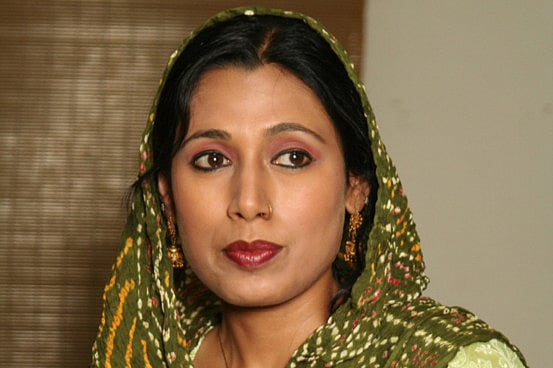
The lead actress and wife of the late director Dinesh Thakur talks about the play’s concept and her role
On Saturday, September 19, Dubai will for the first time see Indian theatre actor and director Dinesh Thakur’s version of Asghar Wajahat’s award winning play Jis Lahore Nahi Dekhya (The One Who Hasn’t Seen Lahore).
Thakur may have passed away in 2012, but the production still continues to be staged around the world — it’s had nearly 250 performances. The play depicts the endearing tale of a courageous old Hindu woman in Lahore during the Indo-Pakistan partition in 1947 who refuses to give up her house after suffering the death of her family. Thakur first staged the play in 2002-2003 after the communal violence that rocked Gujarat and its after-effects.
“Dineshji was very angry and anguished with this scenario. In fact major theatre groups in Mumbai at the time were talking about what artists can do that would bring a change in public opinion,” veteran theatre actress Preeta Mathur Thakur, who plays the lead in the play, said.
Preeta, who is also Thakur’s wife, spoke to tabloid! about how the play came about and her interpretation of her character. Although seen in early teleseries such as Kashish, Preeta prefers to be a theatre actress and has acted in several plays such as Mitro Marjani, Kanyadaan and Aadhe Adhure. She was a member of the well-known theatre group Indian People’s Theatre Association (IPTA) before joining Thakur’s group Ank. Today, she works tirelessly to enhance the art and keep Thakur’s legacy running. She will be next seen in Atke Bhatke Latke Sur, a play written by Ashok Mishra (Welcome To Sajjanpur) and staged by Ank.
How did the play come about?
Actually, Jis Lahore Nahi Dekhya is an older play, written in the 1980s by Asghar Wajahat, and at that time Asghar sahab [sir] had written it keeping in mind the partition and its consequences. But with such political turmoil happening around us, it was extremely disturbing — especially for the people who were secular and broad-minded — to see others like them changing their beliefs and thoughts. Dineshji wanted to give the play a new face, a new shape, to bring across a message of communal harmony, and all the actors in the play were swept [away] with his zeal. Kuldip Singh recorded two beautiful songs for us, which when we first heard multiplied our josh [fervour] to do the play.
“He insisted I play the old woman, which I wasn’t keen upon. I argued there were so many older, more experienced female actors, such as Surekha Sikhri, to do the character. In fact, I wanted to do the role of Begum, which seemed a lot more fun. But he refused. He agreed they were all wonderful actresses, but they were busy doing television and other plays, and may not be able to do as many shows as he wanted to due to their busy schedules. He wanted to stage the play at schools, colleges, wherever possible to spread the message, which we did. He wanted to tell people not to be prejudiced, to look at things in a broader way. So that was the concept behind our play.
What challenges did you face as an actor to portray this character?
When the play was first staged by noted Indian theatre director Habib Tanvir, a man played the role of the old woman. Later, I had the opportunity to talk to him about the casting and he said there didn’t seem to be an actress capable enough — or willing — to play this strong character. So he took a man. Habib’s old woman was a woman who stood up straight and had an aura of bossiness around her. But I interpreted it entirely differently. I saw her as a physically frail woman who has been beaten by personal tragedy, but mentally and emotionally she’s extremely strong. I discussed this with Dineshji. As actors we are born to observe and these observations seep into our subconscious to come up at the right time and right place. I modelled my character on old hawker women I had seen in Mumbai, who are working because they are alone or still taking care of their families, commuting through Mumbai, navigating its busy streets to sell their products. They would make jams and chutneys, and face creams, that they would plead one to buy. Yet, you would always see them smiling.
Dineshji liked my portrayal of her. He was an actor’s director who could extract the best out of you. Then a few days before the opening of the show, he dropped another bomb on me. He said, ‘You have the stature, the voice, the expression all in place. But I need the frailty of the woman to be more visible. I want you to bring it in the movement too’. And I can say I’ve managed to get into the skin of the character after the long run it has enjoyed.
The play continues to be performed after Thakur’s death. Have you stepped into his shoes as director? Have you been able to maintain his vision of the play?
It was really tough, but I’ve tried my best. A couple of other senior actors in the group have also taken up the onus and tried to keep his vision intact. We’ve had replacements in various roles after his passing away. These new people were trained by Aman Gupta, one of our senior actors, and me. Even the other actors who were there during Dineshji’s time have contributed. So I won’t say I have done it alone. It’s been a group effort to keep the vision, its feel, its fabric, intact. Of course, there have been minor changes. One cannot forget that every person has an individual personality. One can never put a square peg in a round hole and you will need to bend the round hole ever so slightly to fit it in.
Don’t miss it
Jis Lahore Nahi Dekhya will be staged at Ductac, Mall of the Emirates, on Saturday, September 19, at 8pm. Tickets are priced at Dh250 and Dh350, call 04-3414777 or go to ductac.org
Sign up for the Daily Briefing
Get the latest news and updates straight to your inbox
Network Links
GN StoreDownload our app
© Al Nisr Publishing LLC 2026. All rights reserved.