Operation Safed Sagar review: Reliable Siddharth leads a sincere, refreshing series that slips into a familiar finish
Siddharth shines in a nuanced war series that falters in its final act
You might have to excuse me for avoiding Operation Safed Sagar initially. The idea was never the problem; it was just believing that this would be another loud, jingoistic film that would turn into meme fodder days later, where one side is completely elevated to the point of invincible heroism. Nuance is a thing of the past; what remains are black-and-white tropes in which it's always clear whose side you're on.
The sordid glow has only intensified over the last few years, to the point where history itself gets rewritten, as in Samrat Prithviraj, and where a three-hour slog like Chhaava has Vicky Kaushal leaping from one elephant's trunk to another while tigers roar on the soundtrack. The side we are meant to cheer has no flaws, only guts and glory.
Against that backdrop, it was hard to believe that Operation Safed Sagar would take a different route. The Netflix series was released just in time for Independence Day and is set against the backdrop of the 1999 Kargil War. The specific subject is the air campaign that the IAF launched to support the Indian Army's Operation Vijay. All the ingredients for another chest-thumper were in place.
For its first three episodes, in a rather Top-Gunish manner, though, the show seems to have learned from its predecessors and appeared more constrained in its approach, teasing that before the war, there are closed-door meetings, strategies unveiled, and, in this case, seedy manipulation that eventually triggers the fire of war. One Prime Minister falls easily for a seething general's tales, and doesn't quite understand what, he is literally signing up for. And in doing so, he instigates a crisis.
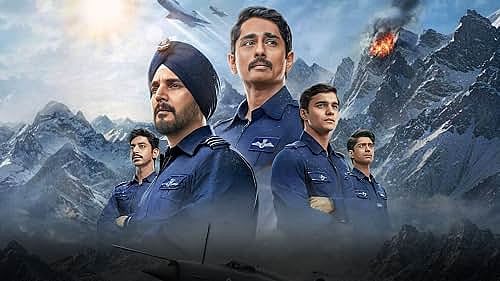
In the 6-part series, the ever-reliable Siddharth plays Squadron Leader Ajay Ahuja, who moves to Bathinda to lead the "Golden Arrows" squadron. Siddharth is admirable in his role, constrained, reserved and sparing with his words: He drives the show, in his presence, and even in his absence. There isn't brutal foreshadowing in his fate, as you would expect in most films. You know the truth, and the heaviness slowly sinks in without the drama as he gets on the flight.
Even so, the early episodes are worth watching for their tough love and gentle humanising: the tangled romances, the bruised egos, the brotherhood that forms among the pilots. The squadron includes Dhali (Abhay Verma), Baldy (Mihir Ahuja), Sangy (Taaruk Raina) and Goofy (Arnav Bhasin), but only Dhali and Baldy are given fully drawn characters. Baldy also gets a brief romance with Prajakta Koli's Madhavi, and it's handled clumsily. At one point she asks him, in all earnestness, "Do you even love me, Baldy?"
Sigh.
Those contrivances aside, the show is good at the small rituals of squadron life: the camaraderie, the sorties, and "bouncing," where juniors turn up uninvited at a senior officer's house. In Ahuja's case, his wife lays the table and promptly puts them to work chopping vegetables.
In the air, the mood changes. The pilots fly in pairs, and every mission depends on flawless communication and absolute trust in the person beside you. Not everyone can hold their nerve. Baldy suffers anxiety attacks mid-flight, and they come close to driving him out of the cockpit altogether and back to Madhavi.
Yet, this isn't the time for love and confusion; war looms in the background.
And then, the war bursts forth.
Episode 4 is where the war arrives. The show traces how the conflict broke out, the uproar over the deaths of the first fallen officers, and the campaign to reclaim the occupied heights. The flights are rather slick and thrilling to watch; and perhaps this is where the series at its most absorbing, attentive to the strategy and the sheer difficulty of striking targets at extreme altitude without hitting your own troops. The tone stays measured, too. We manage without the swelling scores and aggressively expository speeches.
Yet, by episode 5, the cautious restraint gives way and the anger simmers through as storytelling wavers. The opposing side watches cricket matches, while the senior officer insists that a soldier taken hostage must be treated with dignity, only to brutally torture him later. Nuance retreats, once again.
Finally, the series succumbs to the low-hanging fruit and contrivances of all war dramas: The staid pep talks, the determination to find that one triumphant moment, the overjoyed yowl on a successful bombing, and one-tone women characters. We slowly watch a yawing to the old and familiar pattern of war films. The ending messaging is written out clearly with montages from both armies too; they aren't for context, mind you.
Operation Safed Sagar is easily better than the films it will be shelved alongside. It trusts its characters, keeps its score in check. But when it finally has to choose between complexity and consensus, it picks consensus.
Also In This Package
Network Links
GN StoreDownload our app
© Al Nisr Publishing LLC 2026. All rights reserved.