India through Sam Miller’s eyes
Walking through its cities, the former BBC correspondent hoped to get to know the country. What he learnt was it isn’t knowable — ‘it is too large and too varied’
A Strange Kind of Paradise: India Through Foreign Eyes
By Sam Miller,
Jonathan Cape, 432 pages, £18.99
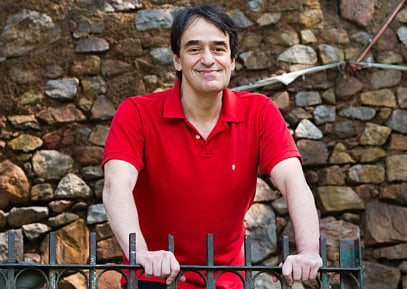
New Delhi-based writer and journalist Sam Miller is the author of “A Strange Kind of Paradise: India Through Foreign Eyes”, an eclectic historical travelogue. The book is an exploration of India’s past and present from the perspective of a foreigner who has lived in India for many years. The author investigates how the ancient Greeks, the Romans, the Chinese, Arabs, Africans, Europeans and Americans came to imagine India.
The 2500-year account of the engagement between foreigners and India spans the centuries from Alexander the Great to “Slumdog Millionaire”, the Oscar-winning film. It features, among many others, Thomas the Apostle, the Chinese monk Xuanzang, Marco Polo, Ibn Batuta, Vasco da Gama, Babur, Clive of India, Mark Twain, E.M. Foster, Allen Ginsberg, the Beatles and Steve Jobs.
Interspersed between these tales is the story of the author’s own 25-year-long love affair with India and how he fell in love with and married an Indian girl. By way of his journey, Miller informs, educates and entertains in equal measure. He traces how others have viewed India and also how he has come to make it his home. Interesting aspects of the book are abundant footnotes and cross-references to religion, history, art, architecture, literature and culture.
Miller was born in London in 1962 and both his parents, Karl and Jane, were professors at London University. He studied History at Cambridge University and Politics at London University’s School of Oriental and African Studies, before joining the BBC in 1986, for which he has worked, on and off, ever since.
He first came to India in 1987 to attend the wedding of his sister, Georgia, in Mumbai. In the early 1990s he was the BBC World Service TV and radio correspondent in Delhi, and on his return to the UK in 1993 was the presenter of the BBC’s current affairs programme, “South Asia Report”. Later, he became the head of the Urdu service and subsequently managing editor, south Asia. He was posted back to Delhi in 2002 and has since lived here with his wife Shireen and their two children Zubin and Roxana.
Well versed in Arabic, Hindi, Urdu and French, Miller’s favourite Indian authors include Premchand, R. K. Narayan, Amitav Ghosh, Vikram Seth and Rohinton Mistry. He has authored “Delhi: Adventures in a Megacity” (2010) and “Blue Guide India” (2012).
Walking has been a passion with Miller. He says, “It is the best way of clearing one’s mind. And what others achieve by sitting and meditating, I attain by walking, as I do not have the patience to sit motionless.” He has had a deep interest, from his childhood days, in exploring cities and understanding how they grow and feels one is able to learn a lot more about the city by walking than by reading.
But sometimes this approach to walking has got him into trouble. In Damascus he is known to have wandered into the barracks of the presidential guard and had to endure a brief but uncomfortable interrogation. In Moscow, he stepped off the kerb, into what he thought was a shallow puddle, only to find himself knee-deep in rainwater.
Miller says Delhi is not an easy city to walk in. “Its occasional irregular pavements contain hidden hazards. In Paris you pay to visit the famous city sewers; in Delhi they come for free! Initially, when I came to Delhi, whenever I asked anyone for directions in my broken Hindi, I would be pointed not to the place I wanted to go but to the nearest taxi stand. When I said that I wanted to walk, most people would smirk, clearly believing I was crazy. But over the years, it has become possible to walk in Delhi. There are more underpasses — probably because the city has evolved a lot and there have been remarkable changes.” Miller had much more to share during an interview with Weekend Review. Excerpts:
Are Indians receptive to your opinion on their country or that of other non-Indian writers? On which particular aspects are you appreciated and criticised?
I think most Indians who read foreign writers are quite capable of distinguishing between them, and wouldn’t dream of lumping them all together. I’m keen to point out the variety of foreign writing about India — some of it is absurd fantasy, some of it is profound and searching, a lot of it is still full of ancient and modern stereotypes. On the whole, many Indians get too upset about foreign criticism, and too excited about foreign praise; and they sometimes seem overexcited about the success of people of Indian origin in other countries. That betrays a lack of confidence in India and Indians, which isn’t really justified.
Having lived in India for more than a decade, do you still feel like an outsider? Why?
I feel like an outsider wherever I go, not just in India. So that says more about me than about my adopted country. And in truth, I feel, in India, I can be both an insider and an outsider, and that is a wonderful viewpoint from which to look at the world around me.
Does India’s present politics affect you?
Yes it does. Indian politics was my first interest during my days as a BBC correspondent in the early Nineties. I still follow elections with great interest, particularly the present one — but more from the point of view of a psephologist than a partisan. My own party political leanings are irrelevant, and I wouldn’t seek to inflict them on Indian voters unless they were close friends.
What was easier to explore and write — the country’s past or present?
It is very hard to write about the present without a real sense of the past. Part of the story of “A Strange Kind of Paradise: India Through Foreign Eyes” is about the interconnectedness of the past and the present. So many important stories about modern India — the linguistic mix of the country, the relationships between different religious and caste groups, the differing ideas about India’s identity — all go back many centuries.
While writing this book, what was your target audience and to whom would you recommend it as a “must read”?
I’m not sure I had a clear target audience in mind. I’m afraid, when I’m actually writing, it’s really as if I am writing for myself. Writing feels like a process of discovery to me, rather than an opportunity to set down what I already think or know. But I do seem to care instinctively more about whether Indians like the book, and always feel it needs to work for an Indian audience. The book is also very much about stereotypes, and so I hope it will be interesting for anyone around the world who cares about the ways any of us fantasise and demonise foreigners and foreign countries.
A lot of foreigners, including writers, are of the opinion that one cannot have enough of India. The more you explore, you discover there’s still more to see. How far do you agree with this notion?
I love living in India, and, yes, however much I travel here, there’s much more to see. I’ve travelled widely everywhere except the Northeast, and the Andamans and Lakshadweep, and yet I still feel as if I have thousands of places which I’d like to visit, or to which I would like to return. In many ways, India is more like a continent than a country — with the size of population, and the variety of languages, cuisines and cultures.
From when you were a newbie, to being, so to say, a veteran, what have you unlearnt about the country?
I came to India with very few preconceptions, and I think that helped me in some ways when I first arrived here. Indians, and foreigners who had lived here a long time, were my first guides. Over time, I’ve learnt that India isn’t “knowable”, in the way many countries are. It is too large and too varied.
As a journalist, which Indian personalities impressed you the most and why?
As a journalist it is best if you can avoid being impressed by personalities, and instead get on with your job.
Nilima Pathak is a journalist based in New Delhi.
Sign up for the Daily Briefing
Get the latest news and updates straight to your inbox
Network Links
GN StoreDownload our app
© Al Nisr Publishing LLC 2026. All rights reserved.