Textile recycling drive inspires community action in UAE
Interactive Abu Dhabi event encourages residents to rethink waste
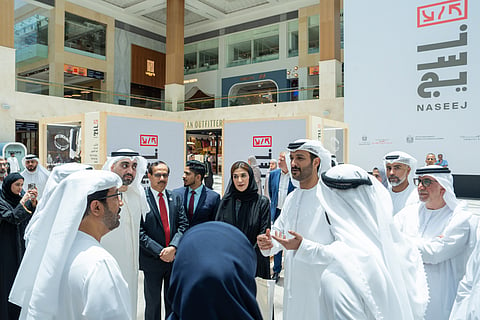
Abu Dhabi: An interactive community initiative aimed at reducing textile waste and encouraging recycling has drawn strong public engagement in Abu Dhabi, as the UAE steps up efforts to build a circular economy and promote more sustainable consumption habits.
Organised by Naseej, the UAE’s National Initiative for Textile Circularity, the three-day activation, titled The Fabric of Possibility, invited residents to explore how everyday choices related to clothing and textiles can help reduce waste and extend the life cycle of materials.
Held at Yas Mall from June 5 to 7, the event formed part of a wider national effort to address growing textile waste while encouraging communities, businesses and policymakers to embrace recycling, reuse and innovation.
Shared agenda
The initiative was launched under the directives of the UAE leadership with the support of the National Projects Office and in collaboration with the Ministry of Economy and Tourism, Emirates Foundation and Tadweer Group. It seeks to accelerate the transition towards a circular textile ecosystem by bringing together government entities, the private sector and local communities under a shared sustainability agenda.
The event was attended by Abdulla bin Touq Al Marri, Minister of Economy and Tourism; Dr Mugheer Khamis Al Khaili, Secretary-General of Erth Zayed Philanthropies; Hamad Abdullah Al Zaabi, Director-General of the National Projects Office; Eng Hamad Ali Al Dhaheri, Undersecretary of the Department of Community Development; Ahmed Talib Al Shamsi, Chief Executive Officer of Emirates Foundation; and Etienne Petit, Chief Executive Officer of Tadweer Group, among other officials and partners.
Textile waste
At the heart of the activation was an immersive visitor experience designed to demonstrate the environmental impact of textile waste and the opportunities created through recycling and reuse.
Visitors were guided through a series of installations that contrasted two potential futures: one driven by increasing waste and resource depletion, and another built on reuse, recycling and circularity. Through visual storytelling, interactive exhibits and hands-on experiences, participants were encouraged to reflect on the consequences of consumer behaviour and the role individuals can play in reducing waste.
Speaking at the event, Abdulla bin Touq Al Marri said Naseej represents an important step in advancing the UAE’s circular economy ambitions.
“Naseej represents a new strategic step in the UAE’s journey towards strengthening circular economy principles. It serves as a unified national platform that brings together government entities, private sector stakeholders and community organisations under a shared vision to enhance resource efficiency and transform textile waste into sustainable economic opportunities,” he said.
He added that the initiative supports the objectives of the UAE Circular Economy Policy 2031 by encouraging innovation, resource efficiency and sustainable business models.
Five pillars
Naseej is built around five strategic pillars: textile collection and recycling, community awareness and engagement, policies and regulations, circular business innovation and behavioural research. Organisers said community engagement remains central to the initiative’s long-term success, with public participation helping to drive lasting behavioural change.
The activation attracted significant interest from visitors, many of whom said it changed the way they viewed clothing consumption and disposal.
“The experience made me look at textiles in a completely different way,” said visitor Ward Yahya. “I had never realised the impact of our everyday choices, but it showed me that even small actions can make a real difference.”
Practical ways
Another visitor, Marko Kaevski, said the event introduced simple and practical ways to contribute to sustainability, including donating unwanted clothing and recycling textiles rather than discarding them.
Businesses are also being encouraged to participate in the initiative by integrating collection points, supporting awareness campaigns and testing new circular solutions.
As Naseej expands its activities across the country, organisers are calling on communities, businesses, researchers and media organisations to help advance textile recycling and support a more circular future, where materials remain in use for longer and less waste ends up in landfills.


