Best of the Best review: Maitreyi Ramakrishnan's dance drama trips over the very clichés it skewers
Bollywood weddings, campus angst and clichés collide in a limp fusion
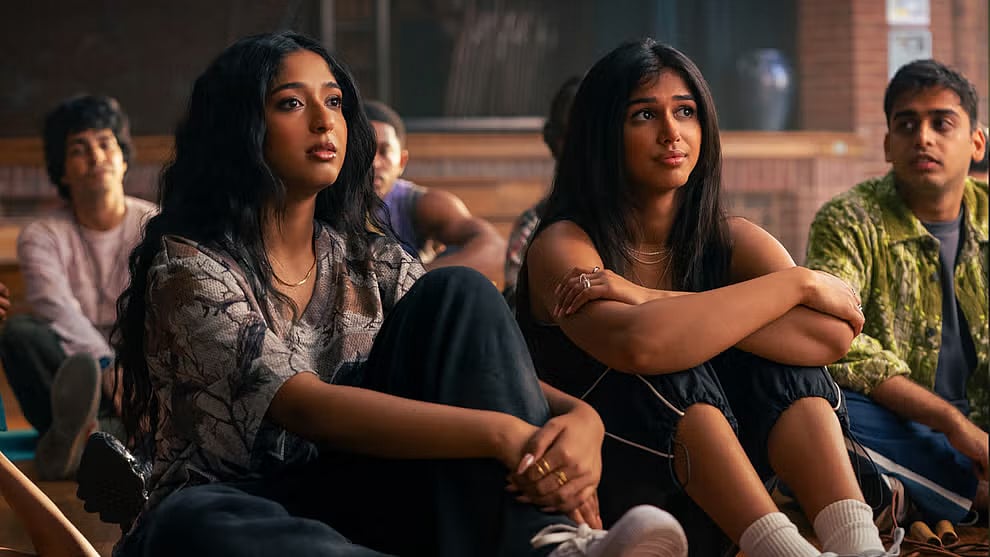
In one scene of Best of the Best, a caustic Maya (played by the iridescent Maitreyi Ramakrishnan) informs her fusion dance team's captain that their planned theme, Bollywood weddings, is trite and clichéd. It's Bollywood through a foreign lens, she says. In other words, if you ChatGPT 'Bollywood,' this is roughly where you end up.
I was almost impressed by those few seconds of self-awareness. They arrived after a determined 30 to 40 minutes of exposition dumps about absent fathers, dialogue that seems written for tweets and reels ("We will walk out there like sexy gladiators"), and a particularly offensive line about Kabul, tossed off as a throwaway joke. So when Maya began schooling the room, I harboured a faint, admittedly bleak hope. Were we finally done with India as a melded blur of colours and clichés? Might this film actually look like it came from somewhere in South Asia?
I was wrong. And if I had to speak in hit tweets, as everyone in this film does, I was as wrong as Maya is when she upstages her own show with a fog machine and ends up dragging her best friend around by the hair.
That early scene turns out to be the film's most revealing moment, though not in the way it intends. Best of the Best knows exactly what the tired foreign gaze on India looks like. It can name it and mock it.
It just can't stop reproducing it. The critique is delivered, the box is ticked, and the film goes right back to serving the same flattened version of India, only now with the alibi of having called it out first. It is a film for those who want India dumbed down to a degree that might mildly confuse even AI, ridden with cliches that you expect from any dance competition film.
You have the wedding routines, the mean girls whose dialogues are now the same in every film, and a very painful Kohinoor reference in the final act. No, please, please stop.
Maya and Anjali (Priyanka Kedia) are best friends, now at UCLA and set on joining a competitive Indian fusion dance society. It's intense, it's grim, and nobody is there to have fun, as captain Rounak warns them. That's a warning to the audience.
Both girls arrive with baggage, as Anjali has to keep her grades up to survive the new setup, because her single mother has made it clear she can't keep paying fees otherwise. Maya is blunt, forthright and rebellious, with more than a trace of Ramakrishnan's Devi from Never Have I Ever, and she nurses a deep insecurity about her best friend, one that curdles when she discovers the team prefers Anjali.
Here the film has something real to work with. The friendship between a girl who has to succeed and a girl who needs to be seen is a rich tension, especially in a diaspora story where both pressures often come from the same place. But the film never gives either struggle room to breathe. Anjali's financial precarity functions as a plot device rather than a lived condition, and Maya's envy is announced more than it is explored.
Nevertheless, not everything here is a riot of messy colour. There are a few highlights, chief among them the leads. Ramakrishnan is effervescent, and her range is more pronounced this time around; you can hear it in the break of her voice during her confrontation with Anjali, a small moment that carries more feeling than any of the film's big speeches. Kedia is given little to work with as Anjali, but she makes the most of it, and her performance is commendable for finding a person inside what is largely a plot function.
The one who actually got a few chuckles out of me was Hasan Minhaj. He does what he does best: a handful of snarky throwaways, delivered as he tries to work out why he's so invested in a fight between two teenage girls. "I'm a little embarrassed," he admits, and it's arguably the film's first genuinely entertaining scene. It works because it's the only moment where the film seems to share the audience's bemusement.
The race to the Best of the Best finals is a jagged one. There's plenty of talk of quitting, plenty of tearful breakdowns and, naturally, ample room for lifelong issues to be resolved in five minutes. Maya's burning inferiority complex is cured by a teammate who literally places a chip on her shoulder to point out that, yes, she has a chip on her shoulder. It's all very Disney Channel in its resolution, and by that point you expect nothing else. Friendship saves the day, fa la lala; even the most arrogant captain of all has been thawed by their friendship.
That, is the real shame. Fusion, as a dance form, is supposed to be about synthesis: two traditions meeting and producing something neither could alone. Best of the Best never manages that. It places its borrowed Bollywood and its American campus drama side by side and hopes the combination will pass for depth. The film spends its runtime insisting it has something new to say about how South Asia is seen, then ends up looking like the very wedding-themed routine Maya rejected in the first act. She was right, as it turns out. Nobody listened, least of all the film.
Network Links
GN StoreDownload our app
© Al Nisr Publishing LLC 2026. All rights reserved.