Palestinian play ‘I Am Yusuf’ opens in Dubai
The production was written by playwright Amir Nazir Zuabi in 2009
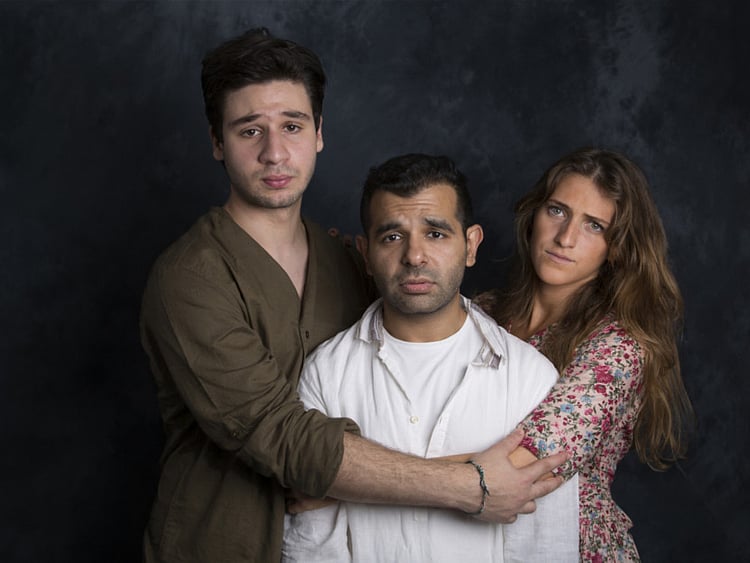
At a time when despairing refugees are at the forefront of the political landscape in the Middle East, I am Yusuf and This is My Brother sheds a retrospective light on harsh realities in 1948 Palestine.
The play was written in 2009 by Amir Nizar Zuabi, who is in charge of the Palestinian National Theatre, “one of the first cultural and art centres”, in Occupied Jerusalem. His work was toured around refugee camps and villages in Palestine in Arabic, then translated into English when it arrived at Young Vic Theatre in London in 2010.
On October 7, 8, 9 and 10 at Ductac Theatre in Mall of the Emirates, the local theatre community Danu Dubai will perform the play in English for a UAE audience, under the guidance of Irish director Padraig Downey.
Downey was amazed by Zuabi’s storytelling when he witnessed a Syrian production by the playwright in Dublin. He got in contact with him and discovered I Am Yusuf. It spoke to him, and he asked for permission to put it on in Dubai with a locally recruited cast. A man on a mission, he found Palestinian actors through the Palestinian Society of the UAE and word of mouth; out of the final 14 cast members, five are Palestinian, and the rest are primarily Pakistani, Indian and Syrian.
The story he’s helping tell is a simple one: a strong bond between two brothers, Yusuf and Ali.
“It’s about their relationship with each other, and their love for each other, and how their worlds fall apart whilst Palestine is partitioned in 1948,” Downey told tabloid!.
There’s also an underlying story of star-crossed love between Ali and a girl named Nada, who he is unable to marry because of Yusuf’s ‘condition’. Yusuf is seen as the ‘village idiot’ — an eccentric character who’s slow on the uptake. Nada’s father feels that if he allows his daughter to marry Ali, their children will suffer genetic issues in the future.
More than that, the story focuses on the fact that war is coming and times are changing.
During its UK run, it was a critical success. The Independent called it “superb” and said it “unlocks what is happening deep in the soul of the dispossessed”. The Guardian gave it four stars out of five and called it “more poetic than rancorous”, “steeped in sorrow rather than in hate”. Downey attributed much of the play’s power to Zuabi’s vision.
“Zuabi was very inspired by the Palestinian playwright Mahmoud Darwish, so his form is Arabic-style theatre,” he said. “There’s a lot of Arabic-style poetry and traditions in it. We were conscious that this was for an international, multinational audience [in Dubai], so we have a lot of that taken up by a singing narrator. She sings in Arabic.”
There are also Quranic verses woven into the play, but done very subtly. There are extracts of the Quran recited by an Emirati, with subtitles provided in English.
Downey felt especially connected to the story due to his own background as an Irishman. He reflected on his family’s own history when he visited them in Boston.
“My country wasn’t even allowed in the UN until 1955, and we had to fight for our freedom ourselves. My great-grandparents, my great aunts and uncles all moved to America and were treated like trash when they moved … If it was a hundred years ago, my passport would be worth nothing,” he said.
Downey adds that the play is ‘absolutely’ relevant today, particularly with the current refugee crisis.
“What is the situation now, with Syrians fleeing their country? Is it their fault? If you were in that situation, what would you do?” Those were the questions the cast and crew posed to each other as they delved into the story they were telling.
Downey, who has lived in Dubai for five years and has visited Palestine before, counts Palestinians among his best friends. The first friend he made was a Syrian man who had to flee the country; he now lives in Sweden.
“I’m very passionate about how all Abrahamic religions come from the region,” he said. “I truly believe that in society, we really need to be more conscientious of our similarities and what binds us together as a human race. It just saddens me that we are all being pulled apart so much and being turned against each other.”
For him, championing meaningful and home-grown theatre, and putting on shows like I Am Yusuf, is all an integral part of resistance against that divide.
“We need to build our art scene here. There are great things being done, but on the theatre scene, especially, we need to move away from the mentality of importing everything. We can grow it here,” he said.
And even as his cast trudges through bleak terrain on stage, there’s a ray of sunshine on the horizon.
“It’s optimistic and ends on a hopeful note, and it shows Palestinians as strong Arabs [and] strong humans,” he said. “We all have a link to Palestine, and we should never forget that.”
Don’t miss it:
Tickets are Dh60-Dh85 through ductac.org. Shows run at 7.30pm, Wednesday through to Saturday, at the Kilachand Studio Theatre, Ductac (MOE). An additional matinee show on Saturday is at 3pm. The proceeds after fees will be donated to Red Crescent (Refugee Fund) for Palestinian and Syrian Refugees; the cast and crew are working for free. Call 04-3414777.
Sign up for the Daily Briefing
Get the latest news and updates straight to your inbox
Network Links
GN StoreDownload our app
© Al Nisr Publishing LLC 2026. All rights reserved.