A tranquil getaway in idyllic Mauritius
Deep in the heart of the sleepy south of Mauritius, we experience romanticism, charm and elegance at the HeritageLe Telfair Resort & Spa
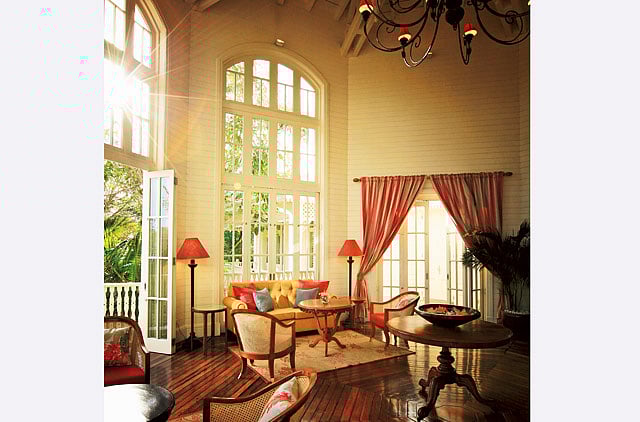
Aheavy brass bell announces your arrival at the open foyer at the Heritage Le Telfair Golf Resort & Spa, and from then on, you step into a bygone era where elegant Mauritian colonial design reigns. White brick walls, structural timber work and wood carvings rest in 19th century colonial architecture that is capped with terracotta pink pergolas. The effect of the decor transports you into another world, ushering in Creole culture and pampering you with the renowned Mauritian hospitality of the ‘sleepy south'.
Entering the main building, you find yourself in a circular, majestic sunroom filled with light, the decor vintage and warm. Wooden floors below, curvilinear metal chandeliers above, ornate brass ceiling fans that remind you of your posh grand aunt's living room, and furniture that is far more delicate than standard British colonial design, instantly transport you into yesteryear.
Creole culture is everywhere. French influence in the curlicues, delicate patterns, and light, bright tones are easily distinguishable and beautifully juxtaposed with friezes and arabesques based on Islamic art, hailing Mauritius' multiculturalism. The atmosphere that descends is one of luxury, lazy island pace, and a peaceful time trapped in a bygone era.
The circular room opens onto a balcony overlooking the Citroniers River, and beautiful gardens and villas spreading out over the park. The resort lazily unfolds on both sides, into and around the gardens, and parallel to the river, while the symmetry and balance in design carry the view straight past the fountains, pools and water features, and into the shimmering turquoise waters ahead. A little further away, a bridge curves over the river and as you stroll along the bank, you are filled with sensations of nature, sight and sound. Paths meander through the tropical gardens and into the rooms and the low-key architecture allows for interconnecting pathways and intimate breakout areas. The landscaping is dotted with educational, near missable, tiny notices identifying the foliage.
Like many places blessed with breathtaking surrounds and island weather, the native architecture that evolves is fairly open with the inside and outdoors frequently merging. Furnishings and accessories remain strictly period specific and the attention to detail never falters - each carving, each tassel, each groove in place and present even in lesser prominent spaces. This resort passes the most gruelling critical design test with flying colours. Antique furniture fills the suites. Walls, upholstery and carpeting tie in nicely with the classical theme - muted greens, whites and beiges that don't muddy the look but keep it crisp and fresh. The fabrics and carpets are made from natural materials, linen, cotton and wild silk, in soft colours. The architectural finishes here interplay with light and dark - dark wooden floors contrasted against panelled ceilings and dado rails. Four-poster beds, armoires, Louis XV-style influenced tables provide hints of French Provençal in the curves and arabesque in decorative details. Spacious bathrooms are finished with earthenware wall tiles and mosaic floors with old motifs. Glass doors decorated with 19th century arabesques subdivide the space into separate sections, and some large windows offer views of the garden.
Balance plays a strong part. Nothing is positioned, not even deliberately, out of place, down to the tiniest candle holder. The land and its offerings are cleverly used everywhere and there is meaning behind each material and accessory. The south's sugar cane plantation culture and its native products are heavily embedded in the cuisine, the soaps, the teas, the fabrics and the textures.
This sprawling resort is nestled in the heart of the Domaine de Bel Ombre, which lies between the turquoise waters of the Indian Ocean and the foothills of the mountains of Plaine Champagne which is crossed by the Citroniers and St Martin's rivers. Its concept and design pay homage to respected naturalist and Irishman Charles Telfair, who stayed on the island with wife Annabella in the 1820s. They were legendary hosts, encouraging friends and relatives to visit and explore this tropical island with its unique fauna and flora as well as its rich multicultural traditions. The resort pays homage to his dedication towards beautifying and developing the south and its sugar plantations, and is built in the grand tradition of old properties on the island. A red flower, painted by Annabella, is now the resort's logo and a recurring brand mascot for Le Telfair.
As you sip vanilla tea on your own private veranda, lying on a carved wooden reclining chair, peace descends. This hotel is a testament to a people who are proud of their land, their culture and their hospitality. This beauty and humility is perfectly captured and translated at the Heritage Le Telfair.
Sign up for the Daily Briefing
Get the latest news and updates straight to your inbox
Network Links
GN StoreDownload our app
© Al Nisr Publishing LLC 2026. All rights reserved.