US goes after Russia’s energy giants now
Gazprom and Rosneft to feel weight of sanctions as will latter’s US partner ExonMobil
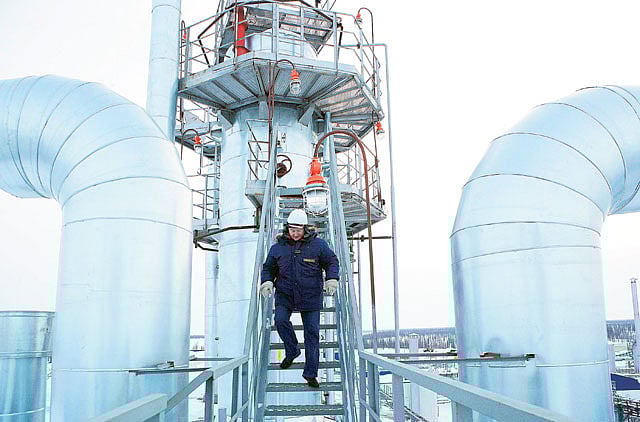
The US dramatically expanded its sanctions against Russia on Friday by adding Gazprom, Europe’s leading energy provider, to the list of targeted companies, as it sought to ratchet up pressure on Moscow to step back from the war in Ukraine.
The latest measures targeting energy, financial services and defence industries also included Lukoil, the privately owned oil group, and Sberbank, Russia’s largest bank.
The new sanctions go much further than previous moves to punish Russia for its role in the eastern Ukraine insurgency by widening the number of companies targeted. In addition to blocking most major state-owned groups from western capital markets, the US has also tightened restrictions on some of Russia’s largest energy projects, a key engine of its future economic growth.
One in particular — ExxonMobil’s high-profile exploration partnership with the state-controlled Russian oil group Rosneft in the Russian arctic — is looking increasingly under threat. The two companies began drilling in the Kara Sea last month, but industry analysts question whether their joint venture can survive under the intensifying sanctions regime.
There was also surprise that the US had decided to sanction Lukoil, the first private Russian company to be penalised in this way. The oil producer is not tied to President Vladimir Putin and has played no role in the Ukraine conflict.
“It sends a message that any Russian firm is now conceivably a fair target instead of solely targeting firms that are state-owned or owned by people believed to be associated with President Putin,” said Andrew Weiss, vice-president for studies at the Carnegie Endowment for International Peace.
The Treasury’s move came as the EU also broadened its sanctions against Russia. It published the names of 24 individuals who would be hit, and confirmed that three Russian energy groups — Rosneft, Gazpromneft and Transneft — had been targeted as well.
However, in an attempt to cool tensions, the EU agreed on Friday to delay the implementation of its controversial trade deal with Ukraine that sparked the current conflict. Karel De Gucht, trade commissioner, said that the deal would enter into force in December 2015 rather than November 2014, as originally expected.
During this period, Ukrainian goods will enjoy privileged access to EU markets but European exporters will not be given similar freedom to ship goods to Ukraine. De Gucht said this one-sided implementation would help Kiev’s battered economy. The extra time is also intended to placate Russia, which argues that an EU-Ukraine trade deal is a threat to its economy.
Some Ukrainian politicians criticised the delay, noting that former Ukrainian president Viktor Yanukovich’s refusal to sign the EU integration deal last November sparked the street protests that eventually toppled him.
But speaking at the Yalta European Strategy conference in Kiev on Saturday, Ukraine’s Prime Minister Arseniy Yatseniuk played down the implications of the delay, saying the agreement would still be ratified by the EU as planned.
“My feeling is that this was a good gesture of the EU, as we got a grace period. The EU opened its market [to Ukraine], and Ukraine is still protected with relatively protective import duties. So for Ukraine this is not a bad deal,” he said. “The Ukrainian side will implement everything that is in the deal. We will approximate all Ukrainian legislation to EU standards.”
The Treasury’s move coincided with growing pressure on the Obama administration to toughen its foreign policy in the face of accusations that US President Barack Obama had been “weak” in his response to multiple crises overseas.
A senior administration official said that the latest round of sanctions could be lifted immediately if Russia observed the ceasefire agreement signed with Ukraine in Minsk. However, Putin claimed new EU sanctions against Russian entities and individuals, including the top-ranking rebel leader in eastern Ukraine, could endanger the peace process there.
“I don’t understand what these new sanctions are about. Maybe someone doesn’t like the fact that the process has taken a peaceful turn,” Putin said.
He said the Russian government was working on retaliatory measures but would only impose sanctions that both hurt the west and created “better conditions” for Russia. Andrei Belousov, the president’s chief economic aide, has said these could include capping imports of certain western automobiles, including used cars and some clothing.
The latest US restrictions build on a previous round that squeezed Russia’s financial services sector. They prohibit Bank of Moscow,Gazprombank, Russian Agricultural Bank, VEB and VTB from securing dollar-denominated debt of greater than 30 days’ maturity — rather than greater than 90 days, as before.
The US Treasury also widened a ban on the export of goods, services and technology for deepwater, Arctic offshore and shale oil projects in Russia to embrace five Russian energy companies: Gazprom, Gazpromneft, Lukoil, Surgutneftegas and Rosneft.
Exxon, which signed a series of co-operation deals with Rosneft in 2011-13, said it was still assessing the impact of the new measures.
Senior administration officials said that the latest round would also hit existing contracts in targeted sectors rather than new agreements, and force companies to start unwinding work in place in the coming 14 days.
“It will affect contracts that are already in place — it will require them to wind down and terminate that work,” said a senior administration official.
The US insisted that local companies had not been “grumbling” about the impact of the sanctions, although Exxon in recent months has been lobbying business groups to minimise their impact. “We are focused on delivering the most powerful blow possible [to Russia], with as little impact here,” said a US official.
The Treasury said the measures complemented restrictions administered by the Commerce department and new EU measures. “This latest round of sanctions will have a profound effect on the Russian defence industry,” said the US official, adding that it would make it difficult to resupply some weapons.
Topping the list of names hit by the latest EU sanctions is Sergei Chemezov, head of state corporation Rostec, which holds stakes in Russian defence and technology companies. Chemezov has also been a close ally of Putin since the 1980s when the two men worked together as KGB operatives in east Germany. Chemezov has been on a US sanctions list since April.
The EU also levied restrictions against Alexander Zakharchenko, the top-ranking rebel leader in Donetsk since August, who represented the pro-Russia separatists during last week’s ceasefire negotiations. Another target is Vladimir Zhirinovsky, the bombastic head of Russia’s far-right Liberal Democratic Party of Russia and a strong critic of the EU and US.
— Financial Times
Sign up for the Daily Briefing
Get the latest news and updates straight to your inbox
Network Links
GN StoreDownload our app
© Al Nisr Publishing LLC 2026. All rights reserved.