UAE the world's 13th largest exporter
Nation surpasses several major economies including India, Brazil and Australia
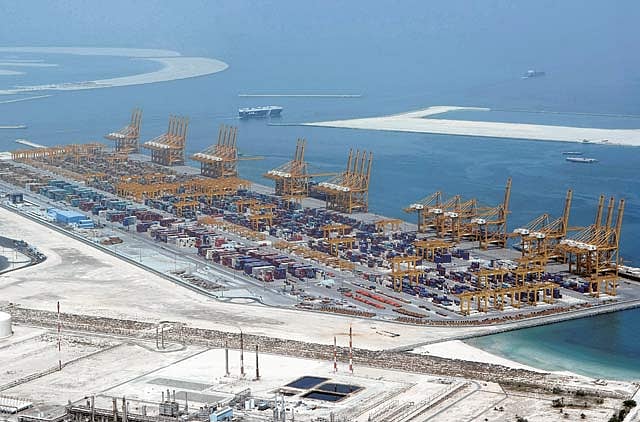
Dubai: The UAE was the world's 13th largest exporter with $235 billion (Dh862.45 billion) or 2 per cent of the world's total merchandise exports in 2010, surpassing major exporting countries such as India, Australia, Brazil and Malaysia, according to the latest World Trade Organisation (WTO) report.
The UAE, the seond biggest Arab economy, also ranked 18th largest importer in the world, having imported $170 billion (Dh623.9 billion) worth of merchandise goods representing 1.4 per cent of the world's total imports, the WTO's annual World Trade Report released on Thursday showed.
This annual WTO ranking considers the European Union a single trade block. However, when the EU is split, the UAE ranks 19th in exports and 25th in imports.
The UAE's exports jumped 27 per cent last year while imports grew 13 per cent, compared to the total value of exports and imports of 2009.
With this, the value of the UAE's total trade rose to $405 billion (Dh1.48 trillion), according to WTO data.
Non-oil trade
However, the country's total non-oil trade grew 14 per cent to Dh754.4 billion last year, compared to Dh660.1 billion in 2009, according to the Federal Customs Authority (FCA) that included Dh485.4 billion worth of imports, Dh83.1 billion worth of exports and Dh185.9 billion worth of re-exports.
The difference of Dh731.95 billion ($200 billion) between the WTO and FCA data (Dh1.48 trillion-Dh754.4 billion) reflects the value of the UAE's hydrocarbon and other trade, including defence purchases.
"Dubai is benefiting from its leading position as a regional hub, with growing links to Asia, and improved competitiveness thanks to the ongoing price correction in the real estate market," International Monetary Fund said last month.
This is echoed by most experts.
"Trade is a major growth area for Dubai," Hamad Bu Amim, Director-General of the Dubai Chamber of Commerce and Industry, said. "Historically, trade and tourism dominated our economy and we are now reinforcing this," he said.
The UAE's average oil production remains at around 2.4 million barrels per day (bpd), according to International Energy Agency data. The WTO report says globally oil prices stabilised at around $78 per barrel in 2010.
This translates into a daily income of $187.2 million in oil receipts per day for the UAE, or $68.328 billion (Dh250.76 billion) in 2010.
However, recent statistics show Abu Dhabi National Oil Company's (Adnoc) official oil selling price reached around $102-$103 per barrel. If the current price persists, the country's oil receipts will increase to about $88 billion.
Infrastructure spending
"Higher oil production and increased infrastructure spending, including through government-related entities (GREs), are the main drivers of growth in Abu Dhabi, though its non-oil growth will continue to slow down partly due to last year's fiscal contraction," according to the IMF. "High oil prices, improved growth prospects in Asia, and low interest rates are contributing to the (UAE's) recovery. Real GDP is projected to continue to grow at 3.3 per cent in 2011."
World merchandise exports were up 22 per cent, rising from $12.5 trillion to $15.2 trillion in a single year, the WTO said, while world exports of commercial services rose 8 per cent from $3.4 trillion to $3.7 trillion.
"The figures show how trade has helped the world escape recession in 2010," WTO Director-General Pascal Lamy said.
"However, the hangover from the financial crisis is still with us. High unemployment in developed economies and sharp belt-tightening in Europe will keep fuelling protectionist pressures.
"WTO members must continue to be vigilant and resist these pressures and to work toward opening markets rather than closing them. ‘Stability' should be the name of the game for 2011".
Nominal merchandise exports of developed economies jumped 16 per cent in 2010 to $8.2 trillion, up from $7.0 trillion in 2009.
"However, because this rate of increase was slower than the world average of 2 per cent the share of developed countries in world merchandise exports fell to 55 per cent, its lowest level ever," it said.
Uncertainty
The Middle East's exports rose 30 per cent to $916 billion (6 per cent of the world total), but imports only increased by 13 per cent to $572 billion (4 per cent of world).
The recent developments pose a certain degree of uneasiness.
"However, recent events in the Middle East and Japan have raised the level of global economic uncertainty and tilted the balance of risk towards the downside," WTO said.
Asia exhibited the fastest real export growth of any region in 2010 with a jump of 23.1 per cent, led by China and Japan, whose shipments to the rest of the world each rose roughly 28 per cent.
China's trade performance is more impressive when one considers that the decline in the country's exports in 2009 was less than half that of Japan (11 per cent compared to 25 per cent).
Sign up for the Daily Briefing
Get the latest news and updates straight to your inbox
Network Links
GN StoreDownload our app
© Al Nisr Publishing LLC 2026. All rights reserved.