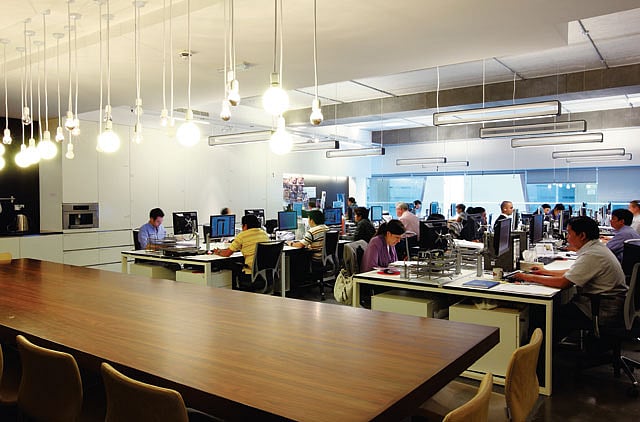
With the market experiencing challenges like never before in recent times, businesses in the UAE have been forced to implement cost-cutting measures to stay afloat. While expansion was the buzzword before the global crisis, the changed conditions have forced firms to be more sensible and realistic. As a result, more companies are now roping in the experts to ensure proper utilisation of office space and energy conservation.
"Since the global economic crisis, organisations understand the need to identify pockets of unused legacy space from the years of expansion as a way to reduce costs and increase energy efficiency across their portfolio. Today there is a genuine need for real estate agility. As a business changes and takes a new direction, the property portfolio must respond to the needs of the business," says Magdy Mekky, vice-president and managing director — Middle East, Johnson Controls, a $34.3 billion company in this specialised area.
But is the task as easy as it sounds? Mekky, for one, realises that while the concept of optimum utilisation of space is increasingly being embraced by organisations across the world, it must also include coming to terms with the needs of employees as the workforce is constantly changing.
According to a study conducted by Johnson Controls, a younger, more dynamic breed of worker is coming up the ranks. "They are technologically sophisticated, highly flexible and mobile, and cite social interaction as important in the workplace. Most rank workplace and workstyle as critical in their choice of employer. To continue to attract, retain and develop new talent, businesses need to understand how their workforce mobilises and how to tap greater productivity from its people resource," says Mekky.
Solutions
For a company that serves 12 million homes and 1 million commercial buildings across 150 countries, workspace solutions are therefore driven by technology in every sense of the term. For instance, this means that today it is possible to anonymously track people's movements to produce a detailed and highly accurate analysis of how the space is used.
A business unit of Johnson Controls, Global WorkPlace Solutions, has developed this technology which it calls The Visible Living Lab, a CoreNet Global award-winning technology. "It is a web-based space management and real-time occupancy tool that uses radio frequency technology and smart cards, the movement of hundreds of occupants is monitored and analysed, in real time, providing in-depth understanding of how users utilise their working environment — be it a meeting room or a desk. Initially, the solution requires energy bills for the last 12 months, built-up area of the facility and occupancy schedule. This analyses the energy footprint in order to evaluate further comparisons with the baseline. The final analysis then helps to target and define the right facility improvement measure to be implemented," says Mekky.
At its Johnson Controls Building Efficiency division, technologies, services and products are developed to enable organisations to get a clear and accurate picture of their facilities. So it is possible to help businesses reduce energy and utility consumption and the associated costs between 15 per cent and 50 per cent. End-users can identify energy intensive applications and the amount being spent on repairs and maintenance building by building on a real-time basis. The company claims that its solutions have reduced carbon dioxide emissions by 13.6 million metric tonnes and generated savings of $7.5 billion since 2000.
Saving money
"A company's property portfolio can be its second highest cost, so they need to really understand how it's used. Space utilisation is often described as ‘Swiss cheese' with pockets of wastage within a property portfolio waiting to be discovered. Experts such as Johnson Controls help clients develop a clear understanding of how their office space is being underutilised. If you're using too much office space, there may be opportunities to renegotiate a lease, sublet unused space, or even consolidate to vacate premises.
"Alongside lease and property costs, energy spend is often too high, as businesses are funding the heating, lighting and cooling of unused space or empty desks. With governments and private enterprises across the Middle East and throughout the world embracing CO2 reduction targets, there has never been a better time for organisations to understand how their property portfolio is being used," says Mekky. The cost for the technology varies from project to project depending on the size, age and application of the facility. However, Mekky says, the benefits of embracing space optimisation, such as reduced property costs and energy usage, far outweigh the cost of consultancy fees.
Regional markets
Johnson Controls has already made its mark in the GCC markets. In Dubai, the company has developed a sophisticated security management system for the Burj Khalifa while it also has a number of energy-efficiency projects in the region, including the Bahrain Bay Project, the Pearl Development in Qatar, and the Kingdom Tower and Jebel Al Qala in Saudi Arabia. "Potential clients are increasingly seeing the need to understand how their property portfolio is being utilised. The benefits, such as reduced costs, a more flexible space responsive to the needs of the business, and a reduction in energy spend make space optimisation consultancy an extremely attractive option," says Mekky, adding that despite space optimisation being a relatively new concept, the company has received positive responses from Middle East-based organisations and from multinational companies operating in the region.
"Organisations gain a competitive advantage by making their property work for them including reduced property costs, greater flexibility to respond to changing economic and market conditions, and reduced energy bills," says Mekky, adding the market in the Middle East, especially GCC countries, is ready for space optimisation services.
"Global economic uncertainty means organisations need to be more flexible in their business and respond quickly to changes. There is an increasing need to reduce CO2 emissions also, requiring a variety of initiatives to meet international and national targets. Space optimisation consultancy can help contribute to achieving both," he concludes.
Homeowner view
- As well as office solutions, Johnson Controls has also developed energy-saving technologies for homes.
Sign up for the Daily Briefing
Get the latest news and updates straight to your inbox
Network Links
GN StoreDownload our app
© Al Nisr Publishing LLC 2026. All rights reserved.