PRYPCO rolls out Dubai marketplace after nod for property stakes trading
Move comes a day after Dubai allows secondary trading of tokenised property in new phase
Dubai: A regulated marketplace allowing the resale of tokenised property stakes will go live in Dubai on February 20, opening secondary trading for fractional real estate ownership under the emirate’s tokenisation framework. The move introduces live buy-and-sell functionality after an initial pilot phase tested tokenised ownership on title deeds.
The marketplace will operate through the PRYPCO Mint App, enabling investors to buy, sell and transfer digital property stakes within a regulated environment. Trading will be available around the clock, subject to compliance requirements and investor eligibility rules.
The launch marks a shift from testing to execution, with secondary trading now permitted as part of the next phase of Dubai’s real estate tokenisation initiative, allowing authorities to observe how fractional property assets behave under live market conditions.
Platform starts live trading
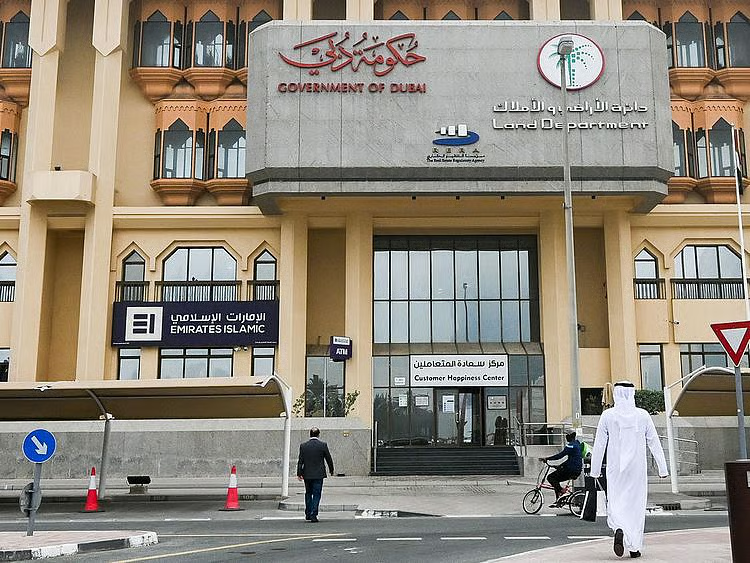
Dubai Land Department (DLD) recently launched MENA’s first tokenised real estate project on the PRYPCO Mint platform, built on Ctrl Alt’s Web3 infrastructure and backed by the Dubai Future Foundation.
The marketplace is operated by PRYPCO Mint, which completed an earlier pilot phase focused on validating the legal, regulatory and technical foundations needed to tokenise real estate directly on property title deeds.
That pilot attracted investors from more than 50 nationalities and facilitated over Dh18.5 million in tokenised property investments, with one offering fully funded in one minute and 58 seconds, according to platform data.
Liquidity is now key
With resale now enabled, the marketplace addresses one of the most persistent challenges in real estate investment: limited liquidity. Fractional property stakes can now be transferred without selling an entire asset, introducing potential exit routes for investors.
The secondary market is structured to allow regulators to track pricing, transaction volumes and investor behaviour in real time. Authorities have positioned the rollout as a controlled test rather than a broad market expansion.
Insights from this phase are expected to inform whether and how tokenised property trading is expanded across additional assets or investor categories in future stages.
Regulatory oversight
The marketplace has been developed in partnership with the Dubai Land Department and operates under licensing and supervision from the Virtual Assets Regulatory Authority (VARA). All transactions are subject to regulatory controls, identity verification and compliance safeguards.
Tokenisation divides a single property into digital tokens, each representing a proportional economic interest linked to the underlying title deed. Ownership of the physical asset remains governed by existing real estate laws.
Trading activity is conducted entirely through approved digital channels, with oversight designed to preserve market integrity as blockchain-based ownership models are tested at scale.
Participation restricted
Access to the marketplace is currently limited to UAE residents aged 18 and above who hold a valid Emirates ID. This maintains alignment with local property ownership rules and regulatory requirements.
While fractional ownership lowers the capital barrier to entry, eligibility restrictions mean participation remains tightly defined during the early stages of secondary trading.
Regulators have indicated that any future expansion of access would depend on performance data, market stability and compliance outcomes observed during this phase.
Infrastructure layer
Rather than replacing traditional property transactions, the marketplace functions as an additional infrastructure layer, integrating land registration, digital assets and transaction governance.
Supporters argue that standardised digital processes could improve transparency and efficiency, while market observers continue to assess how valuation, risk disclosure and investor protections evolve as volumes increase.
The current phase does not introduce new property rights but provides a regulated mechanism for transferring economic interests in real estate.
Testing ground for future
The opening of secondary trading represents a key milestone in Dubai’s real estate innovation roadmap, allowing authorities to evaluate tokenised ownership under live conditions.
Performance during this phase is expected to shape future policy decisions, including whether tokenisation is extended to a broader range of properties or investor profiles.
For now, the focus remains on measured execution, regulatory oversight and data-driven assessment as Dubai tests how tokenised real estate functions beyond the pilot stage.

Sign up for the Daily Briefing
Get the latest news and updates straight to your inbox
Network Links
GN StoreDownload our app
© Al Nisr Publishing LLC 2026. All rights reserved.