Philippines to build its first state-owned oil reserve as Mid-East war rattles energy markets
Bataan oil storage facility to bolster energy security by 2027
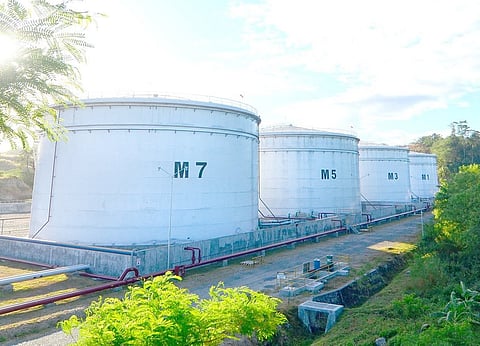
MANILA: The Philippines is moving to set up its first government-owned oil storage facility in Bataan by December 2027.
Energy Secretary Sharon Garin said the Philippine National Oil Corp. (PNOC) has identified its Bataan property as the site, with procurement expected to begin ahead of the first tank's targeted completion.
The facility is meant to give the state direct control over emergency supplies.
It would complement existing privately-owned storage in the country. Officials describe a stockpile as a kind of emergency fund, held in oil rather than cash, to buffer against geopolitical conflicts, natural disasters and extreme price swings.
The plan starts small.
Garin said the first tank is on schedule and the complex would eventually hold one million barrels.
An estimated ₱5 billion ($78.5 million) would be needed to build a system carrying 500,000 to one million barrels.
The government is also seeking investors to co-invest with PNOC in expanding the Bataan facility.
The government is also looking beyond its borders. It is exploring partnerships with foreign companies to turn the country into a regional petroleum storage hub, and may allow foreign firms and suppliers to store oil in the Philippines.
Manila is discussing storage arrangements with Saudi Arabia, Russia, the United States, Japan, Kuwait, the United Arab Emirates and Australia.
The push to build reserves follows supply disruptions triggered by the US-Israeli strikes on Iran in February and is meant to cushion the economy against sudden price surges.
The country of 114 million imports almost all of its energy.
For now, buffers are healthier than the minimum.
Fuel stocks cover 55 days of consumption, well above the mandated 15-day floor, though the government itself holds just one million barrels, in privately-owned facilities.
Garin said the aim is to scale up over the years toward 60 days, split equally between crude and refined fuels.
The Philippines has long relied on private companies to hold oil inventories.
The war in the Gulf, where much of Asia's crude passes through the Strait of Hormuz, has shown how exposed import-dependent economies are to supply shocks.
A state-owned reserve lets the government release fuel in a crisis rather than depend on commercial decisions.
State-owned oil storage tank
The Philippines will build its first government-owned oil storage tank in Bataan on a state-owned property by December 2027, starting at one million barrels, while courting foreign investors and storage partners to expand it.
The country imports nearly all its energy.
A state-held reserve is aimed to soften fuel price spikes and shortages, protecting transport, power and household budgets when global supply is disrupted.
PNOC's procurement process for the first tank is expected to begin.
The Energy Department will keep seeking co-investors and finalize storage talks with partner countries.
Energy security is becoming a national priority across Asia. Singapore, Japan and Gulf producers are all rethinking stockpiles, and Manila wants a seat as a regional storage hub.
Currently, the Philippine Coastal Storage and Pipeline (PCSPC) is the largest fuel storage facility in the country, operating the petroleum storage and pipeline systems of the former Subic Bay Naval Base and Clark Air Force Base.


