File photo of Sheraa
UAE startup race moves beyond ‘raise quicker, grow faster’, Sheraa says
Sheraa says the focus is shifting from fast fundraising to stronger, lasting businesses
Last updated:
4 MIN READ
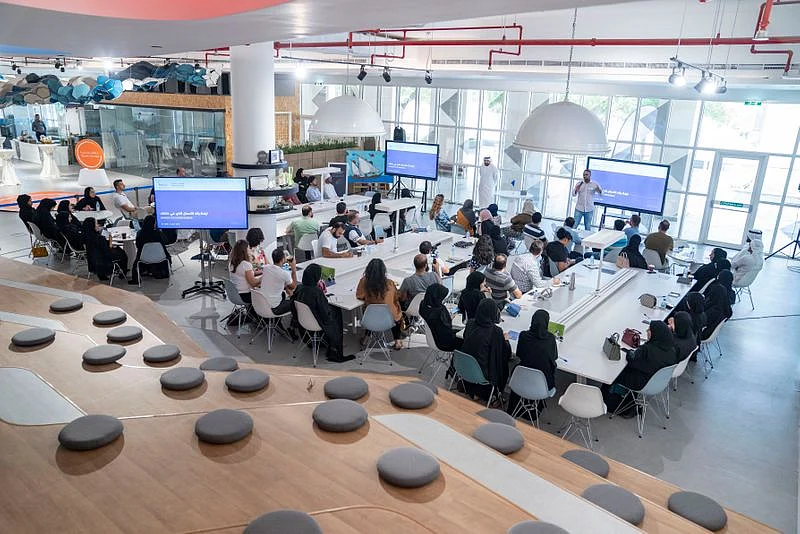
The Sheraa startup programme focuses on fie-tuning Sharjah's credentials as a place to do business.
Gulf News Archive
Sharjah: In the UAE, startup founders are being pushed to look beyond fast fundraising and rapid growth, with more attention now on whether customers return, whether the numbers add up and whether the business can last.
“Startups used to be all about speed. Raise quicker, grow faster. That was the measure of success. Now it’s deeper than that. We’ve matured as an ecosystem,” said Tayeb Hassan, Community Growth Manager at Sheraa and co-founder of Nafsi Health.
Founders are now asking tougher questions about why customers return, how their economics work and what values sit behind their businesses, Hassan said, describing the shift as part of a wider maturation of the entrepreneurial ecosystem in Sharjah and across the UAE.
That change is also reshaping the type of support entrepreneurs need.
Too much information, too little clarity
Access to information is no longer the constraint it once was. AI tools have made it possible for entrepreneurs to learn new skills and find answers almost immediately, but Hassan said the volume of information available is creating another problem.
Founders increasingly need help deciding what deserves their attention at a particular stage of the business.
Get updated faster and for FREE: Download the Gulf News app now - simply click here.
“What is the most important thing I can do for my startup right now? What is the most relevant, highest-leverage task I can do to set myself up for success?” he said.
Sheraa’s role, Hassan said, is increasingly centred on helping founders answer that question while connecting them with people and opportunities that can move their businesses forward.
He described access as one of Sharjah’s biggest advantages for entrepreneurs, given the proximity of universities, investors, corporates and other founders within the emirate.
“Entrepreneurship is usually an isolating journey. Founders get lonely,” Hassan said. “The biggest thing that Sharjah offers founders is access.”
Connecting founders with investors and customers
Sheraa runs initiatives aimed at entrepreneurs at different stages of their businesses.
Its year-round membership programme provides investor and commercial introductions alongside networking and other forms of support tailored to where a founder is in their journey.
The Access Sharjah Challenge connects startups with procurement opportunities at larger organisations, giving young businesses another route to potential customers and commercial contracts.
Hassan described Sheraa as the “glue” connecting investors, universities, corporates and founders who may otherwise rarely find themselves in the same room.
“Sheraa’s role is to shorten that distance for founders, between founders and their next opportunity,” he said.
The Sharjah Entrepreneurship Festival takes that approach to a larger scale by bringing founders, investors, speakers and established entrepreneurs together.
Sheraa’s membership also spans people who are only beginning to explore entrepreneurship through to founders who have operated companies for years, giving participants an opportunity to learn from businesses at different stages.
Support when businesses were hit by disruption
The ecosystem was tested during recent regional disruption, when some businesses saw revenues disappear while others faced products stuck at ports, storage charges and wider supply chain problems.
Hassan said many of the companies affected had otherwise been stable businesses that had done everything expected of them before conditions changed abruptly.
Sheraa responded through its Entrepreneurship Resilience Fund, bringing together monetary grants, marketing support and exposure opportunities intended to help affected businesses regain stability.
“We thought it was almost a duty for us to step up and provide them with the support they needed at that time, as quickly as we could,” Hassan said.
More than 22 partners became involved in the initiative.
The disruption also showed the role local businesses could play when international connectivity and supply chains were affected, with UAE-based founders and manufacturers stepping in to address gaps.
Where Sharjah sees growth
Manufacturing is among the sectors where Hassan sees further opportunity in Sharjah, alongside healthcare, agriculture and sustainability.
File photo of Sharjah Entrepreneurship Festival.
Technology and AI are also expected to play an increasingly important role across industries, with Hassan saying they should be embedded across sectors instead of treated purely as standalone areas.
Local manufacturing became particularly important during regional disruption, when businesses in Sharjah helped fill supply chain gaps.
Agriculture is another area Hassan highlighted, alongside sustainability, which he said has long been a focus for Sheraa.
Sharjah wants to shorten the distance to opportunity
Hassan said Sharjah’s proposition for founders ultimately comes back to access and community.
Entrepreneurs often make location decisions based on cost and other practical considerations, but he said the longer-term question is where a company can continue to build and scale.
“Community equals continuity, equals feedback, equals growth,” Hassan said.
The number is 1,000 entrepreneurs, but really it’s all about that feedback loop of founders taking and then giving once they’ve reached a state of maturity
Tayeb Hassan Community Growth Manager at Sheraa and co-founder of Nafsi Health
The support can become particularly important when founders hit difficult periods and need guidance from people who have already faced similar decisions.
Sheraa is working towards a 2030 vision that includes supporting 1,000 entrepreneurs.
Hassan said the longer-term aim is to create businesses that grow within the ecosystem and later return as investors, mentors, or supporters of the next generation.
Nivetha Dayanand is Assistant Business Editor at Gulf News, covering aviation, financial markets and commodities. A business and financial journalist with a strong interest in multimedia storytelling, she regularly takes complex financial and economic subjects beyond the written word, producing explainer videos that make them easier for a wider audience to understand. Nivetha has interviewed senior policymakers, business leaders and global financial figures both on and off camera. Her past guests include UAE Minister of Economy and Tourism Abdulla bin Touq Al Marri, Khaled bin Alwaleed Al Saud, a member of the House of Saud and the founder and CEO of KBW Ventures, Jihad Azour, Director of the Middle East and Central Asia Department at the International Monetary Fund and Indian ministers Hardeep Singh Puri and N. Chandrababu Naidu. She has also hosted and moderated panels, conferences and awards shows, bringing her newsroom experience to live conversations on business, finance and the economy. An Erasmus Mundus journalism alum, Nivetha is drawn to stories that affect people directly and to reporting that gives a platform to voices that might otherwise go unheard. She was among the first journalists to speak to Petrofac employees in the UAE about unpaid salaries, broke the news of the planned demolition of Dubai’s well-known “Toyota Building”, and helped set the record straight on widely circulated claims that a giant replica of the Moon was coming to Dubai. More recently, her exclusive interview with EDGE Group CEO Hamad Al Marar revealed how the UAE-based defence group deployed its systems along the country’s shore border and established a geofence around the UAE within 48 hours of the February 28 escalation. Prior to joining Gulf News, Nivetha worked at ITP Media, where she helped launch Finance Middle East, a new publication covering the region’s financial sector. Her role spanned reporting and editing, video production, interviews and events. Across print, digital, and video, she focuses on finding the people behind business stories and explaining why those stories matter to the audience reading or watching them.
Sign up for the Daily Briefing
Get the latest news and updates straight to your inbox
Network Links
GN StoreAbout Gulf NewsTerms & ConditionsReach by GNSitemapContact usPrivacy PolicyGN FocusHave your sayWork with usAdvertise with usGulf News epaperPrinting Services
Download our app
© Al Nisr Publishing LLC 2026. All rights reserved.