Major move: UAE joins US-led Pax Silica alliance to secure AI, chip supply chains
How Abu Dhabi’s entry into Washington’s new AI coalition reshapes tech diplomacy
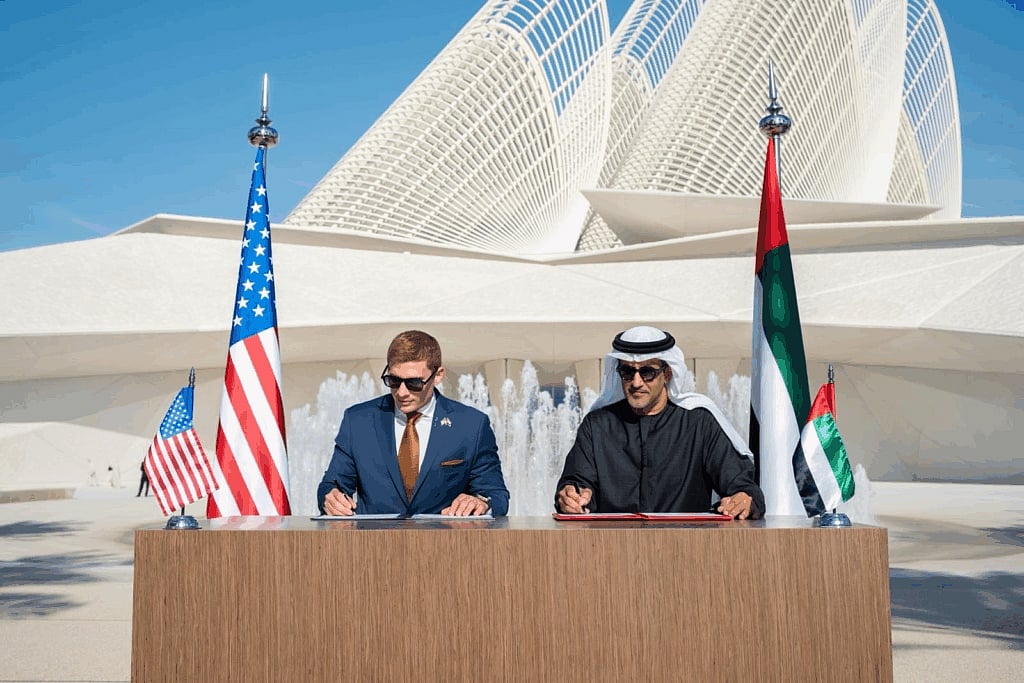
Dubai: The UAE has joined Pax Silica, a US-led initiative aimed at securing artificial intelligence and semiconductor supply chains, as Washington moves to formalise a small bloc of partners around the critical inputs powering the AI economy. The UAE became the ninth signatory this week, joining a group that includes Australia, Britain, Israel, Japan, Qatar, Singapore and South Korea. India is expected to join the pact next month, according to the US State Department.
Pax Silica is the State Department’s flagship effort on AI and supply chain security and a central pillar of the Trump administration’s economic statecraft strategy. The programme seeks to reduce dependence on rival nations and tighten cooperation among countries the United States considers trusted partners. U.S. officials say the initiative reflects a shift toward treating technology supply chains as strategic assets, alongside energy and minerals.
“The UAE signed the Pax Silica Declaration, marking a historic milestone in the region’s economic integration,” the State Department said in a media note. It added that the UAE’s role in energy, investment and technological development made it “an indispensable partner” and said Abu Dhabi’s commitment to building a secure AI ecosystem showed a clear focus on economic diversification.
Signing and scope
Helberg said the two countries had agreed to pursue “multilayered partnerships” to strengthen supply chain security, address coercive dependencies and limit single points of failure across critical technologies. He said the partners would explore joint projects across connectivity and edge infrastructure such as 6G, as well as compute, data centres, advanced manufacturing, logistics, mineral refining and energy systems.
US officials describe Pax Silica as an economic security coalition built for the AI age. It is the first time countries are formally organising cooperation around compute capacity, silicon, critical minerals and energy as shared strategic assets. Washington says the framework is designed to support trusted technology ecosystems and unlock what it calls the economic potential of the new AI cycle.
Helberg said he had invited the UAE, on behalf of President Donald Trump and Secretary of State Marco Rubio, to attend a ministerial-level meeting on critical minerals in Washington next month. He said the meeting would include a “large group” of countries. Critical minerals such as rare earths and lithium are seen by U.S. policymakers as bottlenecks for advanced manufacturing and data-centre expansion.
UAE’s tech push
The UAE’s entry comes as it spends billions of dollars to position itself as a global AI hub. Abu Dhabi is seeking to leverage its close ties with Washington to secure access to U.S. technology, including some of the world’s most advanced semiconductors. The country has also signed a multibillion-dollar deal to build one of the world’s largest data-centre hubs in Abu Dhabi using U.S. technology.
Asked whether Trump’s threat to impose 25% tariffs on countries that trade with Iran, a group that includes the UAE, could affect bilateral ties, Helberg said he was “very confident in the strength and depth of America’s relationship with the UAE.” The comments underline Washington’s effort to ringfence technology cooperation from wider geopolitical disputes. U.S. officials have repeatedly framed Pax Silica as a long-term strategic project rather than a short-term trade arrangement.
While Qatar is a signatory, Saudi Arabia is not part of Pax Silica despite its own ambitions to build a global AI industry. Helberg said he held an initial round of discussions with Riyadh this week but noted that the United States and Saudi Arabia had already negotiated a substantial bilateral AI deal. He did not say whether Washington planned to invite Saudi Arabia to join the broader pact.
Who's in the group
The alliance traces its origins to an inaugural Pax Silica summit attended by Australia, Japan, Israel, the Netherlands, Singapore, South Korea, Britain and the UAE, with Canada, the European Union, the OECD and Taiwan participating as guests. Seven countries — Australia, Israel, Japan, Singapore, South Korea, Britain and Qatar — signed the original declaration, giving the Middle East two representatives after the UAE’s accession. U.S. officials have not said whether they intend to expand the group beyond its current roster.
The name Pax Silica draws on the Latin “pax,” meaning peace, echoing phrases such as Pax Romana and Pax Americana used to describe long periods of stability anchored by dominant powers. “Silica” refers to the compound refined into silicon, the core material used in computer chips. U.S. officials say the branding reflects an effort to link geopolitical stability with control over the inputs that underpin AI systems.
Washington says Pax Silica aims to unite countries home to the world’s most advanced technology companies and to ensure reliable supply chains that support economic security. The State Department highlights what it calls historic growth in demand for energy, critical minerals, advanced manufacturing, technological hardware and new infrastructure tied to AI. The framework is also intended to make it easier for members to coordinate access to minerals and build out a wider supply-chain ecosystem.
From oil to compute
For the UAE, the pact fits into a broader push to diversify away from hydrocarbons and anchor future growth in advanced technologies. The country has cultivated partnerships and investments involving companies such as Microsoft, Nvidia and OpenAI and has backed domestic AI research through the Mohamed bin Zayed University of Artificial Intelligence, founded in 2019. Officials have said the expansion of data centres and compute infrastructure will require sustained, large-scale capital investment.
Last month, UAE Minister of State for AI Omar Al Olama said the country plans to produce 60 trillion AI tokens through Stargate, a five-gigawatt data-centre project backed by major global technology firms. The project is part of Abu Dhabi’s bid to become a global centre for AI development and deployment. Analysts say initiatives such as Pax Silica could shape where future investment in chips, compute and energy-intensive infrastructure is concentrated.
The formation of Pax Silica signals a broader reordering of economic diplomacy around technology inputs rather than finished products. By drawing a tight circle of partners around semiconductors, minerals and compute, the United States is embedding AI supply chains into its alliance system. For members such as the UAE, participation offers deeper integration into those networks as the global competition over AI infrastructure intensifies.

Sign up for the Daily Briefing
Get the latest news and updates straight to your inbox
Network Links
GN StoreDownload our app
© Al Nisr Publishing LLC 2026. All rights reserved.