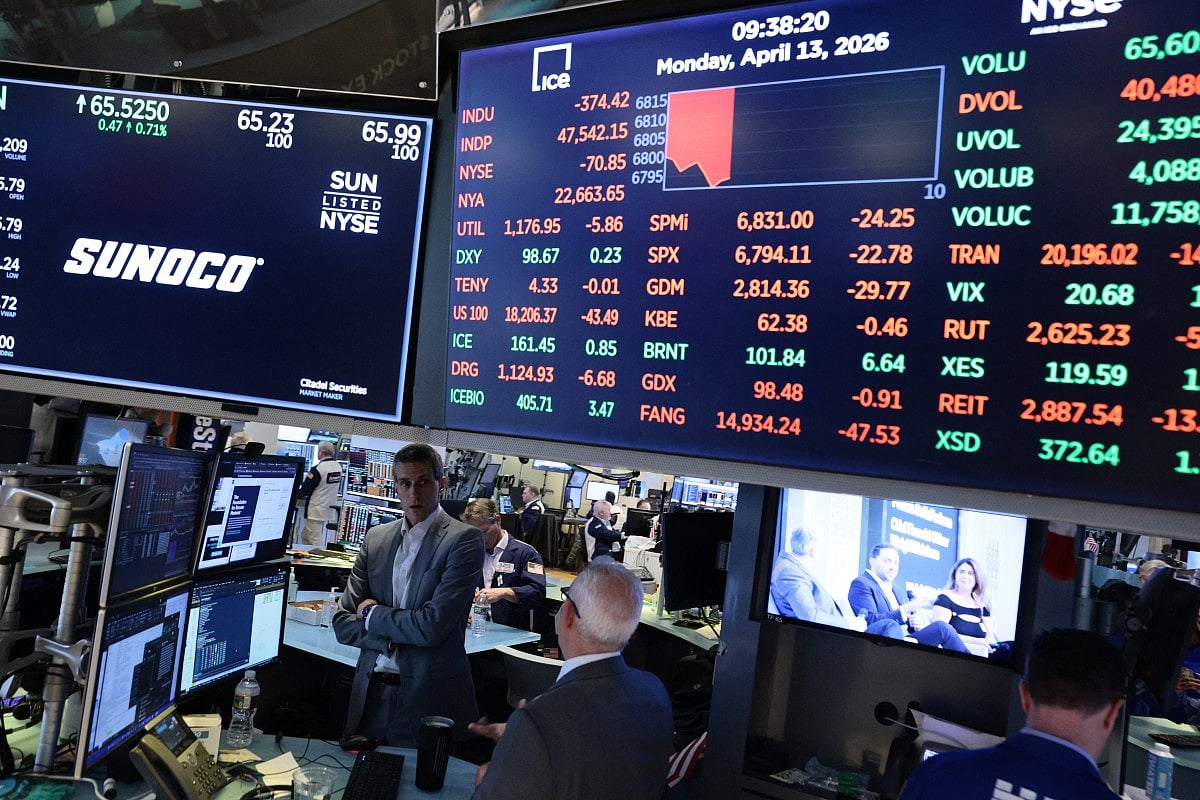
Dubai: Global markets moved back into risk-on mode on Tuesday as investors returned to technology stocks, oil prices fell and gold struggled to recover after Israel and Iran signalled a pause in direct attacks.
Nasdaq 100 futures rose 0.7%, pointing to a second day of gains for technology shares after last week’s pullback, while S&P 500 contracts advanced 0.4%. The recovery was strongest in Asia, where South Korea’s chip-heavy Kospi index jumped 8.2%, making it the top performer among major regional benchmarks.
Get updated faster and for FREE: Download the Gulf News app now - simply click here.
Europe also opened firmer, with the Stoxx 600 up 0.5%, as traders bought back into the artificial-intelligence trade and reassessed geopolitical risk after a volatile stretch for oil, gold and equities.
Oil drops as risk premium fades
The shift in sentiment was most evident in energy markets, where Brent crude fell 2% toward $92 a barrel after Israel and Iran agreed to halt attacks against each other. President Donald Trump also renewed claims that a US peace deal with Tehran was close, adding to expectations that the immediate risk of a wider regional conflict had eased.
The pullback in oil helped calm inflation concerns, since a sustained rise in crude prices would have raised the risk of higher fuel costs, tighter central bank policy and renewed pressure on consumer spending.
Treasuries also gained modestly, with the US 10-year yield slipping one basis point to 4.55% as traders reduced bets on further US interest-rate hikes.
Also Read
Dubai gold prices hold at Dh547.5 as global rates dip amid Iran conflict fears Dubai gold prices jump again as war tensions keep global markets on edgeGold on edge: Market searches for direction as geopolitical risks collide with rising yieldsUAE gold prices slip from June peak, but is now the right time to buy?AI trade gets a second wind
The move back into technology suggests investors are still prepared to buy dips in the AI trade, even after a brief interruption to the rally that helped push equities to record highs.
OpenAI’s confidential filing for an initial public offering added to the sense that investor demand for AI-linked companies remains strong, while Amazon.com Inc.’s record Canadian dollar bond sale showed that major technology firms continue to attract deep pools of capital.
The latest gains point to a market that is becoming more selective but has not abandoned the broader growth story around artificial intelligence, cloud computing and chip demand.
Gold loses support from Middle East risk
Gold remained under pressure as investors reacted to signs of de-escalation in the Middle East. The metal traded near $4,300 an ounce, with fading geopolitical risk limiting its ability to stage a stronger recovery.
Ahmad Assiri, Research Strategist at Pepperstone, said gold prices had retreated toward the $4,300 per ounce level as investors reacted to easing tensions between Israel and Iran.
“Overnight developments point to a modest cooling in tensions between Israel and Iran after both sides signaled a halt to direct military exchanges following efforts led by US,” Assiri said.
He said Israel had indicated that it would refrain from launching additional strikes on Iran for now, while Tehran declared its latest military operation concluded.
“The headlines suggest that markets may be witnessing the release of accumulated tensions, rather than the beginning of a new episode of escalation many had feared,” Assiri said.
That change has reduced demand for traditional safe-haven assets, even as traders remain alert to any fresh military action involving Lebanon, shipping routes or energy infrastructure.
Markets still watching for fresh escalation
Oil’s decline followed an earlier rally, when Brent rose as much as 5% at the start of the week on fears that the conflict could expand and threaten regional supply lines.
Assiri said the benchmark had since surrendered most of those gains after de-escalation headlines emerged.
“The price action suggests that a significant portion of the geopolitical risk premium has faded, although markets remain sensitive to developments that could extend supply disruptions or keep energy security concerns elevated over a longer horizon,” he said.
Gold’s weakness tells a similar story. The metal has tested the $4,300 level and is broadly unchanged for the year, leaving investor positioning closely tied to the geopolitical outlook.
“Gold has also remained under pressure, testing the $4,300 level and leaving the metal broadly unchanged on a year-to-date basis,” Assiri said. “Its recent price action highlights how closely investor positioning has become tied to the evolving geopolitical narrative, with fading tensions continuing to weigh on sentiment toward the precious metal.”
- With inputs from Bloomberg.

Sign up for the Daily Briefing
Get the latest news and updates straight to your inbox
Network Links
GN StoreDownload our app
© Al Nisr Publishing LLC 2026. All rights reserved.