Europe eyes contingency plans
Treasury officials from members reflect on possible scenarios if greece exits
Brussels : Eurozone countries admitted yesterday they are examining likely costs and possible complications arising from a potential exit for Greece, but maintain contingency planning is only prudent common sense.
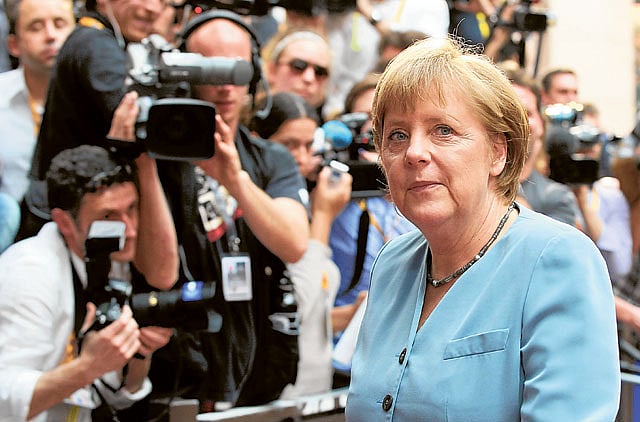
German Chancellor Angela Merkel said that Eur-ope is a long way from realising full fiscal union. The fiscal pact, signed in March by 25 of the European Union's 27 leaders and now being ratified, "is a first, small step toward a politically more binding fiscal union," Merkel said, according to a transcript. "Let me say very clearly: a first, small step."
"When you see the difficulties we're already experiencing trying to implement it, you can appreciate how far off a true fiscal union remains," she said.
Treasury officials from the other 16 Eurozone member states were told this week to "reflect" on what an exit would mean for their economies in preparation for eventual "coordination concerning what each must do on a European level," a diplomat from one Eurozone country told AFP.
He insisted that this was not a political message to Greece, but that it was a "normal" thing to do.
"It does not mean that we think the situation will get that far," he said, adding that "you would have said we were dreaming" otherwise.
"This is not about suddenly being told we have to prepare [for exit]," a second diplomat said.
"Treasury officials were already scratching their heads a year ago looking at different scenarios that could unfold," added a third.
"Frankly, it would be dereliction of duty if they hadn't done this," he said.
European Union president Herman Van Rompuy announced on Twitter that he met with caretaker Greek premier Panagiotis Pikrammenos in the hours leading up to an EU summit in Brussels at which the latter was to brief leaders on the lie of the land in Athens ahead of a decisive June 17 general election.
Greece's four biggest banks will receive ¤18 billion of rescue funds by May 28 to help recapitalise them, a Greek banking source told.
The National Bank of Greece (NBG), Alpha bank, Eurobank and Piraeus bank will get the funds "in the form of bonds between Friday and Monday, following a decision taken by the Bank of Greece," said the official, who asked not to be named. Based on a first estimate, the NBG should get about ¤6.9 billion, Piraeus bank about ¤5.0 billion, Euro-bank ¤4.2 billion and Alpha ¤1.9 billion, the official said.
These sums are part of a ¤25 billion envelope created to help Greece's lenders survive the severe writedown on Greek sovereign debt that was a crucial element of a bigger international bailout package for Athens approved in March.
These funds were transferred from the European Financial Stability Fund (EFSF) to the Hellenic Financial Stability Fund, a Greek body that is now charged with releasing them to Greek banks.
As part of the bank bailout package, Greece in April completed a huge exchange of government debt held by private creditors writing off ¤107 billion of debt.
Sign up for the Daily Briefing
Get the latest news and updates straight to your inbox
Network Links
GN StoreDownload our app
© Al Nisr Publishing LLC 2026. All rights reserved.