Flaring of gas from the Noble Viking drill ship during the Camago-3 well blowback as part of the Malampaya Phase 4 project.
EXPLAINER
How new Philippine gas discoveries boost energy security — first gas to flow before end-2026: report
Phase 4 discoveries offer breathing room as Philippines reshapes its power mix
Last updated:
5 MIN READ
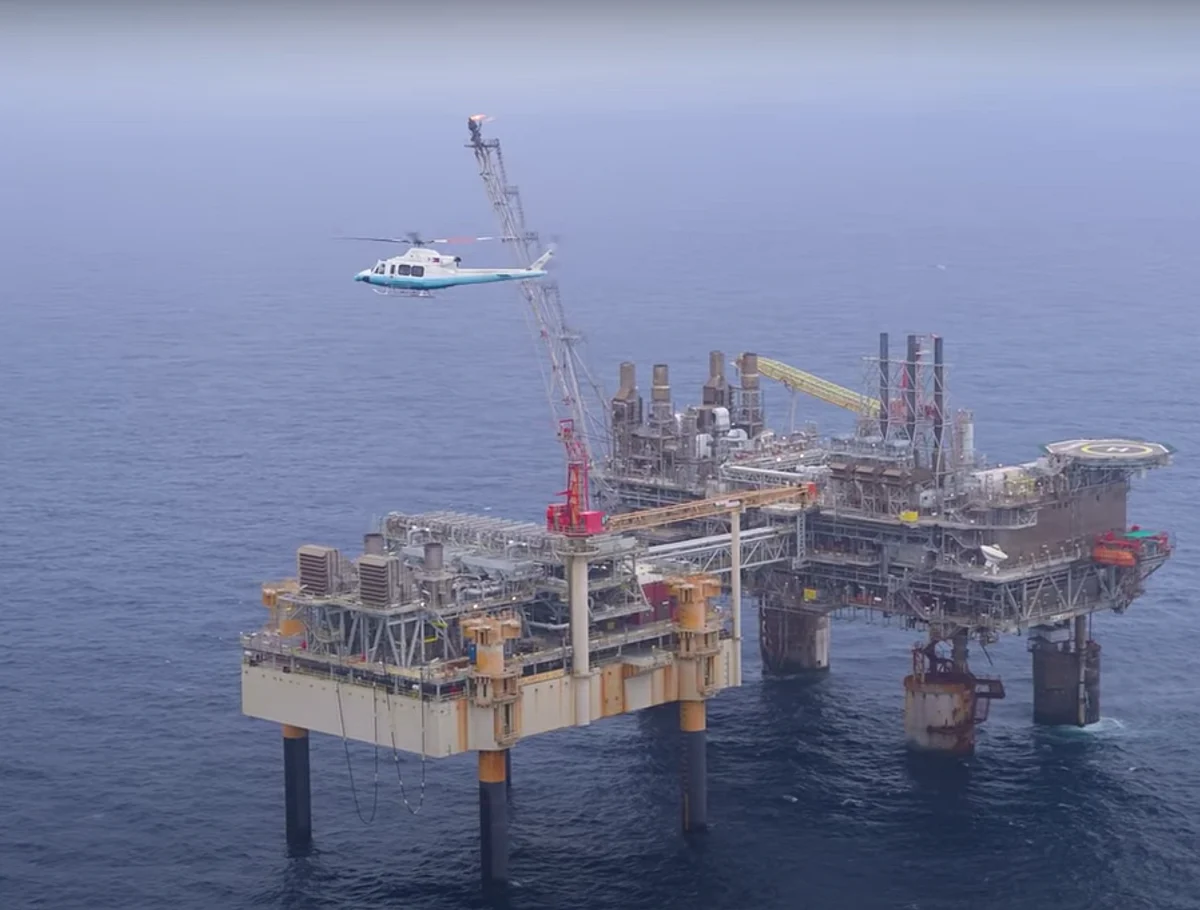
A presidential fly-by on the existing Malampaya oil and gas platform. New wells are being drilled under Service Contract 38 (SC 38).
Manila: The Philippines is entering a potentially important new phase in its search for energy security.
This comes after major natural gas reserves were confirmed near the long-producing Malampaya field off Palawan island group west of Manila.
Philippine President Ferdinand Marcos Jr has describing the reserves as a "national treasure."
The discoveries, part of the Malampaya Phase 4 project, could extend the life of the country's main domestic natural gas source, reduce its exposure to imported fuel.
More importantly, they give Manila greater flexibility as global energy markets become increasingly volatile, according to the presidential palace.
Two wells — Malampaya East 1 (ME1) and Camago 3 — have produced significant results, with combined estimated reserves of about 222 billion cubic feet of natural gas.
The new resources are particularly important because production from Malampaya's original fields has been declining, forcing the Philippines to rely increasingly on imported liquefied natural gas.
Get it: Fast, verified news for FREE ... download the Gulf News app — simply click here
To put the discoveries in perspective, the existing Malampaya gas well has supplied fuel to power plants serving Luzon for more than two decades.
As its original reserves declined, concerns grew that the country would become increasingly dependent on imported energy.
The renewed exploration campaign under Service Contract 38 changed that trajectory.
Malampaya East 1 (ME1) was announced by the presidential palace in January 2026 as the country's first significant natural gas discovery in more than a decade.
Prime Energy, operator of Service Contract No. 38 (SC 38) has announced that it is on track to deliver first gas from the Malampaya Phase 4 (MP4) development by the fourth quarter of 2026. Initial estimates put the Malampaya East-1 reservoir at about 98 billion cubic feet (bcf) of gas in place. The Camago-3 well flowed at rates of up to 60 million standard cubic feet of gas per day (mmscf/d), a substantial addition to Malampaya’s remaining gas resources, as per the Department of Energy.
Initial estimates put the reservoir at about 98 billion cubic feet of gas in place, while testing indicated strong production potential.
A number of prospective geological formations across the length and breadth of the Philippines has proven fossil fuel deposits. Why are they not being drilled? They are. But the number of wells is few and far between. Photo show a presidential fly-by by on the ongoing Malampaya Phase IV Drilling Campaign by SC 38 with Noble Viking drill ship.
The subsequent success of Kamago 3 significantly increased the potential value of the project.
Philippine authorities now estimate the two discoveries at roughly 222 billion cubic feet, enough, according to government estimates, to extend Malampaya's productive life to around 2034.
The government has also estimated that the additional resources could support more than 31 billion kilowatt-hours of electricity.
Strategic value
That extension could prove strategically valuable.
Rather than facing an abrupt decline in its principal domestic gas source, the Philippines gains additional time to expand renewable energy, strengthen its electricity grid, explore other domestic resources and determine how much imported gas it will need in the future.
The discovery also has an economic dimension.
Imported energy exposes the Philippines to international fuel prices, shipping costs, currency movements and disruptions along global supply routes.
A hedge against global energy shocks
Government figures cited in the source indicate that imported energy accounted for about 52% of the country's total primary energy supply in 2025. Natural gas has followed a similar pattern, with imports supplying roughly 55% of the country's gas while Malampaya provided about 45%.
More domestic gas could therefore reduce the country's exposure to some external shocks.
New gem: Flaring from the drill ship Noble Viking to confirm the new gas find at Malampaya East-1, located 5km east of the existing Malampaya Field.
Would it help solve the high electricity rates in the Philippine?
The US factor
The discoveries also come against a changing Asian energy landscape in which the United States has become a major liquefied natural gas supplier.
The Philippines has imported LNG from the United States as it developed infrastructure capable of receiving overseas supplies. That relationship is likely to remain relevant even if domestic production rises.
But increased Philippine gas production should not be interpreted as evidence that American companies are taking control of the new reserves.
The Malampaya Phase 4 project is being developed under an existing Philippine service contract and operated by a consortium that includes Prime Energy and Philippine National Oil Company (PNOC) partners, according to the source material.
The United States' role is better understood in terms of its position as an energy supplier, potential investor and strategic treaty ally.
For Washington and Manila, energy is therefore another component of a broader relationship that encompasses defense, trade and infrastructure.
It would be misleading to portray the discoveries as an immediate cure for high electricity prices.
The cost of electricity depends on power-generation contracts, transmission infrastructure, taxes, fuel costs, supply and demand, among other factors.
Domestic gas can reduce some import-related costs, but it may not automatically translate into cheaper electricity for consumers, say energy industry experts.
The immediate strategic gain is optionality.
The Philippines now has additional domestic fuel available while it continues to diversify its energy mix.
Here's why Palawan matters
The geographic location adds another layer of strategic significance.
Malampaya lies offshore Palawan, close to some of Southeast Asia's most strategically important waters.
The new wells are within the established Malampaya contract area and are not themselves evidence of a confrontation. But their location illustrates why offshore energy resources increasingly matter to national strategy.
For a country heavily dependent on imported fuel, domestic offshore production can reduce reliance on distant suppliers and vulnerable international shipping routes.
That does not eliminate geopolitical risk. But it can give policymakers more room to maneuver during supply disruptions or international price shocks.
The bigger test: what comes next?
The success of Malampaya Phase 4, including the Camago-3 could encourage additional offshore exploration.
The project involves substantial investment. Deepwater drilling, subsea equipment, pipelines and processing facilities require sophisticated technology and long-term financing. The source says the broader exploration campaign includes petroleum service contracts covering prospective areas across Luzon, the Visayas and Mindanao.
But exploration is inherently uncertain.
One successful reservoir does not guarantee that subsequent wells will produce commercially viable quantities of gas. Another well, Bong Pag-asa 1, is part of the wider drilling campaign and could provide further information about the resource potential around the Malampaya area.
The government is meanwhile preparing to connect the new wells to the existing Malampaya production system. Pipeline connections for Malampaya East 1 and Kamago 3 have been completed, with gas deliveries targeted for the fourth quarter of 2026.
Valuable breathing room
The real significance of the 222 billion cubic feet is not that the Philippines has suddenly become an energy superpower.
It is that a country facing the decline of its principal domestic gas field has found a substantial new resource in the same production area.
If the wells perform as expected, Malampaya could remain an important contributor to Philippine electricity generation into the next decade. Further discoveries could strengthen that position.
For consumers, the benefits will depend on how efficiently the gas is developed and integrated into the power system.
The Philippines will still need imported LNG and other energy sources. But every additional unit of commercially viable domestic gas reduces, at least at the margin, the country's exposure to international fuel markets.
That makes the Malampaya a story about a country trying to buy itself more energy security at a time when energy independence is becoming increasingly valuable.
The more consequential question now is whether the Philippines can turn that resource into sustained domestic power, investment and greater resilience without delaying the longer-term transition toward a more diversified energy system.
Sign up for the Daily Briefing
Get the latest news and updates straight to your inbox
Network Links
GN StoreAbout Gulf NewsTerms & ConditionsReach by GNSitemapContact usPrivacy PolicyGN FocusHave your sayWork with usAdvertise with usGulf News epaperPrinting Services
Download our app
© Al Nisr Publishing LLC 2026. All rights reserved.