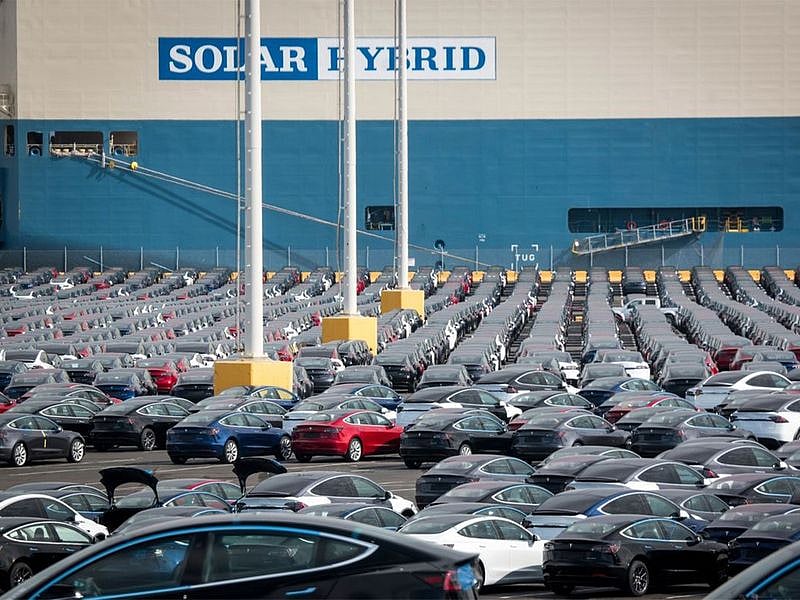
The global electric vehicle market continued its explosive growth in March (2026), with one US brand still ruling global EV sales.
March 2026 rankings showed Tesla's unbreakable grip on the top, according to CleanTechnica, citing March 2026 sales data.
Tesla's flagship Model Y and Model 3 demonstrated remarkable staying power even as a wave of lower-priced Chinese competitors captured the majority of the top 20 best-selling list.
Data compiled by CleanTechnica highlights both the enduring appeal of Tesla's technology and design, and the sheer manufacturing scale coming out of China.
The March 2026 top 20 best-selling EVs worldwide:
Tesla Model Y (USA) — 118,531 units
Tesla Model 3 (USA) — 53,158 units
Geely Xingyuan / EX2 (China) — 34,146 units
BYD Song / Seal U (China) — 34,011 units
BYD Yuan Up / Atto 2 (China) — 33,934 units
BYD Seagull / Dolphin Mini (China) — 31,076 units
Li Auto L6 (China) — 24,198 units
BYD Dolphin (China) — 23,529 units
BYD Seal 06 (China) — 20,635 units
BYD Sealion 06 (China) — 19,662 units
MG 4 (UK/China) — 17,409 units
Wuling Mini EV (China) — 16,815 units
Deepal S05 (China) — 16,395 units
NIO ES8 / EL8 (China) — 16,272 units
BYD Qin Plus (China) — 15,973 units
Toyota bZ4X (Japan) — 15,683 units
BYD Yuan Plus / Atto 3 (China) — 15,014 units
Fang Cheng Bao Tai 7 (China) — 14,197 units
Leapmotor C10 (China) — 13,879 units
Xiaomi YU7 (China) — 13,561 units
Tesla alone accounted for over 171,000 units from just its two core models in a single month — more than double the No. 2 spot and a testament to the strength of its global brand, software ecosystem (including Full Self-Driving capabilities), and established Supercharger network.
The data underscores a tale of two strategies in the EV transition.
Tesla has focused on vertical integration, continuous software updates, a concentrated product lineup (primarily Model Y and Model 3), and premium positioning with advanced driver assistance.
This approach has allowed it to maintain the top two spots decisively. @stats_feedIn contrast, Chinese manufacturers are leveraging massive scale, government support, lower labor and material costs, and rapid model proliferation to dominate the volume game.
Brands like BYD, Geely, Li Auto, NIO, and others (including rebadged or joint-venture models like MG, now under Chinese ownership) fill 16 of the top 20 positions.
Many of these vehicles target price-sensitive markets with competitive ranges and features tailored to local preferences.Key observations from the rankings:
Tesla's efficiency: Two models delivering more sales than the next several Chinese entries combined shows the power of platform sharing and brand loyalty.
China's breadth: The diversity of models (compact city cars like the Wuling Mini EV, family SUVs, and luxury options from NIO) indicates a maturing ecosystem capable of serving every segment.
European and Japanese presence: MG (SAIC-owned) and Toyota represent non-Chinese, non-Tesla entries, but they trail far behind.
Market access realities: Tesla's strength is particularly pronounced in markets like the US and Europe, where tariffs and trade policies limit direct competition from many low-cost Chinese imports. In open markets, Chinese volume is even more dominant. @stats_feed
Notably, VinFast sold 6,795 Limo Green vehicles in 2026 March, making it the best-selling model for the month for the Vietnamese EV maker.
VF 3 saw 4,729 vehicles delivered in March, while the VF 5 and Herio Green with the Herio Green developed based on the VF 5, recorded 4,218 vehicles delivered.
VF 6 posted 3,152 vehicles delivered; VF MPV 7 recorded 2,521 vehicles delivered, while the Minio Green and the VF 7 recorded 1,969 vehicles and 1,732 vehicles delivered, respectively.
The EC Van, VinFast’s EV model for transportation services, recorded 1,136 vehicles delivered during the same month.
This snapshot arrives amid broader global shifts in the auto industry.
Legacy automakers continue to struggle with EV profitability and scaling, while the US and Europe grapple with how to balance domestic industry protection with consumer demand for affordable options.
Meanwhile, falling battery costs and improving infrastructure are accelerating adoption worldwide.
What it means for consumers
For consumers, the data signals good news: more choices and downward pressure on prices. For policymakers, it raises questions about industrial strategy, supply chain security (particularly for critical minerals), and the pace of the energy transition.
For investors, Tesla's ability to hold the top spots despite intense competition highlights its technological and ecosystem moats, while China's rise demonstrates the challenges facing Western automakers trying to catch up.
Elon Musk and Tesla have long bet on EVs becoming the dominant form of personal transportation.
March 2026 data shows that bet is paying off — though the "who" behind many of those vehicles is increasingly Chinese.
The race is far from over, but the leaderboard makes one thing clear: the electric future is no longer coming. It's here, and it's accelerating.
[Sources: CleanTechnica, March 2026 data, as shared by World of Statistics].
Sign up for the Daily Briefing
Get the latest news and updates straight to your inbox
Network Links
GN StoreDownload our app
© Al Nisr Publishing LLC 2026. All rights reserved.