Capital markets mature fast
The UAE has become a stock market leader in the GCC in terms of technology and regulation, attracting foreign investment
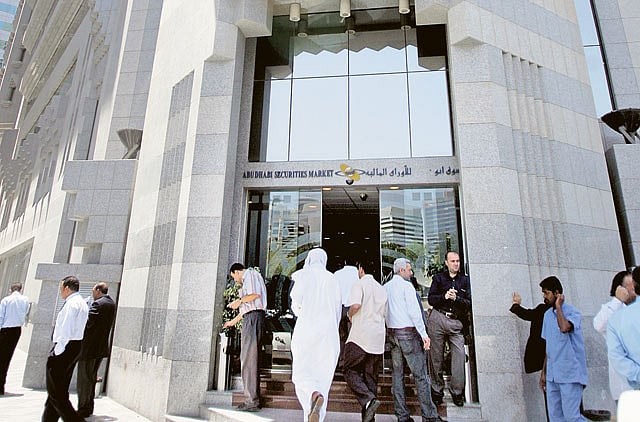
Dubai: As global investors continue to shun the UAE's capital markets, it is perhaps easy to forget the great strides that local stocks have taken over the last decade.
Dwindling volumes and a lack of liquidity across the country's bourses have contributed towards a lethargic equities scene in recent months. Foreign investors, in particular, have been removing their cash from UAE stocks and focusing their attention elsewhere.
However, viewed in a wider context, the UAE's capital markets have developed quite considerably over a relatively short period of time.
Some analysts believe that many of the UAE's most iconic landmarks, such as the Burj Khalifa, the world's tallest building, and Abu Dhabi's Yas Island development, would not be here today if it were not for the capital generated by local companies listing on the country's stock exchanges.
At the turn of the millennium, local investors were still trading over the counter and the UAE had no formal stock exchange.
That all changed in late March 2000 when the Dubai Financial Market (DFM) was officially inaugurated, quickly followed by its counterpart in Abu Dhabi later that year. Over the course of the next decade, numerous new products were launched, rebrandings took place and the DFM became the first, and to this day still the only— Arab bourse to list its shares.
"Although the UAE permitted over the counter equity trading in the late 90s it was not until the launch of regulated securities markets in 2000 that we saw respectable trading volumes and approval from local investors," said Mohammad Ali Yasin, chief investment officer at CAPM Investment.
According to Ali Yasin, local investors were initially reluctant to accept electronic trading with many wishing to continue with paper certificates. However, he said that over time the market saw the introduction of new regulations, laws and trading instruments including bonds, equities and sukuk.
"The UAE has become a stock market leader in the GCC in terms of technology and regulation and is only second to Saudi Arabia in terms of market capital. It has also been successful in attracting foreign investors over the years; local exchanges witnessed unprecedented volumes in the years leading up to the global financial crisis in 2008," Ali Yasin said.
New laws
"However, local bourses still have some way to go until they reach international standard; they are a work in progress and we still need to see new laws introduced as well as amendments to existing laws," he added.
In June, 2006, the FTSE Group and Dubai International Financial Exchange (DIFX) created the first GCC country tradable indices for domestic, GCC and international investors. Borse Dubai — the holding company of the DFM and DIFX — was created the following year to consolidate the Dubai Government's two stock exchanges and boost Dubai's position as a global capital markets hub.
According to Arabi, Dubai's capital markets were vital in creating the brand Dubai Incorporated with investors from all over the world wanting a piece of the action during the boom years.
"Markets are important for any country; it helps to put them on a different pedestal. For instance, the UAE's capital markets helped companies such as Emaar Properties and Arabtec to share their wealth and encourage public participation," Arabi said. "They would not have achieved the recognition they have today or been able to build monuments, such as the Burj Khalifa, in such a short period of time without the capital generated from equity markets.
"Even though we have seen a reduction in trading values over the last few years, there is no doubt capital markets have substantially contributed to the growth of the UAE," he added.
It has been a particularly volatile year for global equities with the Arab Spring, the US credit downgrade and the Eurozone's sovereign debt crisis all contributing towards panic and negative investor sentiment.
"Like every equity market across the world, our markets have gone through cycles. There have been boom times but we are currently going through a bust," Ali Yasin said.
Blue chips benefit
He said the growth of public companies, especially real estate firms, has been one of the main drivers of the UAE over the past decade, adding that blue chips benefited greatly from a stock market listing when the economy was doing well.
"Projects such as Burj Khalifa and Yas Island would probably have taken a decade longer to complete if they were left to the public sector. Companies such as Aramex, Dana Gas and du, which is now a major player in the telcom sector, have been crucial in the development of the UAE; the country would not have evolved as a leader without the establishment of a strong capital market," he said.
The Dubai Financial Market (DFM) was established as a public institution by a resolution from the Ministry of Economy before commencing operations on March 26, 2000. The Abu Dhabi Securities Market formally opened its doors later that year on November 15.
On January 29, 2000 the late Shaikh Zayed Bin Sultan Al Nahyan issued a federal decree to set up the Emirates Securities and Commodities Authority, which would be based in Abu Dhabi. The authority, which has a financial and administrative independence, was set up to monitor the UAE's capital markets but cannot practice trade activities nor own or issue any securities.
Five years later, the Dubai International Financial Exchange, the new stock exchange in the city's fin-ancial free zone, opened for trading. A day later, the DFM set up as a Public Joint Stock Company with paid up capital of Dh8 billion, becoming the first Sharia compliant stock exchange in the process. It remains today the only Arab bourse to sell shares to the public.
The trading of DFM shares began on March 7, 2007 following an initial public offering (IPO) that was highly oversubscribed, generating more than Dh201 billion.
Far away from the sterotypical image associated with the Wall Street bearpit of the 80s — all pin-stripe jackets and traders waving pieces of paper, the DFM operates on an automated screen-based trading system in line with most of the world's major stock exchanges.
Brokerages
Investors place their orders with DFM accredited brokers, who enter those orders into the trading system, which automatically matches buy and sell orders of a particular security.
Brokerages, however, are also suffering as a result of low trading volumes with dozens either closing or suspending their operations over the last few years. "On the 26th of March, the establishment of DFM was the beginning of a new era and [a] significant step on the path of developing the financial market in the UAE," Eisa Kazim, managing director and chief executive officer of the DFM, said in a speech at the DFM's 10th anniversary gala dinner last year.
"Capital markets have moved to an organised environment and trading in stocks has shifted from the traditional paper format to a comprehensive high-tech electronic platform since the first day of DFM's inception.
"Moreover, the launch of DFM, along with the rules issued by the Securities and Commodities Authority, provided the market with the appropriate corporate governance rules, which promote disclosure and transparency," he added.
Borse Dubai, the holding company for DFM and Nasdaq Dubai, was created on August 6, 2007 in a bid to consolidate the Government of Dubai's two stock exchanges. Its primary function is to explore growth opportunities across global capital markets in a bid to leverage technology, liquidity, regulation and expertise.
Over the next couple of years, several other key milestones were passed. In March 2008, the DFM's Sharia Board issued the first Islamic standards for trading shares of DFM listed companies before two rebrandings took place — Abu Dhabi Securities Market becoming Abu Dhabi Securities Exchange and Dubai International Financial Exchange renamed to Nasdaq Dubai.
The DFM became the majority owner of Nasdaq Dubai through an acquisition of shares from Borse Dubai and Nasdaq OMX, the international exchange group in May 2010.
**********************
Key decision on emerging market status next month
Dubai: The next big date in the calendar for the UAE's capital markets is in mid-December when investment bank Morgan Stanley reveals whether the UAE has been successful in achieving an upgrade to emerging market status.
MSCI (Morgan Stanley Capital International) global equity indices serve as the basis for over 400 exchange traded funds throughout the world and inclusion in the emerging markets index would be a stamp of approval from the international community and boost the UAE's appeal in the eyes of foreign investors.
More than 70 countries are covered by the investment bank's developed, emerging and frontier market indices with the UAE currently classified in the latter category alongside financial lightweights such as Vietnam, Slovenia and Kenya.
An upgrade would see the UAE join some of the world's fastest growing economies — including the BRICs (Brazil, Russia, India and China) — in the emerging markets index.
(MSCI) extended their classification review period in June this year to give additional time for market participants to "assess the impact of the recent positive changes implemented" in the UAE and Qatar.
Institutional investors welcomed the implementation of new delivery versus payment (DvP) settlement models on the Dubai Financial Market, the Abu Dhabi Securities Exchange and the Qatar Exchange, MSCI said in a statement. However, the index provider said the issue of foreign ownership limits remains a concern, especially in Qatar.
Huge progress
"We have seen huge progress, let's not forget that the UAE is a young nation and what has been achieved here over the last 40 years is pretty amazing. I moved here about 12 years ago when the UAE did not even have a recognised market or a regulator," said Haissam Arabi, chief executive and fund manager at Gulfmena Investments.
"In the space of 10 years, the country's capital markets have pretty much made it to emerging markets status, which is absolutely stunning and testimony to the great progress of the nation. Markets move in cycles but the most important thing is that a country has the infrastructure in place. When the markets kick back in, the UAE will be by far the cheapest emerging market," he added.
Timeline
- March 26, 2000 Dubai Financial Market (DFM) is officially inaugurated
- November 15, 2000 Abu Dhabi Securities Market formally opens
- September 26, 2005 Dubai International Financial Exchange opens for trading
- December 27, 2005 DFM is set up as a public joint stock company
- August 6, 2007 Borse Dubai is created — the holding company of Dubai Financial Market and DIFX
- March 18, 2008 DFM's Sharia Board issues the first Islamic standards for trading shares
- November 18, 2008 Dubai International Financial Exchange rebrands its market as Nasdaq Dubai
- July 11, 2010 Nasdaq Dubai outsources key market functions to DFM
Sign up for the Daily Briefing
Get the latest news and updates straight to your inbox
Network Links
GN StoreDownload our app
© Al Nisr Publishing LLC 2026. All rights reserved.