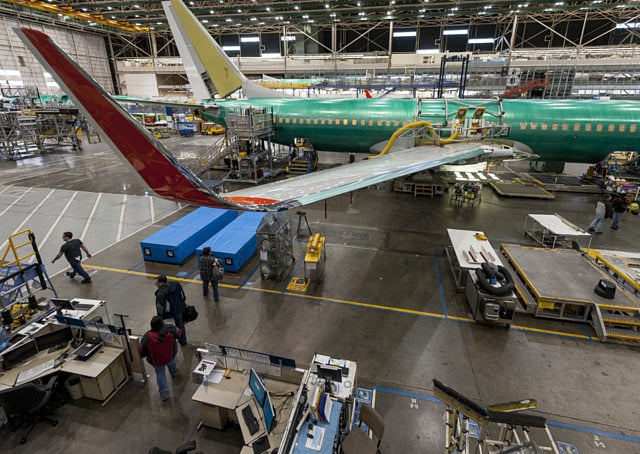
United Airlines is testing the latest innovation in aeroplane design that may prompt passengers to do a double take. Called a split scimitar, it is reminiscent of a medieval sword and is a variation on winglets, which extend up from the tips of wings.
United Airlines is trying it out not to win any design awards, but to make the plane fly more efficiently and ultimately reduce fuel consumption. The airline estimates that if all goes well, the new design will help save $200 million (about Dh735 million) a year once installed on its newest Boeing 737-800 and 737-900 models. It will be introduced by the beginning of next year. United Airlines said it could improve a plane’s performance by 2 per cent compared with the current winglet design it uses on much of its fleet.
Since the dawn of the jet age more than 60 years ago, the basic design of an aeroplane has changed little. But new materials, better computing power and more refined mathematical models have allowed aerospace engineers to improve the basic features of large passenger jets, including wing performance.
Winglets reduce drag at the tip of an aeroplane’s wings and can improve fuel performance by as much as 5 per cent a flight. Multiplied over thousands of flights, the savings can exceed $1 million a year for just one plane.
“They smoothen the airflow over the wings and help improve lift,” says Captain Joel Booth, Managing Director of Operations Planning and Fuel Efficiency, United Airlines. “It’s an efficiency device.”
The search for improvement in a plane’s efficiency, no matter how small, comes after a surge in the price of fuel, which now accounts for roughly a third of an airline’s costs. Jet fuel is currently well above $3 a gallon, up from 85 cents a gallon in 2000.
Fuel savings
To offset this increase, airlines have pursued a variety of fuel-saving strategies, like taxiing with just one of two engines running, shutting off the plane’s auxiliary power when parked at the gate or using more direct flight paths for landing. They have also started trials with green fuels, although those are still more expensive than kerosene for the time being. Delta Air Lines even bought an oil refinery outside Philadelphia last year.
Airlines have taken small steps too, giving pilots electronic tablets to replace their hefty flight manuals, using lighter paper for their in-flight magazines in a bid to cut weight from the cabin or using lighter seats in coach.
While all these things undoubtedly help, the big difference to the economics of flying will come from more fuel-efficient engines and planes.
As well as newer models built more efficiently, airlines also want to improve the efficiency of their existing planes. That’s where the winglets come in, since those can be bolted onto existing models.
The physics behind winglets has been well understood since the 1960s, when Nasa did some research on them. The first came out in the 1980s on business jets and later equipped the Boeing 747 and the MD11. At the time, those early models improved performance from 1.5 per cent to 3.5 per cent. Nowadays, high fuel prices have made them nearly mandatory for all types of commercial planes.
“There are still some basic physics that we use to minimise the drag on the aeroplane, and that hasn’t changed over the years,” says Robert D. Gregg, III, Chief Aerodynamicist, Boeing Commercial Airplanes.
Designs vary in part because every plane — and every wing — is different. Some business jets have “spiroid” wingtips, like a big “O” at the end of the wing. The double-decker Airbus A380 has arrow-shaped tips. The wingtip on the Airbus A330 is slanted at an angle of about 60 degrees.
Rapid repayment
Plane makers could improve efficiency simply by extending the length of the wings. But that’s usually impossible, given the constraints imposed by airports and parking gates. The standard for single-aisle planes, for instance, is that the wings must not exceed 36 metres (or 118 feet).
A conventional winglet extends the length of the wing by about eight feet upwards, and that is now common on many Boeing 737s.
The maker of the new scimitar design, a joint venture between Boeing and a Seattle-based company called Aviation Partners, estimated that the new design had shown improvements of 30 per cent to 40 per cent over their original winglet. This would save United Airlines 45,000 gallons of jet fuel per plane every year and cut carbon emissions by 476 tonnes a year.
Winglets cost anywhere from $500,000 for a 737 to more than $2 million for bigger planes. But the pay-off can be rapid. Southwest Airlines estimates that it saves 54 million gallons of fuel every year thanks to equipping 93 per cent of its fleet of 737s with winglets.
An airline putting winglets on a twin-aisle Boeing 767-300ER, which can fly nonstop between Los Angeles and Frankfurt, can expect to save about 600,000 gallons, or about $1.8 million, annually in operating costs, according to some estimates. (The saving represents about 1 per cent of the plane’s list price of $185.8 million, although airlines typically get significant discounts on their purchase.)
“In an environment where the price of fuel is high, you can pay off a set of winglets in less than two years,” Booth says.
The latest generation of aeroplanes — Boeing’s 787 and Airbus’s A350 — do not have wingtips, but their wings have a raked design that provides similar aerodynamic efficiencies. Alan Pardoe, a spokesman for Airbus, says the wing design was an integral part of the savings promised by the A350.
Attracting attention
The economic appeal of the winglets has opened a new front in the commercial rivalry between Boeing and Airbus, which came up with its own design, called sharklets, as an add-on to its A320 series last year.
Airbus, however, has been accused by Aviation Partners of infringing on its patent. The case is headed to international arbitration in London.
Still, the winglets have proved so popular that both Boeing and Airbus have incorporated them into the redesign of their single-aisle bestsellers, which will include a more efficient engine — the Airbus A320 Neo and the Boeing 737 Max.
“Performance improvements of that magnitude get the attention of airlines,” according to a recent research report by AirInsight, an aviation consultancy. “A 5 per cent improvement in overall operating costs is quite significant.”
— The New York Times
Sign up for the Daily Briefing
Get the latest news and updates straight to your inbox
Network Links
GN StoreDownload our app
© Al Nisr Publishing LLC 2026. All rights reserved.