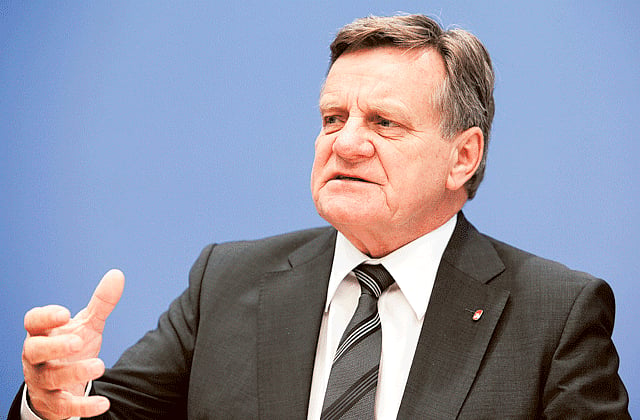
Berlin: It was only in the third quarter of 2011 that Etihad Airways acquired a nearly 30 per cent stake in the loss-making German carrier, airberlin. And almost a year later, boasting a fleet of 152 aircraft, the carrier is already talking about getting back to profitability in 2013 — the partnership is helping airberlin save around $150 million (Dh550.5 million) on a full-year basis. In an interview at the airline’s headquarters in Berlin, airberlin’s [interim] chief executive, Hartmut Mehdorn, talks about how the partnership with Abu Dhabi-based Etihad Airways is helping airberlin make its flight from currently being in the red to being in the black again by the end of next year, which is also when Mehdorn’s term ends.
How has airberlin’s partnership with Etihad Airways helped you so far? Has the alliance helped you fast-track into profitability?
The presence of Etihad Airways helps us substantially. There is no doubt that Etihad is helping us overcome crisis. Thanks to Etihad partnership, we are able to operate much easily. We have a lot of programmes that are helping us raise efficiency. They know something which we can learn from and vice-versa.
Etihad is on one hand our shareholder and on the other hand, a real partner. We have many new collaborations in the market coming up step-by-step such as new codeshares for the future.
Also, on technical side, we have fleet commonality with the upcoming Boeing 787. We have 15 Dreamliners on order with additional options, and will have the first two in 2015. Etihad, too, has big order for the Dreamliners.
One big advantage [of the partnership] is that Etihad is a world champion in service. We just jump on their standards and don’t have to develop it ourselves.
We have been happy to have Etihad Airways as one of our shareholders. We like it that we have a professional in our Board — James Hogan [Eithad Airway’s President and CEO). Especially in difficult days, it helps to have airline knowledge and professionalism in Board.
It was a move that was made in the third quarter of 2011. We are quite proud that we have in a very short time settled a big bunch of actions where we cooperate and create synergies.
Airberlin has approximately 35 million customers per year. With this alliance now they have a chance to make one step into Abu Dhabi and then travel to everywhere in Asia and some other markets. We have 1,500 codeshares in place today worldwide.
How do you see Etihad benefitting from this deal on the other hand?
While Abu Dhabi has become airberlin’s new gateway to Asia and Australia, partnership with airberlin gives Etihad Airways access to the broad European market, offering opportunity for global growth.
Etihad is a rather young airline — and basically, a point-to-point airline. And we are a network airline. That’s something which Etihad doesn’t do as the Middle East is a different market — where home market is not too big, while we are sitting in central Europe in a very solid home market. Germany is quite a nice market and we do a lot of things outside of Germany, too.
So Etihad has at once made a dramatic short cut to have a European network at their disposal through our cooperation. That’s an advantage.
Your airline made a loss in the first half of 2012. What is your full-year financial forecast?
We keep saying that this year is a transition year for airberlin. In the first half of this year, we have been in the red so I cannot call it a good year, of course. However, we are still saying that in 2013 we envisage to be back to being profitable. So yes, we plan to get back in the black by end of 2013.
We think we should be, at the end of the day, fair not too bad in our annual result. Please don’t ask me how much because it’s still too early for us. We don’t trust the market development for the time being. But we have ambitious targets.
Do you expect the current 30 per cent stake Etihad holds in airberlin to go up at some stage?
I don’t think that is Etihad’s strategy — to be the major shareholder, which will create a couple of other questions because as per the European law, 51 per cent of the shares have to be with the European shareholder.
As per my discussions with James Hogan, there is no intention to raise the current stake. At present he is happy with the 30 per cent stake.
What are some of your key challenges to growth today?
Fuel costs amounted to around 20 million euros for airberlin last year. This year, it would be another 110 million euros. So fuel prices continue to be a challenge.
And then we have some home base crisis. We are building our hub here in Berlin and we are faced with the delay of Berlin’s (new) airport — the Berlin Brandenburg Airport, which we urgently need to perform and to provide the right services to our customers. Nevertheless, the strategic position of airberlin is quite aggressive.
Beyond that, there is no question that airline industry as a whole in the western hemisphere is in crisis. We are fighting our market in Europe between Lufthansa — one of the European giants — in our home market and also in European area with Air France-KLM and British Airways and Iberia. And we are sitting in the middle.
Sign up for the Daily Briefing
Get the latest news and updates straight to your inbox
Network Links
GN StoreDownload our app
© Al Nisr Publishing LLC 2026. All rights reserved.