Emirates flight EK31 Dubai-London diverts after 7700 emergency alert: What happened onboard
General emergency code 7700 issued as Emirates flight reroutes to Frankfurt
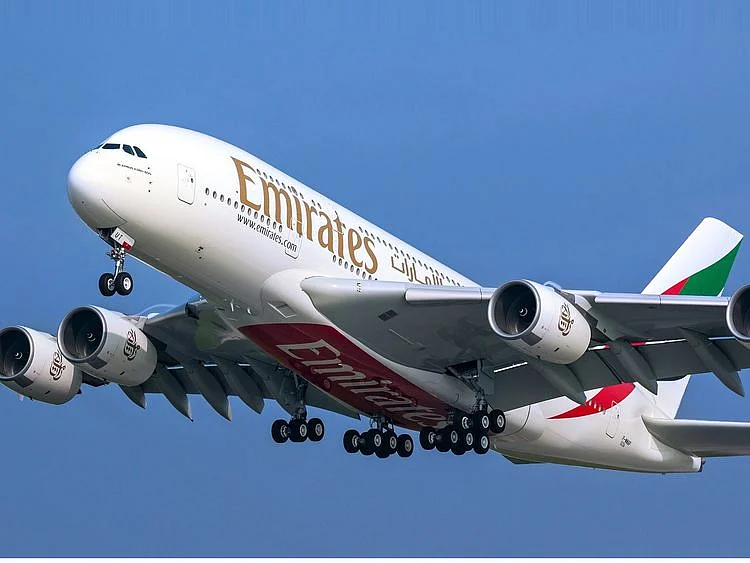
An Emirates flight from Dubai to London Heathrow diverted to Frankfurt on Thursday after a passenger suffered a medical emergency onboard, the airline confirmed.
The passenger disembarked in Frankfurt and received further medical attention, while the aircraft landed safely. Flight-tracking data showed the crew transmitted the 7700 general emergency code before the diversion.
Here’s what happened during the flight, why EK31 diverted and what the 7700 code means.
Get updated faster and for FREE: Download the Gulf News app now - simply click here.
What happened to Emirates flight EK31?
Emirates confirmed on X that flight EK31, operated by an Airbus A380-800, diverted to Frankfurt on October 1 because of a medical emergency involving a passenger.
The airline said its cabin crew assisted during the incident and medical support was arranged for the passenger on arrival. The aircraft landed safely in Frankfurt, where the passenger disembarked to receive further medical attention.
No further details about the passenger’s condition were immediately available.
Emirates issues statement
Our cabin crew assisted the flight, and medical support was arranged on arrival. The aircraft landed safely in Frankfurt, where the passenger disembarked to receive further medical attention.Emirates
“We apologise to customers for the delay. The health and safety of our passengers and crew is always our highest priority,” Emirates said.
The airline confirmed that the diversion was caused by a medical emergency involving a passenger and said the aircraft landed safely in Frankfurt.
Flight declares general emergency
Flight-tracking information cited by AIRLIVE showed EK31 cruising at around 40,000 feet when the crew transmitted squawk code 7700, the international transponder code used to signal a general emergency.
The aircraft subsequently descended and diverted to Frankfurt instead of continuing to London Heathrow.
EK31 had departed Dubai International Airport shortly after 11.25am UAE time for its scheduled journey to London.
What happened to EK31 after it landed in Frankfurt?
Emirates said the aircraft was expected to resume its journey from Frankfurt to London Heathrow at approximately 6pm local time on October 1.
The diversion delayed passengers travelling onwards to London, with Emirates apologising for the disruption.
What does squawk 7700 mean?
Squawk 7700 is the international transponder code used by aircraft crews to alert air traffic controllers to a general emergency.
It can be used in different situations, including a medical emergency, technical problem or another incident requiring urgent assistance. The code itself does not indicate the nature of the emergency.
For comparison, squawk 7500 indicates unlawful interference, including a suspected hijacking or security threat, while 7600 indicates a loss of radio communication with air traffic control.
How are 7700 and 7500 different?
7700: Signals a general emergency.
7500: Signals unlawful interference, including a suspected hijacking or security threat.
7600: Indicates a loss of radio communication with air traffic control.
Why is the 7500 code in the news?
The 7500 code drew attention following the flydubai FZ1073 incident on September 30.
The Dubai-Tel Aviv flight diverted to Tabuk, Saudi Arabia, after an incident in the cockpit. The crew transmitted 7700, followed by 7500, during the incident.
Preliminary investigations by Saudi authorities and a UAE security team have focused on the cockpit altercation. Both crew members were treated after the incident, while authorities have urged against speculation as investigations continue.
The use of 7500 in that incident indicated unlawful interference to air traffic control. This differs from 7700, which signals a general emergency without specifying its cause.
Network Links
GN StoreDownload our app
© Al Nisr Publishing LLC 2026. All rights reserved.