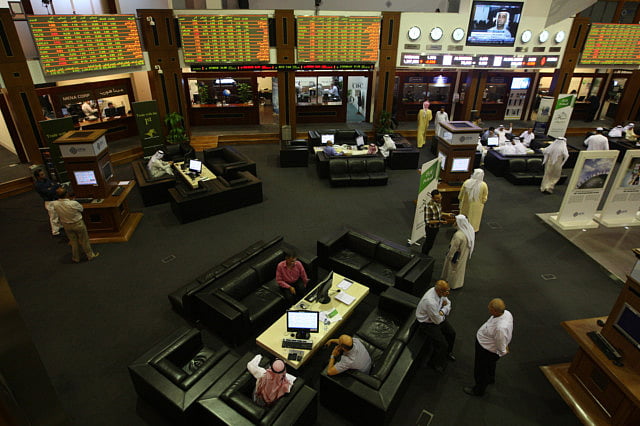
After five years of suffering, Gulf bourses have regained vitality and their attractiveness for local and foreign investors.
As we bid goodbye to 2013 and welcome the New Year, let’s take a look at what transpired on GCC bourses. The Dubai Financial Market attained a 105 per cent growth, the highest among global bourses, while the Abu Dhabi Securities Exchange index experienced a 63 per cent upturn, Saudi Arabia 30 per cent and Qatar 31 per cent. Other Gulf bourses have also had significant gains as indices returned to pre-crisis levels. Some stocks have soared by 200 per cent.
Although Gulf markets recovered relatively late compared with the US and other Asian bourses, the gains since have been rapid thanks to economic and geopolitical factors prevailing in the region.
With the stabilisation of the situation in Egypt and the preliminary agreement between the five major countries and Iran over its nuclear programme, signs of political stability have started to show up in the Middle East, which has encouraged the return of capital and attracted foreign investments into the GCC capital markets.
This has led to the acquiring of stakes in leading bank stocks to the full extent possible by foreign investors. Some of the banks have got board of directors’ approval to raise the foreign shareholding from 15 to 25 per cent.
Stability
Political developments in the region have played a crucial role in helping GCC stock markets to recover, whereas economic conditions have been ripe for growth for two years thanks to stability and support from high oil prices. Now, with the improvement in the political situation, the financial markets have received a strong push to return to their previous highs.
Furthermore, developments such as Dubai’s victory to host the World Expo 2020 have helped the Abu Dhabi and Dubai stock markets, with their gains exceeding Dh50 billion.
Also, the budget announcement by the UAE and Saudi Arabia, which includes record expenditures, have in turn contributed to offering extra support to the financial markets. It is expected that other GCC budgets will be similar in scale in terms of investment outlays.
Although some investors still fear a re-entry into the GCC capital markets because of prior experiences, these are purely psychological rather than objective. This requires an objective analysis of investment options available in GCC markets, especially related to investment portfolios, financial institutions and foreign capital.
No doubt the high gains attained by GCC markets will be accompanied by speculations aimed to reap windfall profits. Yet, these are matters that exist in any financial market in the world. Moreover, the recent performance by the Gulf stock markets are logical and reflective of the return on equity (earnings per share) potential and medium-term outlook of listed companies.
Track-record
Some shares are still subject to the whims of speculators, especially the relatively cheap scrips of smaller companies and some of which are still in recovery, while others still suffer from structural problems related to liquidity and the nature of the sector they are in, such as shipping, for instance.
It is imperative for investors, especially small ones, to be selective with their exposures and only go for stocks that have a track-record and reward dividends. Meantime, they need to avoid getting into speculative buying as much as they can.
This is because GCC markets are expected to see further progress. According to the IMF, 2014 will be unique for UAE capital markets, making stock investments viable in the long run. The stability in oil prices will provide a good environment for the wider economy and for the business sector, including listed companies.
Sign up for the Daily Briefing
Get the latest news and updates straight to your inbox
Network Links
GN StoreDownload our app
© Al Nisr Publishing LLC 2026. All rights reserved.