Ethiopia’s EV bet: Can a fuel crisis force the world’s fastest electric-car transition?
Can Ethiopia's hydropower and EV push redefine its transportation future?
Ethiopia’s decision to ban imports of new petrol and diesel cars in 2024 was less a climate policy than an economic survival strategy.
With fuel imports costing billions annually and the country defaulting on its debt, Addis Ababa turned to cheap hydropower and Chinese-made electric vehicles to cut its dependence on oil.
The result is one of the world’s most radical transport experiments. B
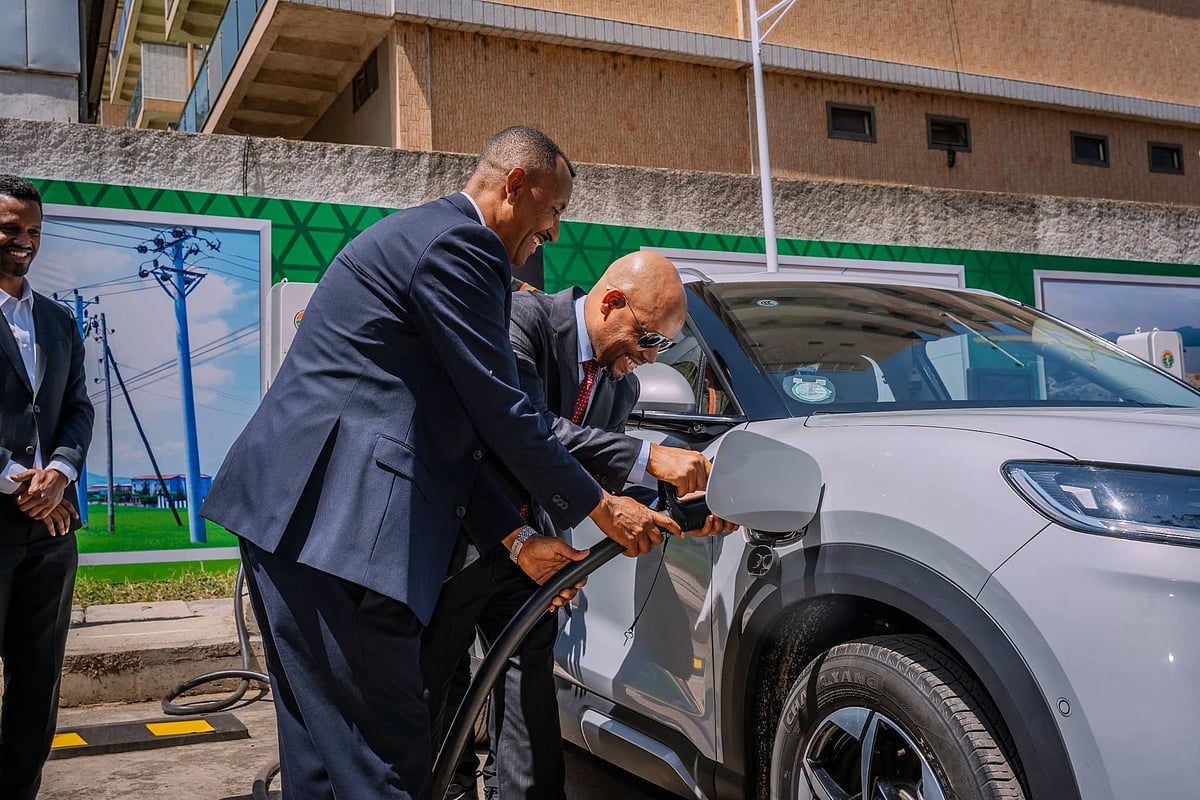
On October 31, the state-owned utility rolled out 11 fast-charging points: Five in the capital, while the remaining six extend coverage along key routes linking Addis Ababa with industrial and regional centres.
The facilities are equipped with fast and standard chargers and can serve up to 96 vehicles simultaneously.
They use a digital payment system, according to the EEU.
The launch raised Ethiopia’s EEU-operated charging network from three to 14 stations, with a combined capacity to charge about 150 vehicles at once.
Eight of the 14 stations are in Addis Ababa.
One of the new Addis Ababa facilities, along Hachalu Road, was built with the city administration and can charge nearly 12 vehicles at a time.
Another station near the new international convention centre is located in a high-traffic area.
But high vehicle prices, a weak electricity grid, limited chargers and renewed regional conflict could determine whether the gamble succeeds.
Ethiopia acts
Ethiopia imports more than it exports, and fuel is among its largest import bills. Bloomberg reported that the country was spending as much as $5 billion annually on imported fuel, a burden it could no longer sustain after its 2023 debt default, BBC reported.
WHY IT MATTERS: Ethiopia banned imports of new petrol and diesel vehicles in 2024, making charging infrastructure central to its electric mobility policy. The new stations are intended to reduce “range anxiety” and support EV adoption beyond the capital.
On October 31, 2026, state-owned Ethiopian Electric Utility (EEU) inaugurated 11 fast-charging electric vehicle stations across six cities, expanding public charging capacity to 96 vehicles at a time as the country pushes its transition away from petrol and diesel cars. New stations were opened in Addis Ababa, Bishoftu, Mojo, Batu, Adama and Hawassa.
The International Monetary Fund (IMF) approved a $3.4 billion financing package in 2024 to support reforms over four years. As part of the deal, Ethiopia floated its currency, and the birr fell about 30 percent against the dollar, making imported fuel even more expensive.
Fuel shortages have also become a security issue.
In March, authorities ordered fuel suppliers to prioritise security institutions, major projects and essential industries, while the Tigray region suspended fuel supplies amid fears of renewed civil war.
The EV boom
The ban did not confiscate existing petrol cars. It stopped new fossil-fuel vehicle imports and made EVs cheaper through reduced tariffs, creating a sudden shift in the market.
By 2024, more than 60 percent of newly registered cars in Addis Ababa were electric. Bloomberg reported that EVs accounted for about 6 percent of vehicles on the road by 2026, above the global average of 4 percent.
The number of EVs rose from 7,000 in 2022 to more than 100,000 in 2025, according to government figures.
Those numbers cannot be independent verified.
Hydropower advantage
Ethiopia’s Grand Ethiopian Renaissance Dam, Africa’s largest hydroelectric plant, produces about 5,000 megawatts and cost roughly $5 billion to build. It gives the country access to some of the world’s cheapest electricity.
About 96 percent of Ethiopia’s electricity comes from hydropower, and the country exports power to Kenya, Djibouti and Tanzania. This makes EVs more economically viable than in countries reliant on imported fossil fuels for electricity.
The obstacles
The biggest barrier is affordability. A small BYD Seagull costs about $23,000, while average annual income per person is below $1,000. Only 13 out of every 1,000 Ethiopians own a car, far below the African average of 73.
The grid is also uneven. Only about 55 percent of Ethiopians have electricity access, blackouts are common, and the country had almost no public charging stations when the ban took effect.
Ethiopia now has around 200 public charging stations, but most EV owners charge at home. The utility targets up to 2,000 public charging stations by 2033.
The government has licensed 17 EV assembly companies, though only BKG Manufacturing had begun operations when Bloomberg reported.
China’s role
Chinese brands dominate Ethiopian dealerships. To encourage local assembly, Ethiopia charges 15 percent duty on fully built EV imports, 5 percent on semi-knocked-down kits, and zero duty on completely knocked-down vehicles assembled locally.
BKG assembles electric minibuses using parts from China’s Nanjing Golden Dragon Bus Company. The plant produces about one vehicle a day, far below the scale needed to meet Ethiopia’s targets.
What’s next
Ethiopia’s 2025 climate plan targets 500,000 EVs and more than 2,000 charging stations by 2033. The country will host the UN Climate Summit in Addis Ababa in 2027, giving it a global platform to showcase its transition.
But the real test is whether EVs become affordable for ordinary Ethiopians and whether the grid can keep up.
Regional instability and renewed conflict add further risk to an already fragile transition.
What it means
Ethiopia’s experience shows that a developing country can move fast on EVs when fuel costs, cheap hydropower and import policy align. But it also shows the limits of policy without infrastructure, affordability and political stability.
For other African countries, the lesson is mixed. Ethiopia’s model may work where hydropower is cheap and fuel imports are unsustainable, but it is harder to replicate where electricity access and charging networks remain weak
For drivers, the expansion means more public charging options in major cities and along transport corridors. For Ethiopia, it is a practical step toward making its unprecedented petrol-car import ban workable. The challenge remains whether electricity supply, affordability and vehicle availability can keep pace with the country’s fast-growing EV fleet.
Highlights
Ethiopia became the first country to ban imports of new gasoline-powered cars in 2024.
The policy was driven mainly by a fuel-import bill of up to $5 billion a year, not climate goals.
Ethiopia defaulted on its debt in 2023 and later secured a $3.4 billion IMF-backed financing package. EVs made up more than 60 percent of new car registrations in Addis Ababa in 2024. The government targets 500,000 EVs and more than 2,000 charging stations by 2033.
Chinese-made EVs dominate the market, with some vehicles assembled locally under preferential tariff rules.
Sign up for the Daily Briefing
Get the latest news and updates straight to your inbox
Network Links
GN StoreDownload our app
© Al Nisr Publishing LLC 2026. All rights reserved.