** ADVANCE FOR WEEKEND EDITIONS, MAY 2-5 **Stan Lee, 79, creator of comic-book franchises such as "Spider-Man," "The Incredible Hulk" and "X-Men," smiles during a photo session April 16, 2002, in his office in Santa Monica, Calif. Lee, who has a minor role in the upcoming Sony Pictures film "Spider-Man," opening in May, has weathered financial trouble in recent years. Now, a new wave of filmmakers are turning to Lee's superheroes for big-budget adventure movies. (AP Photo/Reed Saxon)
Obituary: Stan Lee was a superhero ahead of his time
The comic book icon helped redraw the world of fiction, and made sure everyone knew it
Last updated:
6 MIN READ
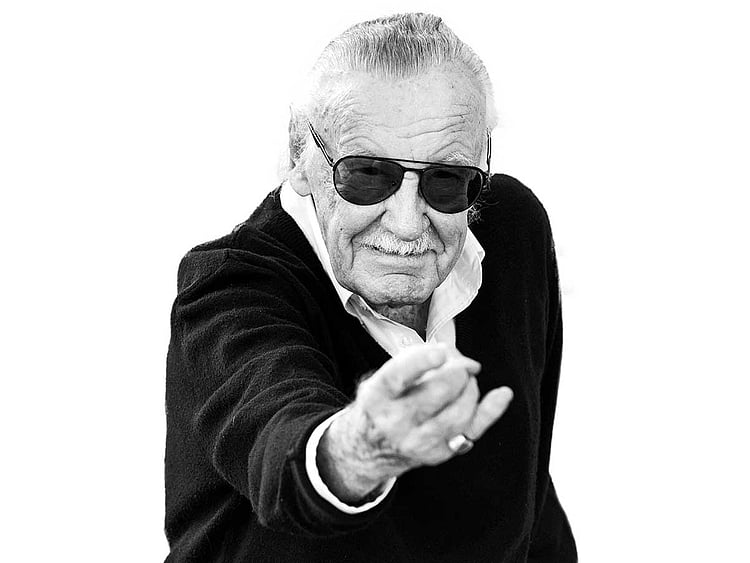
Stan Lee
AFP
It became easy, in recent years, to dismiss him as the wisecracking grandpa of the American comic book, a past-his-prime gimmick who cameoed alongside Earth’s angstiest superheroes in the high-grossing Marvel blockbusters of the past decade.
But Stan Lee, who died Monday, was far more than that. It’s no stretch to say that he helped redraw the world of American fiction. And he certainly made sure everyone knew it.
From the ashes of pulp magazines and the radioactive raw material of postwar uncertainty about science and power, he summoned — not single-handedly, but certainly without parallel or peer — a textured, self-sustaining universe of imperfect heroes.
(FILES) In this file photo taken on July 18, 2017 Comic-book writer, editor, and publisher Stan Lee places his hands in cement during his hand and footprint ceremony at TCL Chinese Theatre IMAX, in Hollywood, California. Marvel legend Stan Lee, who revolutionized pop culture as the co-creator of iconic superheroes like Spider-Man and The Hulk who now dominate the world's movie screens, has died. He was 95 years old. Lee, the face of comic book culture in the United States, died early November 12, 2018 in Los Angeles, according to US entertainment outlets including The Hollywood Reporter. He had suffered a number of illnesses in recent years. / AFP / VALERIE MACON
While Updike and Cheever were doing it in literature, while Kubrick and Lumet and Penn were doing it at the movies, the father of Marvel presented comic-book America — which meant, at the time, mostly adolescent boys — with a pantheon of deeply flawed protagonists who, despite their presence in so many tales to astonish, were in many ways just like you and me.
These outcasts and misfits rose to the alarm clock’s buzzing and slogged to work each morning to get the job done, not in a fanciful Metropolis or Gotham but on the actual streets of New York City and in the imperfect America beyond it. For them, the struggle was the thing — no matter whether the task was saving the world, paying the rent or trying to make ends meet as a freelance photographer or a blind lawyer or an itinerant stunt motorcyclist.
Unlike DC Comics’ iconic heroes, many of whom had been destined for greatness as the last sons of doomed planets, Amazon royalty or rightful kings of the sea, the likes of Spider-Man, the Fantastic Four, Iron Man, the Ghost Rider and the Incredible Hulk composed a catalogue of human frailties — schmoes who inadvertently, or negligently, wandered into the traffic of destiny.
Some moneyed, some working-class, all neurotic, they had powers thrust upon them by misfortune or questionable choices. Their abilities were just as often bane as boon. And sometimes it was hard to tell the heroes and the villains apart. Sort of like real life.
Also Read
Stan Lee death: Celebs offer thanks and condolencesMarvel Comics legend Stan Lee dead at 95This was in no small measure due to Lee, who as Marvel’s editor-in-chief wrote many of the books himself during comics’ “Silver Age” years of the early 1960s. With seemingly boundless energy and a staggering variety of voices, he breathed personality, ambiguity and a common narrative into soon-to-be-beloved characters.
“One of the things we try to demonstrate in our yarns is that nobody is all good, or all bad,” Lee wrote in a column for Marvel’s March 1969 issues. “Even a shoddy super-villain can have a redeeming trait, just as any howlin’ hero might have his nutty hang-ups.”
It’s hard to overestimate how groundbreaking this philosophy was in a nation that, with a tone set by production-code Hollywood since the early 1930s, had spent three decades positioning largely unambiguous heroes at the centre of its rising mass culture. Add government efforts in the 1950s to demonise comics as the mind-decayers of America’s youth, and to push publishers back toward pablum, and you’ll have some idea what Lee accomplished at the beginning of the 1960s.
Suddenly here was Tony Stark, a genius inventor with daddy issues (and, we would eventually learn, an alcoholic narcissist) who fixed his literally broken heart by turning himself into Iron Man. Here was Peter Parker, a meek high-school nerd who had no clue how to handle the creepy abilities and hormonal changes bestowed upon him by the bite of a radioactive spider on a class field trip. Talk about playing to your target audience.
Here was Bruce Banner, a military scientist who tried to save someone from one of his test blasts and ended up locked in a battle with his own angry, destructive id — hardly an incidental narrative in an era when psychotherapy and self-help were sharply on the rise. And here was Matt Murdock, blinded in a horrible accident by irradiated waste, proving every night with precision radar powers, as Daredevil, that disability isn’t necessarily destiny. And here were the X-Men, mutants and perpetual outsiders whose struggle to find a place in the mainstream on Earth has been variously framed as a parable for race relations, anti-Semitism and the Red Scare.
Even Steve Rogers, whose Captain America was the most Superman-like of the bunch, had demons. He was the skinny kid rejected by his World War II draft board who wanted so badly to fight that he volunteered to be a guinea pig for a “supersoldier serum” that would turn him into the ultimate fighting machine.
Captain America debuted during the war years when Marvel was still called Timely Comics, but Lee and his team updated the story for the 1960s by giving Rogers even more ghosts: He lay frozen in ice for nearly two decades after falling into the sea, and awakened out of time in a fast-changing, morally murky world he barely recognised or could navigate.
FILE - In this April 11, 2012, file photo,Stan Lee arrives at the premiere of "The Avengers" in Los Angeles. Comic book genius Lee, the architect of the contemporary comic book, has died. He was 95. The creative dynamo who revolutionized the comics by introducing human frailties in superheroes such as Spider-Man, The Fantastic Four and The Incredible Hulk, was declared dead Monday, Nov. 12, 2018, at Cedars-Sinai Medical Center in Los Angeles, according to Kirk Schenck, an attorney for Lee's daughter, J.C. Lee. (AP Photo/Matt Sayles, File)
There was another, less-noticed corner where Lee was equally groundbreaking. As Marvel’s editor, in an age before computers were in every pocket, he worked tirelessly to develop a relationship with his audience.
He talked about stuff behind the scenes and curated a tallish tale of a wacky, collegial studio of writers and artists who might do just about anything in their pursuit of good stories. His regular column, Stan’s Soapbox, talked directly to readers in a way that presaged the kind of access to celebrities that Twitter, Facebook and Instagram afford today.
Many felt Lee didn’t share enough credit with such comics pioneers as Jack Kirby and Steve Ditko, who worked alongside him in those early years as he developed the “Marvel Method” of story development. Fair enough. But part of Lee’s genius was his ability to be a master of collage.
Like a Bob Dylan or a Gene Roddenberry, Lee took cultural threads — elements already afoot in society — and constructed his own quilt. While his source material was sometimes derivative, what he stitched was something new under the sun.
And within his emerging pantheon of white male angst, Lee was often an enthusiastic champion of progressive views about race, if not always gender. The now-fabled Black Panther first appeared in a Marvel comic book in 1966, becoming one of the earliest mainstream superheroes of African descent, though it took until 1973 for him to snag a marquee spot in a comic entitled Jungle Action.
(FILES) In this file photo taken on July 18, 2017 Comic-book writer, editor, and publisher Stan Lee places his hands in cement during his hand and footprint ceremony at TCL Chinese Theatre IMAX, in Hollywood, California. Marvel legend Stan Lee, who revolutionized pop culture as the co-creator of iconic superheroes like Spider-Man and The Hulk who now dominate the world's movie screens, has died. He was 95 years old. Lee, the face of comic book culture in the United States, died early November 12, 2018 in Los Angeles, according to US entertainment outlets including The Hollywood Reporter. He had suffered a number of illnesses in recent years. / AFP / VALERIE MACON
“None of us is all that different from each other. We all want essentially the same things outta life,” Lee wrote in the pages of Marvel Comics in February 1980. “So why don’t we all stop wasting time hating the ‘other’ guys. Just look in the mirror, mister — that other guy is you.”
Marvel is a calibrated commercial juggernaut now, its stories drowning in the merchandise that amplifies them. It has been dismissed as mass-produced storytelling for a mass-produced age. Yet somehow, among the things Lee manages to leave behind is a lingering sense — snake oil, maybe, but potent nonetheless — that with Marvel’s tales, still, anything might happen.
Sign up for the Daily Briefing
Get the latest news and updates straight to your inbox
Network Links
GN StoreAbout Gulf NewsTerms & ConditionsReach by GNSitemapContact usPrivacy PolicyGN FocusHave your sayWork with usAdvertise with usGulf News epaperPrinting Services
Download our app
© Al Nisr Publishing LLC 2026. All rights reserved.