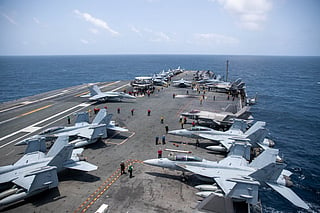
Kuwait intercepts Iranian drones, Bahrain sounds air raid sirens as US reimposes naval blockade amid escalating Iran tensions
US strikes, Iranian ‘dark fleet’ manoeuvres deepen Strait of Hormuz crisis

Highlights
We are closing this coverage now. For the latest updates, click here.
Blasts heard in Tehran as US expands bombing campaign
Explosions have been reported in the Tehran area amid the latest wave of US strikes on Iran, which appear to be expanding beyond previous targets.
As of 5am Gulf Standard Time (GST) on Thursday (July 16, 2026), the US Central Command confirmed the latest wave of evening strikes against Iran. The command said it was "completed" at 9 pm Eastern Time on July 15 (1am GMT on July 16).
"US forces struck Iranian command centres, air defence sites, missile and drone capabilities, and coastal surveillance facilities to further degrade Iran's ability to threaten innocent mariners crewing commercial vessels transiting the Strait of Hormuz," the command stated.
CentCom stated its forces "used precision munitions to hit targets in multiple locations including Bandar Abbas. Earlier this morning, American forces struck coastal defence and cruise missile sites on Greater Tunb Island during a 90-minute wave. The US military is holding Iran accountable at the Commander in Chief's direction."
Get updated faster and for FREE: Download the Gulf News app now - simply click here
Blockade: US military disables non-compliant vessel in Arabian Gulf
US forces confirmed that they have enforced naval blockade measures against Iran from midnight on July 15, 2026 by disabling an unladen oil tanker attempting to sail toward an Iranian port in the Arabian Gulf.
US Central Command (CentCom) forces observed Curacao-flagged M/T Belma transiting international waters toward Kharg Island.
The commercial vessel ignored multiple warnings as it attempted to violate the US blockade, according to the command.
A US aircraft disabled the vessel after firing hellfire missiles into the ship’s smokestack. The ship is no longer transiting to Iran.
Bombs hit Iran's Rask, Chabahar garrison — 7 killed: report
Projectiles reportedly struck the southeastern Iranian cities of Rask and Chabahar in Sistan and Baluchestan province late on Wednesday, with Iranian media reporting explosions. Few immediate details were provided on the damage or casualties.
Subsequent reporting by Iran's semi-official Tasnim News Agency indicates that the Chabahar Port's maritime traffic control centre was hit in a renewed US strike, while Iranian authorities also reported attacks elsewhere in the province, including the Bampur Army garrison.
Tasnim said at least seven Iranian military personnel were killed in the Bampur strike.
Trump threatens Pickaxe Mountain, Kharg Island
US President Donald Trump has now openly threatened Pickaxe Mountain and Kharg Island. The US leader declared that the US would eventually "take out" the underground tunnel complexes deeply buried near Natanz, Iran, that Western analysts believe could support future nuclear activities.
Experts say the mountain complex is among the hardest military targets in the world because its tunnels are buried hundreds of feet beneath solid rock, potentially beyond the reach of even America's most powerful bunker-busting bombs.
Pickaxe Mountain forms part of several "options" reportedly now under consideration by Trump following a White House briefing by military leaders. Trump is also weighing a significant expansion of US military operations in Iran, including the possible seizure of Kharg, Tehran's main oil export hub.
Get — updated faster and for FREE: Download the Gulf News app now - simply click here
Trump weighs major escalation, sending troops into Iran
President Trump is leaning toward expanding US military operations in Iran after days of briefings from top aides, U.S. officials said. Options include stepping up airstrikes, sending ground forces to seize Iranian islands near the Strait of Hormuz and bombing a fortified site that could be used for covert nuclear work.
Trump hosted a Situation Room meeting Tuesday evening to discuss the potential seizure of Kharg Island and other territory along the Strait of Hormuz using U.S. troops, as well as the potential bombing of a tunnel complex at Pickaxe Mountain.
US forces launch new wave of strikes against Iran: US military
The United States launched a new wave of strikes against Iran on Wednesday in a bid to curb Tehran's ability to threaten the Strait of Hormuz, the US military said.
The strikes - which started at 1900 GMT - "are targeting Iranian military capabilities used to threaten vessels freely transiting through the Strait of Hormuz," US Central Command said in a post on X.
Iran summons UK ambassador to protest Revolutionary Guards ban: state media
Iran's foreign ministry on Wednesday summoned Britain's ambassador to Tehran to protest the ban this week on the Islamic Revolutionary Guard Corps, vowing that the move would "not go unanswered".
"Following the unjustified action of the British government in placing the name of the Islamic Revolutionary Guard Corps under the 'State Threats Prevention Act', Hugo Shorter, the British ambassador to Tehran, was summoned today, Wednesday... at the Ministry of Foreign Affairs," state news agency IRNA said, adding that the move would be "met with a reciprocal and decisive response from Iran".
US has no plans to deploy ground troops to Iran: Vance
US Vice President JD Vance said on Wednesday that the Trump administration has no plans to deploy ground troops to Iran. He said Washington is seeking to combine military pressure with negotiations to achieve two main objectives: preventing Tehran from acquiring a nuclear weapon and ensuring the continued flow of oil and gas through the Strait of Hormuz.
Israel says killed three Hezbollah members in south Lebanon
The Israeli military said it killed three Hezbollah members in south Lebanon on Wednesday, shortly after US-sponsored Israel-Lebanon negotiations were held in Rome.
"Earlier today (Wednesday), IDF soldiers identified three armed Hezbollah terrorists in the area of Beit Yahoun, located within the Security Zone in southern Lebanon," the military said in a statement.
"Following the identification, the IDF eliminated the three terrorists, who were carrying combat equipment, in order to remove the threat posed to IDF soldiers operating nearby," it added.
Israeli forces remain deployed in what the military describes as a security zone extending roughly 10 kilometres (six miles) into Lebanese territory.
'Criminal Iranian aggression' targeted a number of Kuwait facilities
Kuwaiti armed forces said they have detected four cruise missiles and 21 hostile drones inside Kuwaiti airspace since dawn today. All were intercepted and neutralised.
The Iranian aggression also targeted a number of vital facilities across the country, causing material damage but no casualties, the ministry said.
The armed forces reaffirmed their readiness to continue carrying out their duties with full efficiency, maintaining the highest level of preparedness to safeguard the nation's security and ensure the safety of citizens and residents.
Tehran has no reason to honour its MoU: Iran's top negotiator
Iran's chief negotiator and Parliament Speaker Mohammad Bagher Ghalibaf said Iran is engaged in an "existential war" with the United States and called for a non-partisan approach to both the conflict and negotiations. While accusing Washington of seeking to "dismember Iran", he said the country must continue its armed resistance while also using diplomacy and negotiations to protect and consolidate its national interests.
In a statement posted on Telegram, Ghalibaf said Tehran had "no reason to adhere" to its memorandum of understanding with the US if it failed to deliver benefits for Iran. He added that Iran's national security depends on maintaining its arrangements in the Strait of Hormuz and said the country's strategy should be guided by national interests, national security and a long-term perspective, stressing that Iran had no choice but to rely on its own strength.
Blasts heard near US consulate in Iraq's Erbil
Several explosions were heard Wednesday near the US consulate in Erbil, the capital of Iraq's northern Kurdistan region, AFP journalists said.
Air defences were activated near the consulate, which was a target of repeated drone and rocket attacks during the Middle East war.
Iran has 'never welcomed war': Chief negotiator
Iran's chief negotiator and Parliament Speaker Mohammad Bagher Ghalibaf said the country has "never welcomed war" and remains committed to defending its national security and interests.
He said diplomacy and negotiations are important tools alongside military preparedness, describing talks as part of Iran's "strategy of resistance" rather than a sign of compromise.
Ghalibaf also said Iran's national security depends on maintaining its arrangements in the Strait of Hormuz, adding that the country's armed forces have full freedom to respond to enemy aggression.
Iran reports fresh US strikes near Hormuz
US projectiles have hit Iran's Hengam Island near the Strait of Hormuz, the Iranian Mehr news agency has reported.
Iranian media reported that the United States struck Hengam Island in southern Iran on Wednesday as the military confrontation between Washington and Tehran continued. The Mehr News Agency said US projectiles hit a site on the island, located south of Qeshm near the Strait of Hormuz. No immediate details were released on casualties or damage.
At least 35 Iranians killed in latest US attacks: Health ministry
At least 35 people have been killed and around 300 injured in US attacks on Iran this month, according to Iran's Health Ministry. The ministry's spokesperson said most of the casualties were reported in Iran's southern provinces.
'We have no plans for negotiations at this time,' says Iran's Deputy FM
Iran said on Wednesday it has no plans at present to return to negotiations with the United States, saying its immediate priority is defence and responding to US strikes as Washington expands its military operations and reinstates a naval blockade on Iranian ports.
Kazem Gharibabadi, Iran's Deputy Foreign Minister for Legal and International Affairs, warned that any U.S. military action would be met with a "decisive response" from Iran.
In a statement published on the Iranian government's website, he said Iran's armed forces would respond firmly to any American attack and would not leave "any aggression or any action against the Iranian people unanswered."
Gharibabadi added that the United States and its president should recognise that similar policies had failed in the past, claiming Iran had inflicted a "heavy defeat" on both the United States and Israel.
Lebanon, Israel conclude two days of 'positive' talks
Lebanon and Israel completed a new round of Washington-mediated negotiations in Rome on Wednesday, agreeing to implement the "pilot zones" in southern Lebanon agreed under a recent framework deal, a US official said.
"Talks concluded after two days of productive and positive discussions," the official said in a statement shared by the US embassy in Beirut, adding that the participants "agreed on the structure and guidelines for the pilot zone process, to be finalised and implemented in the coming days".
The US-brokered negotiations took place in the Italian capital over the framework agreement sealed last month after five rounds of talks in Washington, with Lebanese negotiators hoping for progress on an Israeli withdrawal from southern Lebanon.
Iran's Araghchi visits Doha days after Iranian attacks
Iran said Foreign Minister Abbas Araghchi travelled to Qatar on Wednesday to pay tribute to its deceased former emir, days after the Islamic republic launched salvos at the gas-rich emirate.
Araghchi is scheduled to "meet with Qatari authorities and offer his condolences", the foreign ministry said in a statement, following the death on Sunday of Sheikh Hamad bin Khalifa Al Thani, who ruled the Gulf state from 1995 to 2013.
The visit comes amid renewed hostilities between Iran and the United States, which have surged to a scale unseen since an April ceasefire.
Trump will address a defense technology gathering
President Donald Trump is headlining a defense summit at the U.S. Army War College on Wednesday, planning to tout major investments in battlefield technology when the war in Iran has reduced the U.S. supply of Tomahawk cruise missiles and Patriot and THAAD interceptors.
The gathering in Carlisle, Pennsylvania, is organized by Republican Sen. David McCormick. It has also featured Defense Secretary Pete Hegseth; Gen. Dan Caine, chairman of the Joint Chiefs of Staff; Army Secretary Dan Driscoll; CIA Director John Ratcliffe; and Mike Waltz, U.S. ambassador to the United Nations.
Trump has been a frequent visitor to the critical swing state of Pennsylvania, including last month, when he went to a Mack Trucks facility in Macungie, outside Allentown, hoping to boost Republican Rep. Ryan Mackenzie's reelection chances.
US redirects two vessels attempting to breach blockade
The US military said it has redirected two commercial vessels that attempted to breach the naval blockade since operations resumed 17 hours ago.
In a post on X, US Central Command (CENTCOM) said American forces remain "vigilant and prepared" to ensure full compliance with the blockade.
UAE strongly condemns renewed Iranian hostile attacks on Bahrain, Kuwait, and Jordan
The United Arab Emirates has condemned in the strongest terms the renewed hostile attacks by Iran targeting Bahrain, Kuwait, and Jordan with missiles and drones.
In a statement, the Ministry of Foreign Affairs (MoFA) affirmed that these hostile attacks constitute a flagrant violation of the sovereignty of the brotherly nations and a threat to their security and stability.
The Ministry reiterated the UAE’s full solidarity with the Kingdom of Bahrain, the State of Kuwait, and the Hashemite Kingdom of Jordan, and its support for all measures aimed at safeguarding their security and stability.
US military says completed 90-minute wave of strikes on Iran
The US military said it had completed its latest wave of strikes against Iranian targets on Wednesday that "further degraded Iran's ability to attack commercial shipping in the Strait of Hormuz."
US Central Command (CENTCOM) said on X that it "launched precision munitions against coastal defense systems and cruise missile storage and launch sites on Greater Tunb Island during the 90-minute wave."
Iran adds two years to Briton's jail term, family says
A British man held by Iran for alleged spying has had two more years added to his 10-year jail term for talking to the media, his son said Wednesday.
Craig Foreman and his wife Lindsay were detained while travelling in Iran during a round-the-world motorbike trip at the start of 2025.
They were sentenced in February to 10 years in prison on espionage charges that they deny.
"We have received extremely concerning reports that Craig has been sentenced to a further two years in prison," their son Joe Bennett said.
"We understand he was told he was being taken to see his lawyer, but was instead brought before a judge and informed of the additional sentence."
Bennett said Craig Foreman "was told the two years had been added because he had spoken to the press".
"We didn't think we could be any more shocked at their appalling treatment, but in this case we are absolutely flabbergasted."
US military says launched 'wave of strikes' on Iran
The United States launched a wave of strikes against Iran on Wednesday, US Central Command (CENTCOM) said, after Washington reimposed a naval blockade in a return to war between the foes.
US forces "began launching a wave of strikes... designed to further degrade military capabilities Iranian forces have used to attack commercial shipping in the Strait of Hormuz," CENTCOM said on X.
Get updated faster and for FREE: Download the Gulf News app now - simply click here
US-Iran conflict: Wednesday's key developments
Iran hangs protester – Judiciary confirmed the execution of Mohammad Amini Dehaghani, convicted for taking part in anti-government protests earlier this year.
Bahrain intercepts attacks – Bahrain's military said it intercepted and destroyed multiple Iranian aerial attacks targeting civilians.
Indian sailor's body found – The body of Heramb Karmarkar, a marine engineer missing since Sunday's attack on the GFS Galaxy off Oman, was recovered.
Seven Iranian soldiers killed – Iran's army said US strikes hit a barracks near Iranshahr in the southeast, killing seven military personnel.
Bushehr targeted again – Fresh US strikes hit Iran's Bushehr port city, home to the country's only civilian nuclear plant; three locations were reportedly hit.
US completes new strike wave – CENTCOM said US forces carried out a seven-hour wave of strikes on dozens of Iranian military targets, aiming to degrade Iran's ability to threaten shipping in the Strait of Hormuz.
Iran vows Hormuz stays shut – Iran's Revolutionary Guards said the Strait of Hormuz will remain closed until the US ends its "aggression," warning other oil export routes could also be targeted.
Iran strikes US allies – Iranian state TV reported attacks on US targets in Jordan (Al-Azraq base), Kuwait (a US logistics centre) and Bahrain (Fifth Fleet facilities). Jordan and Kuwait said they intercepted the drones/missiles; Bahrain sounded air raid sirens.
Bahrain military says intercepted Iran aerial barrages
Bahrain's military said it had intercepted aerial attacks from Iran on Wednesday after warning sirens sounded in the early hours in the tiny Gulf nation.
"The General Command of the Bahrain Defence Force announces that Iran continues its systematic hostile approach through its criminal attacks that target civilians," it said in a statement adding the military "succeeded in intercepting and destroying a number of the treacherous Iranian aerial attacks this morning".
Body of Indian sailor missing after Oman ship attack found
The body of an Indian sailor who went missing after his ship was attacked off the coast of Oman has been recovered, a seafarers' union official said Wednesday.
Heramb Karmarkar, a 30-year-old marine engineer from the western Indian city of Pune, had been missing since Sunday's attack on the Cypriot-flagged GFS Galaxy.
"I got a call Tuesday evening from the company the ship belonged to informing me that Heramb Karmarkar's body has been found by the Omani coast guard," Manoj Yadav, of the Forward Seamen's Union of India, told AFP.
US strikes killed seven military personnel in southeast: Iran army
US strikes killed seven Iranian military personnel in the country's southeast on Wednesday, the Iranian army said, as the two countries ramped up their fighting.
They were killed in a missile attack on a barracks close to the city of Iranshahr, in the far southeast of Iran, the army said in a statement.
US strikes again hit Iran's southern port of Bushehr
Fresh US strikes hit Iran's southern port city of Bushehr, home to the country's only civilian nuclear plant, state news agency IRNA reported on Wednesday.
"The American enemy attacked three locations in Bushehr today," the city governor, Mohammad Mozafari told IRNA, the day after another attack as Washington and Tehran stepped up their military confrontation.
US expands sanctions targeting Iran oil, cryptocurrency sectors
The United States on Tuesday expanded its sanctions targeting Iran's oil sector, taking further aim at the network of petroleum shipping magnate Mohammad Hossein Shamkhani, the Treasury Department said.
Treasury Secretary Scott Bessent said the department had also frozen $130 million held in digital wallets linked to Iran's central bank, hitting a sector that has seen increased activity since the start of the war.
The move came after US forces carried out a fourth straight day of strikes against Iran and reimposed a naval blockade, with Iran in turn hitting ships in the Strait of Hormuz, according to the International Maritime Organization.
Missing Indian sailor from Oman ship attack is dead, family says
An Indian national who went missing following an attack on the commercial vessel GFS Galaxy off the coast of Oman has died, his father-in-law confirmed on Wednesday, Reuters reported. Of the 11 Indian nationals who were on board the vessel, 10 were rescued, India's foreign ministry had said on Sunday.
Iran warns other export routes for oil and gas will also be 'closed': Tasnim
Iran warns that amid direct response to the US naval blockade on Iranian oil and gas exports, other export routes for oil and gas which serve the interests of America and its allies will also be "closed". Tasnim, an agency linked to the IRGC, added: "oil and gas exports from the region: either for everyone or for no one."
Iran's warning came in direct response to the US naval blockade on Iranian oil and gas exports.
The US has reimposed a naval blockade on Iranian oil/gas exports (targeting vessels in/out of Iranian ports via the Strait of Hormuz), which resumed at 12.01 am on July 15, 2026 (GST) after a prior period of lifting under a fragile ceasefire.
Iran's state media responded with threats to disrupt alternative export routes used by US allies, which fits Iran's longstanding pattern of threatening to escalate regionally if its own exports are blocked.
The overall situation remains tense amid the ongoing US-Iran confrontations in the region.
Using Hormuz as a tool of economic coercion or blackmail is unacceptable: UAE minister
Targeting commercial shipping or using the Strait of Hormuz as a tool of economic coercion or blackmail is unacceptable, according to a UAE minister. Lana Nusseibeh, UAE Minister of State, said: "Such actions amount to piracy and pose a direct threat to regional stability, the security of its peoples, and global energy security. Ultimately, our shared goal is to achieve enduring peace, stability, and security in the Gulf and across our wider regional neighbourhood.”
Nusseibeh joined foreign ministers from the Gulf Cooperation Council (GCC) and the European Union in Brussels at the High Level Forum on Regional Security and Cooperation to discuss regional developments in the Gulf and the Strait of Hormuz. The meeting was co-convened by EU High Representative Kaja Kallas, GCC Secretary General Jasem Mohamed Albudaiwi, and Bahrain’s Foreign Minister Dr. Abdullatif bin Rashid Al Zayani, and took place on the sidelines of the Foreign Affairs Council of EU ministers.
Nusseibeh said: “We are closely aligned with our European partners when it comes to peace and security in the Gulf and the freedom of navigation in the Strait of Hormuz. The present situation is not just a regional problem, but one that directly impacts global economic and security interests."
Oil prices climb: Murban crude surges nearly 5% on renewed Hormuz tensions
Oil prices rose Wednesday as concerns over shipping security in the Strait of Hormuz and tighter supply expectations lifted benchmarks, with Abu Dhabi’s Murban crude posting the sharpest gains.
WTI for August delivery climbed 50 cents to $79.84 a barrel, up 0.63%, while Brent crude rose 80 cents to $85.53, gaining 0.94%.
Murban crude, the key Middle East benchmark, jumped $3.79 to $81.93 per barrel, a 4.85% surge.
Natural gas futures also edged higher, gaining 0.38% to $2.915.
The moves come amid lingering uncertainty in the Persian Gulf following the fragile US-Iran ceasefire.
Market participants are closely watching compliance with safe passage through the Strait of Hormuz, which carries about one-fifth of global oil trade.
Kuwait contains blaze caused by Iranian assault, no casualties
Specialised firefighting divisions in Kuwait on Tuesday successfully contained and extinguished a blaze caused by the hostile Iranian aerial aggression against the country, the Kuwait Fire Force (KFF) announced.
The official spokesperson for the KFF, Brigadier General Mohammad Al-Gharib, said in a press release carried by the Kuwait News Agency, that six KFF detachments, supported by rapid-response fire suppression units from the Kuwaiti Army and the National Guard, coordinated an immediate tactical intervention to isolate and suppress the fire.
Brigadier General Al-Gharib confirmed that emergency responders neutralised the hazard at the site with zero casualties reported, noting that the losses were limited to material damage.
Iran Guards say Hormuz to remain closed till US ends 'acts of aggression': state TV
Iran's Revolutionary Guards said Wednesday the Hormuz strait would remain closed until the United States ends its "acts of aggression" while warning that other regional oil export routes could also become targets.
Fighting between the United States and Iran, which began late February, has hampered energy supplies through the Strait of Hormuz, a key transit route for oil and gas shipments from the Gulf.
The Revolutionary Guards (IRGC) said they carried out attacks on US military facilities in Bahrain and Kuwait following American strikes on Iranian territory, according to statements by Iranian state television IRIB.
"The enemy should know that now that its maritime raiders have blocked the Indian Ocean route for oil and gas exports to the world -- thereby endangering the interests of America's economic rivals -- it should also expect the closure of other oil and gas export routes that serve the interests of the United States and its allies," the statement said.
US completes new wave of strikes on Iran
The US military completed another round of strikes against Iran at 10 p.m. ET on July 14, hitting dozens of military targets near the Strait of Hormuz and along Iran's coastal areas. Fighter aircraft, drones, and naval vessels launched precision munitions over a seven-hour period against Iranian missile and drone sites, naval capabilities, and coastal defense systems, aiming to further degrade Tehran's ability to threaten commercial shipping and civilian crews. The strikes came the same day US forces resumed their naval blockade of vessels transiting to or from Iranian ports and coastal areas, which took effect at 4 pm ET. The US said its forces remain "vigilant, lethal, and prepared" to carry out operations directed by the Commander in Chief.
Jordan intercepts three Iranian missiles over its airspace
Jordan's Armed Forces said they thwarted an incursion into Jordanian airspace on Wednesday, intercepting and shooting down three missiles fired from Iranian territory, according to a statement carried by Petra, Jordan's official news agency. A military source added that the interception caused no human injuries or material damage.
Trump reviews plans for wider strikes on Iran, Axios reports
US President Donald Trump convened a meeting in the White House Situation Room on Tuesday night to review plans for a broader wave of military strikes against Iran, according to a report by Axios citing three sources familiar with the discussions.
The report said the proposed campaign would extend beyond the current US operations around the Strait of Hormuz and target additional strategic sites inside Iran. The discussions reportedly focused on increasing military pressure on Tehran in an effort to force it to reopen the Strait of Hormuz and accept US demands over its nuclear programme.
Get updated faster and for FREE: Download the Gulf News app now - simply click here
Kuwaiti air defences intercept Iranian drones amid escalating conflict
Kuwait’s air defence systems were actively engaging hostile drone threats on Wednesday following what the Kuwaiti military described as part of ongoing Iranian aggression, according to an official statement from the General Staff of the Kuwaiti Armed Forces.
In a public advisory issued early Wednesday, July 15, 2026, the Kuwait Army General Headquarters confirmed that its defences were responding to incoming unmanned aerial vehicles.
The statement reassured residents that any explosions heard were the result of successful interceptions by air defence systems rather than impacts on the ground.
“Kuwaiti Air Defenses are currently responding to hostile drone threats,” the bilingual Arabic-English statement read. “The General Staff of the Kuwaiti Armed Forces confirms that any explosions that may be heard are the result of air defense systems intercepting hostile targets. The public is urged to adhere to safety and security instructions issued by the relevant authorities.”
US Central Command commander condemns Iranian attacks on commercial shipping, civilian targets
US forces have conducted multiple rounds of strikes against Iranian military targets as tensions escalate in the Persian Gulf region, U.S. Central Command said, following what it described as "Iranian attacks on commercial vessels" and other "aggression".
In a statement released late on Tuesday, Admiral Brad Cooper, commander of CentCom, said Iran has "intentionally targeted civilians across the region by attacking seven commercial ships resulting in nearly a dozen civilian crew members killed, missing, or injured" over the past seven days.
Iranian forces have also launched dozens of missiles and drones toward neighboring Gulf countries, he added.
"US forces are holding Iran accountable for unwarranted aggression that continues to endanger innocent lives," Cooper said.
The statement accompanies ongoing US military operations. CentCom has reported completing several waves of strikes against Iranian sites, including coastal defense systems, missile and drone facilities, and maritime assets in locations such as Bushehr, Bandar Abbas and others.
One recent mission involved precision munitions over a five-hour period.
The operations stem from Iran's reported attacks on commercial shipping in the Strait of Hormuz, a critical chokepoint for global oil transit, and broader regional hostilities.
US officials have framed the response as necessary to protect international maritime traffic and deter further Iranian actions against civilian and commercial targets. Iran has denied or countered such claims, accusing the US of aggression.
More than 50,000 US service members are deployed across the Middle East, with CentCom stating its forces "remain vigilant, lethal, and ready."
The situation remains fluid, with potential for further escalation in one of the world's most volatile regions.
Get updated faster and for FREE: Download the Gulf News app now - simply click here
Bahrain activates air raid sirens amid rising Iran-US tensions
Bahrain activated air raid sirens on Wednesday and urged residents to seek shelter after the United States carried out strikes against Iran and reinstated its naval blockade of Iranian ports, raising fears of further escalation in the Gulf.
"The siren has been sounded," Bahrain's Interior Ministry said in a post on X. "Citizens and residents are urged to remain calm and proceed to the nearest safe place."
The warning came as tensions surged across the region following renewed US military action against Iran, prompting Gulf states to heighten security measures amid concerns that the conflict could spill beyond Iran's borders.
Bahrain hosts the US Navy's Fifth Fleet, making it a key strategic hub for American military operations in the Middle East.
Iran's 'dark fleet' gears up as US reimposes naval blockade: shipping trackers
Iran appeared to be positioning vessels capable of evading a naval blockade just hours before the United States reinstated its naval blockade of Iranian ports on Wednesday, according to maritime intelligence firms that monitor global shipping.
The US blockade took effect at 12:01 am Gulf time (July 15) after Washington declared the collapse of a US-Iran memorandum of understanding that had temporarily eased restrictions on Iranian oil exports.
Marine tracker Windward told CNN it had identified 23 Iranian-linked vessels operating in or near the Strait of Hormuz that displayed behaviours commonly associated with so-called "dark vessels" — ships that disable or manipulate their Automatic Identification System (AIS) transponders or use deceptive identity practices to make tracking more difficult.
Trump threatens to expand Iran campaign, says US could target bridges and power plants
US President Donald Trump has threatened a major escalation in the military campaign against Iran, saying the United States could begin striking the country's bridges, power plants and other critical infrastructure next week — if Iran doesn't return to negotiations.
Speaking to reporters, Trump said the US military has so far refrained from attacking some of Iran's most important civilian infrastructure but warned that restraint could end if Iran continues military operations and refuses to negotiate.
"Next week, it gets REALLY bad for them, because next week comes the POWER PLANTS. Next week comes the bridges. We're going to knock out ALL of their power plants."
Trump reinforced the warning, saying the campaign could intensify next week if there is no diplomatic breakthrough.
"We'll knock out all of their bridges unless they get to the table and negotiate."
Iran says it is no longer bound by parts of US ceasefire deal
Iran's Foreign Ministry said Tehran no longer considers itself obligated to fulfill parts of its memorandum of understanding (MoU) with the United States, accusing Washington of repeatedly violating the agreement reached last month to halt hostilities.
"As long as America does not act on its promises, no expectations should be held from Iran either," Baghaei said, adding that the MoU has entered a "crisis phase."
US military restores blockade in response to Iran's attacks on ships on the Strait of Hormuz
The US military says it has reimposed its blockade of Iranian ports in response to Iran's attacks on commercial ships on the Strait of Hormuz, as the interim ceasefire deal unravels and concerns grow about a return to all-out war.
The US first imposed the blockade in mid-April and then lifted it in mid-June, a day after the signing of the interim deal aimed at permanently ending the war. The deal set a 60-day timeline to also negotiate an agreement on Iran's nuclear program, but talks have stalled as fighting over the strait has intensified.
When US President Donald Trump announced the return of the blockade Monday, he also said he would impose a 20% fee on ships passing through the strait. But he dropped the plan to collect fees hours before resuming the blockade, citing requests from allies in the Gulf.
Kuwait engages 6 hostile missiles, 33 drones
Kuwaiti Air Defense forces have successfully intercepted and neutralized a hostile barrage of Iranian aerial targets, including one ballistic missile, five cruise missiles, and 33 weaponized drones, the Ministry of Defense Spokesman Colonel Saud Al-Atwan said.
He also disclosed that a Kuwaiti Navy vessel was targeted during the hostilities, resulting in the wounding of four service members.
Hormuz crossings continue falling
Just 10 verified crossings were recorded through the monitored Strait of Hormuz zone on 13 July, marking a further slowdown in maritime activity as renewed conflict continues to affect regional shipping.
Low risk commercial vessels accounted for the sharpest day on day reduction, while nine of the 10 crossings used the Iranian Route. The IMO has now confirmed 53 incidents and 14 seafarer fatalities, with another attack added to its incident tracker.
US forces launch new round of strikes on Iran: US military
The United States launched strikes against Iran for the fourth day in a row Tuesday as Washington prepared to reimpose a naval blockade on Iranian ports, the US military said.
The strikes are aimed at "degrading Iranian capabilities used to attack commercial shipping in the Strait of Hormuz," US Central Command said on X, adding that they came as "American forces prepare to resume the naval blockade against Iranian ports and coastal areas."
US‑Israel war on Iran: Recent developments
Day 136: 2 UAE tankers hit, US to resume Iran blockade
Day 135: US military launches another round of Iran strikes
Day 134: Strait of Hormuz tensions flare after ship attack
Day 133: US swaps strikes with Iran while keeping nuclear talks alive
Day 132: Israel vows stronger military action against Iran
Day 131: Trump tempers fury to end NATO summit on high note
Day 130: Iran reports explosions on sites around Hormuz Strait
Day 129: Body of Khamenei arrives in Qom ahead of procession
Day 128: Massive turnout at Khamenei funeral