As Trump and Xi meet in Beijing, world leaders call for security in Strait of Hormuz
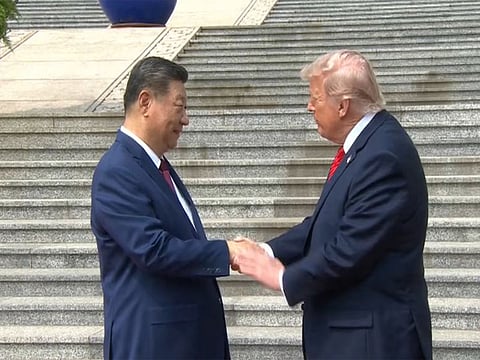
Chinese leader welcomed US President with a handshake for a superpower summit
Highlights
We are closing this coverage now. For latest updates, click here.
'Floating armoury' seized by Iranian forces in the Gulf of Oman
A vessel reportedly operating as a “floating armoury” in the Gulf of Oman has been seized by Iranian military forces, according to maritime risk management company Vanguard.
The UK Maritime Trade Operations (UKMTO) said the ship is now “bound for Iranian territorial waters.”
The vessel — identified by maritime risk consultancy Vanguard as the Honduras-flagged Hui Chuan — was last tracked transmitting its Automatic Identification System (AIS) signal on Wednesday, when it was located roughly 70km (about 40 miles) north-east of Fujairah in the United Arab Emirates, BBC reported.
Trump had 'good meeting' with Xi: White House
US President Donald Trump and Chinese President Xi Jinping held a "good" meeting in Beijing on Friday, the White House said. ''The two sides discussed ways to enhance economic cooperation, including expanding market access for American businesses into China and increasing Chinese investment in US indsutries," the White House said in a statement. According to the statement, the two sides agreed that the Strait of Hormuz must remain open to support the free flow of energy. Both countries, it added, agreed that Iran can never have a nuclear weapon.
Trump says Xi won’t arm Iran, China backs opening of Hormuz
President Donald Trump said Chinese President Xi Jinping pledged not to provide military equipment to Iran and voiced support for keeping the Strait of Hormuz open, a notable signal as Washington, Beijing and Gulf capitals navigate the war’s fallout. China has long been one of Iran’s most important economic partners, especially as a buyer of Iranian oil, but Beijing has also been trying to protect its broader interests in the Gulf and keep shipping lanes open. That balancing act has grown more visible in recent weeks, with Xi publicly urging that Hormuz remain open for normal passage and Chinese officials calling for de-escalation.
World leaders call for security in Strait of Hormuz
As US President Donald Trump and Chinese leader Xi Jinping met in Beijing on Thursday, a group of world leaders restated their call for the Strait of Hormuz to return to normal operations.
In a statement, the leaders affirmed their “commitment to using collective diplomatic, economic, and military capabilities to support freedom of navigation through the Strait of Hormuz.”
“Navigation must be free, as per the provisions of the United Nations Convention on the Law of the Sea (UNCLOS), and international law,” the statement read. It pledged support for “an independent and strictly defensive multinational military mission” to achieve that goal, including by conducting “mine clearance operations.”
The message came from 26 countries, including Britain, France, Bahrain, Canada, Germany, Japan, Qatar and South Korea.
Hezbollah says targeted Israeli troops in north Israel
Hezbollah on Thursday said it targeted Israeli troops in northern Israel with a drone, as Lebanon and Israel were holding a new round of direct talks in Washington.
In a statement, the group said it "targeted a gathering of Israeli enemy army soldiers at the Rosh HaNikra site" near the border with Lebanon with a drone.
The Israeli military had earlier said that "several Israeli civilians were injured and evacuated to receive medical treatment" after "an explosive drone that was launched by the Hezbollah terrorist organisation fell within Israeli territory, near the Israel-Lebanon border". The Galilee Medical Center said the wounded were in Rosh HaNikra.
Xi to order 200 jets: Trump
US President Donald Trump said that Chinese President Xi Jinping agreed to order 200 Boeing jets, describing the move as a commitment from the Chinese leader.
“One thing he agreed to today is he is going to order 200 jets,” Trump said during a clip of an interview with Fox News’ Sean Hannity that was quoted by CNN.
“Boeing,” Trump said, “200 big ones,” adding, “That’s a lot of jobs.”
Boeing shares fell about four percent, suggesting investors had expected a bigger order.
IMF sees risks to global growth forecast over sustained Iran war
The International Monetary Fund warned on Thursday that continuing disruptions due to the Iran war meant its global economic outlook was moving towards an "adverse" scenario, with growth pared down and greater risks to inflation.
Last month, the multilateral lender's World Economic Outlook predicted global growth would drop to 3.1 per cent in 2026 in its "reference" scenario, but warned of a bleaker outlook if the war were to drag on.
In the "adverse" scenario, where oil prices remain higher for longer, inflation expectations become less stable and financial conditions tighten, growth would slow to 2.5 per cent, the Fund said at the time.
On Thursday, the Fund's chief spokesperson said the global economy was headed towards this less auspicious situation.
Trump says Xi stressed would not send military equipment to Iran: interview
US President Donald Trump on Thursday said President Xi Jinping had offered China's help to open the Strait of Hormuz and pledged not to send military equipment to aid Iran in its war against the US and Israel.
"He said he's not going to give military equipment... he said that strongly," Trump told the "Hannity" show on Fox News, after the two leaders met in Beijing.
"He'd like to see the Hormuz Strait open, and said 'if I can be of any help whatsoever, I would like to help,'" Trump added.
The US policy on Taiwan is “unchanged": Rubio
The US policy on Taiwan is “unchanged,” US Secretary of State Marco Rubio said following a meeting between top US and Chinese officials in Beijing, reported CNN.
The top US diplomat said China “always” raises the matter, and “we always make clear our position.”
“From our perspective, any forced change in the status quo in the situation would be bad for both countries,” Rubio said in an interview with NBC News in Beijing.
Pain at the pump drives up US consumer spending in April
Rising gas prices drove up US consumer spending in April even as overall consumption slowed, according to official data released Thursday.
Retail sales totaled $757.1 billion in the United States in April, up 0.5 percent from the previous month and 4.9 per cent year-on-year.
That represents a sharp slowdown from March, when spending rose 1.6 per cent compared to February numbers. The data is nevertheless in line with market expectations.
The broad index of retail and food sales includes in-store purchases, dining out, gas purchases and more. It is not adjusted for inflation, which accelerated sharply over the period.
This implies that, while Americans spent more, they did not necessarily purchase more goods and services by volume.
US consumers are facing soaring prices at the pump due to the repercussions of the war in the Middle East. Their spending at gas stations increased by nearly 21 per cent compared to last year, Thursday's data showed.
New Israel-Lebanon talks open in Washington: diplomats
Israel and Lebanon opened a new round of peace talks in Washington on Thursday as their latest ceasefire is set to expire, diplomats said.
One diplomat privy to the two-day talks said that the two sides started discussions just after 9am (1300 GMT) at the State Department.
Iran says no US visas issued yet for 2026 World Cup
Iran's football federation chief on Thursday said no visas had yet been issued for the national team to participate in the 2026 World Cup in the United States, state media reported.
"Tomorrow or the day after tomorrow, we will have a decisive meeting with FIFA. They must give us guarantees, because the visa issue has still not been resolved," the state news agency IRNA quoted federation chief Mehdi Taj as saying.
"We have not received any account from the other side regarding who has been granted visas. No visas have been issued yet," he added.
According to Taj, the players were expected to travel to the Turkish capital Ankara for fingerprinting as part of the visa process.
"The players must travel to Ankara for fingerprinting, but we are trying to arrange for this to be done in Antalya so there will be no need to travel to Ankara," he said.
US filings for jobless benefits hits 211,000 as the war in Iran drags on
The number of Americans filing for jobless aid rose last week but remains historically low despite the economic uncertainty caused by the war in Iran.
US applications for unemployment benefits for the the week ending May 9 rose by 12,000 to 211,000, the Labor Department reported Thursday. That's slightly more than the 207,000 new applications analysts surveyed by the data firm FactSet had forecast.
Weekly filings for unemployment benefits are considered a proxy for US layoffs and are close to a real-time indicator of the health of the job market.
The four-week moving average of jobless claims, which evens out some of the week-to-week gyrations, inched up by 750 to 203,750.
The total number of Americans filing for unemployment benefits for the previous week ending May 2 jumped by 24,000 to 1.78 million, in line with analyst forecasts.
Xi warns Trump on Taiwan at Beijing summit
Chinese President Xi Jinping warned his US counterpart Donald Trump that missteps on Taiwan could push their two countries into "conflict", a stark opening salvo as they met in Beijing on Thursday at a superpower summit.
Trump arrived in China with accolades for his host, calling Xi a "great leader" and "friend", and extending an invitation to visit the White House in September.
Beyond the pomp as he welcomed Trump, Xi in less effusive tones said the two sides "should be partners and not rivals", and highlighted the issue of Taiwan - which Beijing claims as its territory - straight off the bat.
"The Taiwan question is the most important issue in China-US relations," Xi said, according to remarks published by Chinese state media shortly after the start of the talks, which lasted two hours and 15 minutes.
"If mishandled, the two nations could collide or even come into conflict, pushing the entire China-US relationship into a highly perilous situation," Xi added.
Iran allows Chinese ships to pass Hormuz since Wednesday
Iranian media reported Thursday that naval forces had allowed a group of Chinese ships to pass through the strategic Strait of Hormuz since the night before.
"Following a decision by the Islamic republic, a number of Chinese vessels have been allowed to pass through the Strait of Hormuz under Iranian-managed transit protocols," the Tasnim news agency said.
It added that the passage, which was requested by Beijing, began on Wednesday evening after "an understanding on Iranian management protocols".
Stocks diverge tracking tech, US-China talks
European and Asian stock markets diverged on Thursday as investors weighed high-stakes talks between the United States and China and optimism over artificial intelligence.
US President Donald Trump and Chinese counterpart Xi Jinping met in Beijing for a closely watched summit that covered thorny issues including Taiwan, but yielded few concrete outcomes in its opening phase.
After a lacklustre session in Asia, European equities rose in midday trading.
London edged up 0.3 per cent after data showed the UK economy had a solid start to the year, though the Middle East war and political turmoil threatened to cloud the outlook.
Frankfurt climbed more than one percent and Paris advanced 0.6 per cent, lifted by tech stocks.
"The UK index has been weighed down by its lack of tech, which is driving a global stock market rally," said Kathleen Brooks, research director at trading group XTB.
Enthusiasm for artificial intelligence led another tech-led rally on Wall Street on Wednesday, powering the Nasdaq and S&P 500 to record highs.
"Politics and a recalibration of interest rate expectations are both failing to dampen the market mood," Brooks said. "The question now is, how long can it last?"
Trump says talks with Xi 'extremely positive and productive'
US President Donald Trump said Thursday that talks earlier with Chinese counterpart Xi Jinping had been "extremely positive" while addressing a banquet on the first full day of a closely watched summit in Beijing.
"We had extremely positive and productive conversations and meetings today with the Chinese delegation earlier," said Trump in the lavish Great Hall of the People, describing the evening as "another cherished opportunity to discuss among friends".
Trump invites Xi to visit White House in September
Trump extended a Sept. 24 invitation to Xi and his wife, Madame Peng, during his reciprocal toast.
"And we look forward to it," Trump said.
He also thanked Xi for his hospitality.
"This has been an amazing period of time," Trump said.
Trump recounts 'fantastic day' in China to open banquet toast
"This is a great honor. It was a fantastic day," Trump said. "It really was a magnificent welcome like none other."
He described his talks with Xi as "extremely positive conversations" and said everything that they discussed was "all good for the United States and China.
"And it was a great honor to be with you," the U.S. president said, referring to his Chinese counterpart.
Xi says U.S.-China relationship is most important in the world
Xi Jinping called for the China and the U.S. to work together as partners rather than rivals in an opening toast ahead of the state banquet that was largely positive though measured.
"We both believe that China and the U.S. relationship is the most important bilateral relationship in the world. We must make it work and never mess it up," Xi said.
Xi noted it was the 250th anniversary of American independence.
"Achieving the great rejuvenation of the Chinese nation and making America Great Again can go hand in hand," he said. "Both China and U.S. stand to gain from cooperation and lose from confrontation, should be partners rather than rivals."
He then toasted Trump and the audience.
Delhi condemns attack on Indian-flagged ship off Oman coast
India’s Ministry of External Affairs (MEA) on Thursday strongly condemned the attack on an Indian-flagged ship off the coast of Oman, calling it “unacceptable” and voicing concern over continued threats to commercial shipping in the region.
In an official statement, the MEA said all Indian crew members aboard the vessel were safe and thanked Omani authorities for rescuing them, media reports said.
What Trump and Xi discussed at the Temple of Heaven
U.S. reporters were mainly kept far away from the leaders when they toured the UNESCO heritage site.
But China's official Xinhua News Agency cited Trump as being impressed to see the Temple of Heaven still standing tall and magnificent after over 600 years, showcasing exquisite Chinese classical architectural art.
Xi said ancient Chinese rulers held sacrificial ceremonies at the temple to pray for national peace and prosperity.
Xi said it showed the traditional Chinese thought that "the people are the foundation of the state, and when the foundation is solid, the state is stable," according to Xinhua.
Trump said he vividly remembers his 2017 visit to the Forbidden City, Xinhua reported.
Trump attends Chinese state banquet in his honor
The affair brought Trump back to the Great Hall of the People, where he opened his first full day in Beijing in closed-door talks with Xi.
Inside the hall, round tables were draped with white tablecloths.
Key members of Trump's Cabinet including Secretary of State Marco Rubio, Defense Secretary Pete Hegseth and Treasury Secretary Scott Bessent milled about before Trump arrived.
Chinese premier stresses cooperation in talk with US executives
Chinese Premier Li Qiang stressed the need for friendship and cooperation in U.S.-China ties as he spoke with U.S. business leaders accompanying President Donald Trump in Beijing.
Li met executives including Elon Musk, Apple's Tim Cook and Nvidia CEO Jensen Huang on the sidelines of Trump's summit with Chinese President Xi Jinping.
"China and the United States have been able to maintain frank and smooth dialogue and communication and actively safeguard a stable and healthy bilateral relationship" despite international turbulence, Li said.
Collaboration is needed for "mutual success and shared prosperity," Li added.
Fujairah says smoke at oil industries zone caused by pipeline maintenance fire
The Fujairah Government Media Office said smoke seen in the emirate’s oil industries area on Thursday was caused by a minor fire resulting from pipeline maintenance works.
In a statement, the office said the incident was linked to routine maintenance operations and described the fire as accidental.
Civil defence teams in Fujairah were immediately deployed to the site and brought the situation under control, the statement said.
Authorities urged the public not to circulate rumours and to rely only on official sources for information regarding the incident.
Israel army says Israeli civilians injured in Hezbollah drone strike
A Hezbollah drone strike injured several Israeli civilians on Thursday, the Israeli military said, hours before US-brokered talks between Israel and Lebanon were set to begin in Washington.
"A short while ago, an explosive drone that was launched by the Hezbollah terrorist organisation fell within Israeli territory, near the Israel-Lebanon border," the military said.
"As a result, several Israeli civilians were injured and evacuated to receive medical treatment at the hospital."
Trump-Xi meeting was 'good': White House
US President Donald Trump and Chinese leader Xi Jinping held a "good" meeting in Beijing on Thursday, the White House said, in a readout that did not include any reference to Taiwan.
"President Trump had a good meeting with President Xi of China. The two sides discussed ways to enhance economic cooperation," the White House said in a statement.
It made no mention of discussions on self-ruled Taiwan that Xi earlier said could cause a "conflict" between China and the United States should the issue be mishandled.
Turkey lifts 2026 inflation forecast on Mideast war fallout
Turkey's central bank has raised its year-end inflation forecast to 26 percent from 16 percent, governor Fatih Karahan said Thursday, pointing to higher energy prices due to the Middle East war.
Turkey has grappled with double-digit inflation since 2019, with annual inflation rising to 32.37 percent in April from 30.9 percent in March.
"We forecast that inflation will be 26 percent by the end of 2026," Karahan said.
The bank also predicted inflation would fall to 15 percent by the end of next year and to just nine percent in 2028.
Karahan said the war sparked by the US and Israeli strikes on Iran had propelled energy as well as transportation prices.
"We believe those effects will persist in the short term," he said, adding: "I would like to emphasise that we are not wavering in our resolve at this time."
Turkey's official inflation figures are often disputed by independent economists from the Inflation Research Group (ENAG), who estimated that April's consumer prices increase was 55.38 percent year-on-year.
Trump, Xi agreed Strait of Hormuz 'must remain open'
US President Donald Trump and his Chinese counterpart Xi Jinping agreed Thursday that the Strait of Hormuz "must remain open", the White House said, as the two leaders met in Beijing.
"The two sides agreed that the Strait of Hormuz must remain open to support the free flow of energy," the White House said.
Get updated faster and for FREE: Download the Gulf News app now - simply click here.
Israel army says striking Hezbollah in southern Lebanon
Israel's military said it launched strikes against Hezbollah targets across southern Lebanon on Thursday, hours before US-brokered talks between the two countries were set to begin in Washington.
"The IDF has begun striking Hezbollah terror infrastructure sites in several areas in southern Lebanon," the military said after issuing evacuation warnings for a number of villages in the area.
Gulf countries reject new 'administration'
Bahrain, UAE, Saudi Arabia, Qatar, Kuwait, and Jordan condemn, reject Iranian claims regarding new "administration" or "legal rules" for Strait of Hormuz.
The GCC countries urgently submitted a joint letter to the United Nations, addressed to António Guterres, Secretary-General of the United Nations, and Ambassador Fu Cong, Permanent Representative of China and President of the Security Council for May, expressing their condemnation and categorical rejection of the recent statements made by an official of Iran regarding the countries of the region and the Strait of Hormuz.
Iran internet blackout continues
The internet blackout in Iran has entered its 76th day, with connectivity restrictions now exceeding 1,800 hours. Access remains limited under a tiered system, where only select users are granted partial connectivity while the wider public remains largely offline.
China's commerce ministry open to expanded US cooperation
China is willing to work with the U.S. to continuously expand its cooperation list, China's Ministry of Commerce spokesperson He Yongqian said Thursday.
Chinese Vice Premier He Lifeng and U.S. Treasury Secretary Scott Bessent engaged in "candid, in-depth and constructive" exchanges in South Korea on Wednesday, He said.
For the next step, China is willing to work with the U.S. to expand their cooperation based on the principles of equality, respect and mutual benefit, He said.
They also would shorten the problem list while promoting healthy economic and trade ties between the sides, He said.
Trump and Xi exchange views on the Middle East, state media reports
Trump and Xi have exchanged views on the situation in the Middle East, the Ukraine crisis and the Korean Peninsula, the official Xinhua news agency reported without providing additional details of the discussion.
The wars in Iran and Ukraine and relations with North Korea have been sources of tensions between Washington and Beijing.
Trump and Xi agreed to support each other this year by hosting the APEC Economic Leaders' Meeting in Shenzhen, near Hong Kong, and the G20 Summit in Florida, Xinhua reported.
Xi calls for stability in relationship with US
Xi said he and Trump agreed to establish a new orientation for U.S.-China relations that is "constructive, strategic and stable."
Xi said the bilateral relationship should take this direction for the next three years and beyond, according to China's official Xinhua news agency.
Xi said this new strategic orientation should have "limits to competition" and "differences are managed."
Xi said both sides should use political, diplomatic and military communication channels to ensure the goals.
Xi says China-US economic ties are win-win, state media reports
Economic ties between China and the United States are mutually beneficial and win-win in nature, Chinese President Xi Jinping told U.S. President Donald Trump during their talks, according to the Chinese official news agency Xinhua.
"Yesterday, our economic and trade teams produced generally balanced and positive outcomes. This is good news for the people of the two countries and the world," Xi said.
The Chinese president said facts have shown time and again there are no winners in trade wars, calling on both sides to jointly sustain the good momentum they have worked hard to build, Xinhua reported.
"Where disagreements and frictions exist, equal-footed consultation is the only right choice," he said.
Iran war and oil dominate BRICS meet in India
BRICS foreign ministers, including from Iran and Russia, met in New Delhi on Thursday, where India warned of "considerable flux" with conflict driving economic uncertainty and energy insecurity.
War in Iran and the related fuel crisis are dominating discussions in the two-day gathering.
India, which holds the BRICS chair this year, was hosting the foreign ministers from the expanded bloc, which now includes Iran, Saudi Arabia and the United Arab Emirates - countries at odds over the conflict launched by the United States and Israel on February 28.
Asian shares mixed and Chinese stocks trade lower
Asian shares were mixed Thursday as investors closely monitored takeaways from U.S. President Donald Trump's summit with Chinese leader Xi Jinping in Beijing.
The Shanghai Composite index lost 1% to 4,199.19. Hong Kong's Hang Seng gained 0.3% to 26,478.99. Markets in Japan and South Korea were higher, with Tokyo's Nikkei 225 up 0.2% and Seoul's Kospi gaining 1%.
Investors are watching for progress on the Iran war and U.S.-China trade relations from the Xi-Trump summit, as well as possible trade deals on areas such as soybeans, airplanes and chips.
XI says door to American business opening wider
Xi said China's door of opening to American business will only open wider and wider he told American CEO's on Wednesday morning during his meeting with Trump, China's official Xinhua news agency reported.
Xi said American companies are deeply participating in China's reform and opening, with both sides benefiting from this. He said China welcomes the U.S. to strengthen mutually beneficial cooperation with China and believes American businesses will have even broader prospects in China, according to Xinhua.
Traveling to China as part of the U.S. delegation are some 17 CEOs, including Tesla's Elon Musk, Apple's Tim Cook and Boeing's Kelly Ortberg, the White House says.
Trump, Xi visit Beijing's Temple of Heaven
US President Donald Trump and Chinese counterpart Xi Jinping visited Beijing's historic Temple of Heaven after concluding high-stakes talks on Thursday.
The two leaders arrived at the world heritage site shortly after 1 pm (0500 GMT), where Trump told reporters that "China's beautiful", after talks that touched on thorny issues.
Trump and Xi wrap up meeting after about two hours
The White House and Chinese state media said the leaders concluded their meeting after about two hours of talks.
The leaders discussed trade, Taiwan and other differences in the U.S.-China relationship
Xi warns Trump differences over Taiwan could bring US and China to clashes or conflict, state media reports
In a closed-door meeting Xi told Trump that if Taiwan is handled well, U.S.-China relations "will enjoy overall stability," according to a readout of their bilateral talks published by the official Xinhua news agency.
If not, however, the two countries risk "clashes and even conflicts, putting the entire relationship in great jeopardy," Xi was reported to have said.
Xi tells Trump US, China could 'come into conflict' if Taiwan issue mishandled
Chinese leader Xi Jinping told US President Donald Trump on Thursday that their countries could come into conflict if the issue over Taiwan claimed by Beijing is mishandled, Chinese state media said.
"The Taiwan question is the most important issue in China-US relations," Xi said, according to state broadcaster CCTV.
"If mishandled, the two nations could collide or even come into conflict, pushing the entire China-US relationship into a highly perilous situation".
Get updated faster and for FREE: Download the Gulf News app now - simply click here.
Hezbollah claims 17 operations against Israeli forces in southern Lebanon: Iranian media
Hezbollah carried out 17 operations on Wednesday targeting Israeli military positions, forces and vehicles in southern Lebanon, according to Iranian state media Press TV.
Press TV reported that the operations included eight drone strikes, five missile or rocket attacks, one artillery strike, and one guided missile launch.
According to the news agency, Hezbollah targeted two "Nimr" military vehicles, two "Merkava" tanks, one armoured personnel carrier and two military bulldozers during the attacks.
The group also claimed that its fighters "ambushed" Israeli troops near the outskirts of the town of Haddatha, using pre-planted explosives along with 'light and heavy weapons and artillery fire'.
Xi tells Trump US, China should be 'partners not rivals'
Chinese leader Xi Jinping told US President Donald Trump the two countries should be "partners and not rivals" as they met for talks in Beijing on Thursday.
"A stable China-US relationship is a boon for the world. Cooperation benefits both sides, while confrontation harms both. We should be partners and not rivals," Xi said.
Xi added he was "happy" to receive Trump for the US leader's first trip to China since 2017 as "the world has arrived at a new crossroads."
Trump tells Xi 'we're going to have a fantastic future together'
US President Donald Trump told Chinese leader Xi Jinping on Thursday that the two superpowers would have a "fantastic future together" as the men met for talks in Beijing.
"It's an honor to be with you. It's an honor to be your friend, and the relationship between China and the USA is going to be better than ever before." Trump said at the meeting in the Great Hall of the People, adding that the two nations were going to "have a fantastic future together".
Trump, Xi shake hands at Beijing's Great Hall of the People
US President Donald Trump met Chinese leader Xi Jinping at Beijing's Great Hall of the People for a high-stakes summit, AFP saw Thursday.
The two leaders shook hands after Trump arrived in a motorcade to the steps, where a US delegation including State Secretary Marco Rubio, War Secretary Pete Hegseth and business CEOs including Elon Musk awaited him.
Rubio says Trump will make the case to China to take a 'more active role' on Iran
The secretary of state, who is with Trump in Beijing, said administration officials will underscore that "economies are melting down because of this crisis" and that will result in consumers "buying less Chinese product."
"So it's in their interest to resolve this," Rubio said in an interview with Fox News' Sean Hannity. "We hope to convince them to play a more active role in getting Iran to walk away from what they're doing now and trying to do now in the Persian Gulf."
The message contrasts with comments by Trump, who downplayed differences with Xi over Iran before departing from Washington.
"We have a lot of things to discuss," Trump told reporters. "I wouldn't say Iran is one of them, to be honest with you, because we have Iran very much under control."
Get updated faster and for FREE: Download the Gulf News app now - simply click here.
US, Chinese officials agree: No country can exact shipping tolls in Hormuz
Senior US and Chinese officials agree that no country can be allowed to exact shipping tolls in the Strait of Hormuz, the State Department said, in a sign that the two countries are trying to find common ground on efforts to pressure Iran to give up control of the vital waterway. The statement by the State Department comes ahead of a high-stakes summit between President Donald Trump and Chinese President Xi Jinping, where Iran's chokehold on the strait will be on the agenda.
Trump set to meet Xi in Beijing amid mounting rivalry
President Donald Trump is set to meet Chinese President Xi Jinping in Beijing in a high-stakes summit where tariffs, competition over technology, the war in Iran and the future of Taiwan are expected to dominate the agenda, US and international media reported.
The two leaders’ talks come as Washington and Beijing try to manage deep economic ties amid mounting strategic rivalry, with tariffs and US export restrictions on advanced chips and other technology likely to be front and center, as per CNBC and AP.
Trade and tariffs are expected to top the schedule as negotiators look for steps to stabilise economic relations and possibly narrow punitive duties that have weighed on bilateral commerce.
The Iran war and related regional tensions are also on the agenda, with both sides reported to seek clarity on each other’s positions and potential cooperation or de‑confliction.
Taiwan remains a key flashpoint, with Beijing stressing its core interest and Washington signaling continued support for the island’s defence, according to briefings and coverage ahead of the summit.
Tehran demands Kuwait's release of 4 Iranians detained in the Gulf
Iran’s foreign minister, Abbas Aragchi, said Tehran is demanding the immediate release of four Iranian citizens detained by Kuwaiti authorities after an incident in the northern Arabian Gulf. Kuwaiti officials earlier said the four — who allegedly confessed to links with Iran’s Islamic Revolutionary Guard Corps (IRGC) — were arrested this month as they attempted to land on a Kuwaiti island.
Aragchi accused Kuwait of boarding and attacking an Iranian vessel and said Iran “has the right to respond,” calling the detentions an unlawful attempt to “sow discord.”
In a post on X he wrote that the incident occurred “near [an] island used by the US to attack Iran” and reiterated demands for the detainees’ immediate release. Kuwait’s Interior Ministry said the four included two navy colonels, a captain and a lieutenant commander, and that they admitted they had been tasked with “infiltrating” Bubiyan Island.
Study points to limits of Hormuz as central strategic 'lever' for Iran
Iran's strategy prior to October 7, 2023, and the subsequent regional escalations — including the intense Spring 2026 conflict with the United States and Israel — relied heavily on ballistic missiles, drones, and a network of "proxy" forces, including those in Lebanon, Iraq, Yemen and Palestine. Those pillars have been significantly "degraded", elevating the strategic importance of the Strait of Hormuz, reports the Institute for the Study of War (ISW) and its partner, Critical Threats Project (CTP).
This strategy, too, has its own limits, another think-tank pointed out. "Iran’s ongoing strategy of leveraging the Strait of Hormuz as a geopolitical pressure point is widely perceived as a source of strategic advantage," according to the Begin-Sadat Centre for Strategic Studies (BESA). "However, this assessment overlooks a fundamental reality: Iran is structurally more vulnerable to sustained disruption of the strait than are its regional adversaries," the centre pointed out.
UAE denies reports regarding visit by Israeli Prime Minister or receiving any Israeli military delegation
The United Arab Emirates denies reports circulating regarding an alleged visit by Israeli Prime Minister Benjamin Netanyahu to the UAE, or receiving any Israeli military delegation in the country. The UAE reaffirms that its relations with Israel are public and conducted within the framework of the well-known and officially declared Abraham Accords, and are not based on non-transparent or unofficial arrangements.
US‑Israel war on Iran: Recent developments
Day 75: Trump arrives in Beijing for summit with Xi
Day 74: Iran signals potential 90% Uranium enrichment
Day 73: Trump calls Iranian response 'totally unacceptable'
Day 72: 'As of today, Tehran’s restraint is over': Iran official
Day 71: Iran keeps US waiting on response to peace plan
Day 70: US fires on Iran tankers as talks hang in balance
Day 69: Iran creates agency to control shipping at the Strait of Hormuz
Day 68: Trump threatens 'higher level' bombing of Iran if deal not agreed
Day 67: 'Project Freedom' paused 'for a short period': Trump
Day 66: UAE intercepts 12 ballistic missiles, 3 cruise missiles, 4 drones


