In this image from a video made available by the US Navy, a boat of Iran's Islamic Revolutionary Guard Corps Navy (IRGCN) operates in close proximity to patrol coastal ship USS Sirocco (PC 6) and expeditionary fast transport USNS Choctaw County (T-EPF 2) in the Strait of Hormuz, Monday, June 20, 2022. A U.S. Navy warship fired a warning flare to wave off an Iranian Revolutionary Guard speedboat coming straight at it during a tense encounter in the strategic Strait of Hormuz, officials said Tuesday. (U.S. Navy via AP)
Warthogs, Apaches over Hormuz: US unleashes low-altitude firepower to hunt Iranian swarm boats in showdown
Hunt on for Iran's fast-attack and drone boats imposing tanker squeeze in Hormuz Strait
Last updated:
3 MIN READ
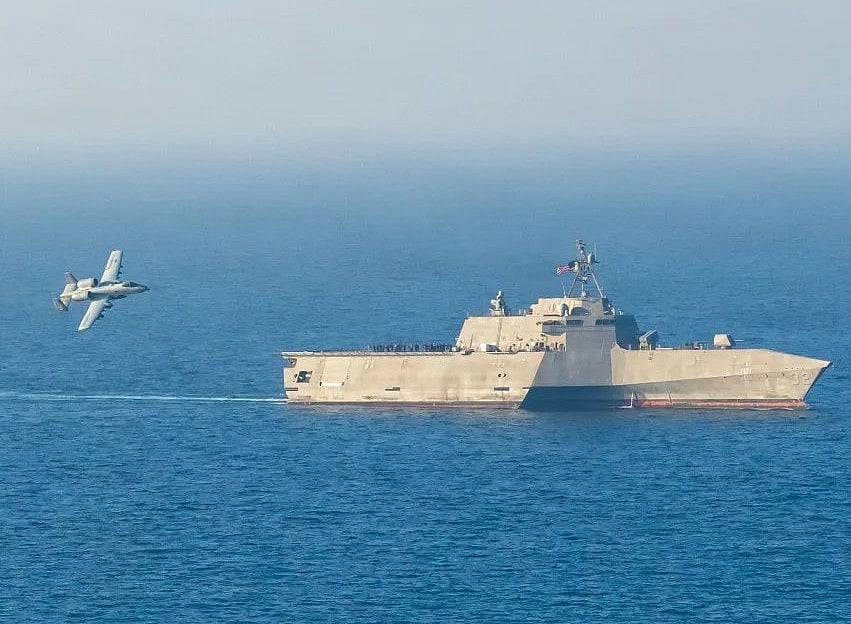
The Littoral Combat Ship (LCS) USS Santa Barbara is in the Arabian Gulf conducting mine countermeasures with unmanned surface vehicles. While hunting mines, she's operating under armed overwatch from A-10C Warthogs loaded with JDAMs, laser-guided APKWS rockets, and enough firepower to shred any fast boat or drone swarm the Islamic Regime throws at them.
The US military has escalated operations in the Strait of Hormuz.
According to General Dan “Razin” Caine, A-10 "Warthogs" and Apache helicopters are now actively targeting Iranian fast-attack boats, including remote-controlled vessels laden with bombs that threaten oil tankers.
AH-64 Apache gunships are also engaging drones and Iranian militia-linked threats.
This marks a significant shift in Pentagon's strategy involving the use of military hardware for close-range battlefield control see combat action.
The A-10s, built for close-range destruction of ground and surface targets, are now being used to hunt fast-moving vessels in one of the world’s most critical waterways. Apaches are expanding operations — targeting threats before they can escalate. This marks a new phase
The United States War Department is reportedly intensifying operations in the Strait of Hormuz, signaling a sharper, more aggressive phase in efforts to secure one of the world’s most critical trade corridors.
According to General Dan Caine, the battlefield is shifting closer to the water’s surface.
A-10 Thunderbolt II jets — long known for their devastating low-altitude attack capability — are now being deployed to directly engage Iranian fast-attack craft, alongside US minesweepers-littoral combat shiplike the USS Santa Barbara.
Swarm boat attacks
These include swarm-style boats and, increasingly, remote-controlled explosive vessels that pose a growing threat to commercial oil tankers transiting the narrow chokepoint.
This handout photo released by Iran's Revolutionary Guards Corps (IRGC)'s official website Sepanews on February 17, 2026, shows Iran regime's fast-attack boats manoeuvering around a tanker vessel during a military exercise by members of the IRGC and navy in the Strait of Hormuz.
Complementing the Warthogs are AH-64 Apache gunships, which are reportedly intercepting drones and monitoring militia-linked maritime activity across the Arabian Gulf.
'Pivot' to close-range engagements
Defense analysts say the pairing reflects a deliberate "pivot" toward close-range, high-precision engagements — aimed at neutralising threats before they can reach major shipping lanes.
Open-source intelligence and defense watchers have tracked increased US aerial patrols and rapid-response manoeuvres in the Gulf, with some X posts highlighting the resurgence of the A-10 in maritime interdiction roles— an uncommon but not unprecedented mission set.
Asymmetric war tactics
The move comes amid heightened tensions with Islamic Revolutionary Guard Corps naval units, which have historically relied on asymmetric tactics — fast boats, mines, and drones — to challenge larger conventional fleets.
A US Army AH-64D Apache helicopter fires missiles during military exercises of Nato allied countries in Orzysz, northwestern Poland, on September 17, 2025.
Deploying aircraft designed for close air support into this environment could help Pentagon war planners to counter speed with precision, and break Iran's grip over the strategic Hormuz Strait.
Evolving air-sea battle
While the US Central Command has not released full operational details, analysts point to a broader strategic recalibration: securing maritime flows not just through deterrence, but through active, near-contact enforcement.
With nearly a fifth of global oil passing through Hormuz, even minor disruptions can ripple across energy markets.
This evolving air-sea battle underscores a stark reality — control of the strait is no longer just about naval dominance, but about who can act fastest, lowest, and with the most precision in the world’s most volatile shipping lane.
Sign up for the Daily Briefing
Get the latest news and updates straight to your inbox
Network Links
GN StoreAbout Gulf NewsTerms & ConditionsReach by GNSitemapContact usPrivacy PolicyGN FocusHave your sayWork with usAdvertise with usGulf News epaperPrinting Services
Download our app
© Al Nisr Publishing LLC 2026. All rights reserved.