The LUCAS, which the US has mass produced after reengineering the Shahed drone captured from Iran.
US 'ready' to use clone of Iran’s own Shahed drone against it — sign of what’s coming next
Pentagon turns Iranian-made Shahed-style kamikaze drones into American attack platforms
Last updated:
4 MIN READ
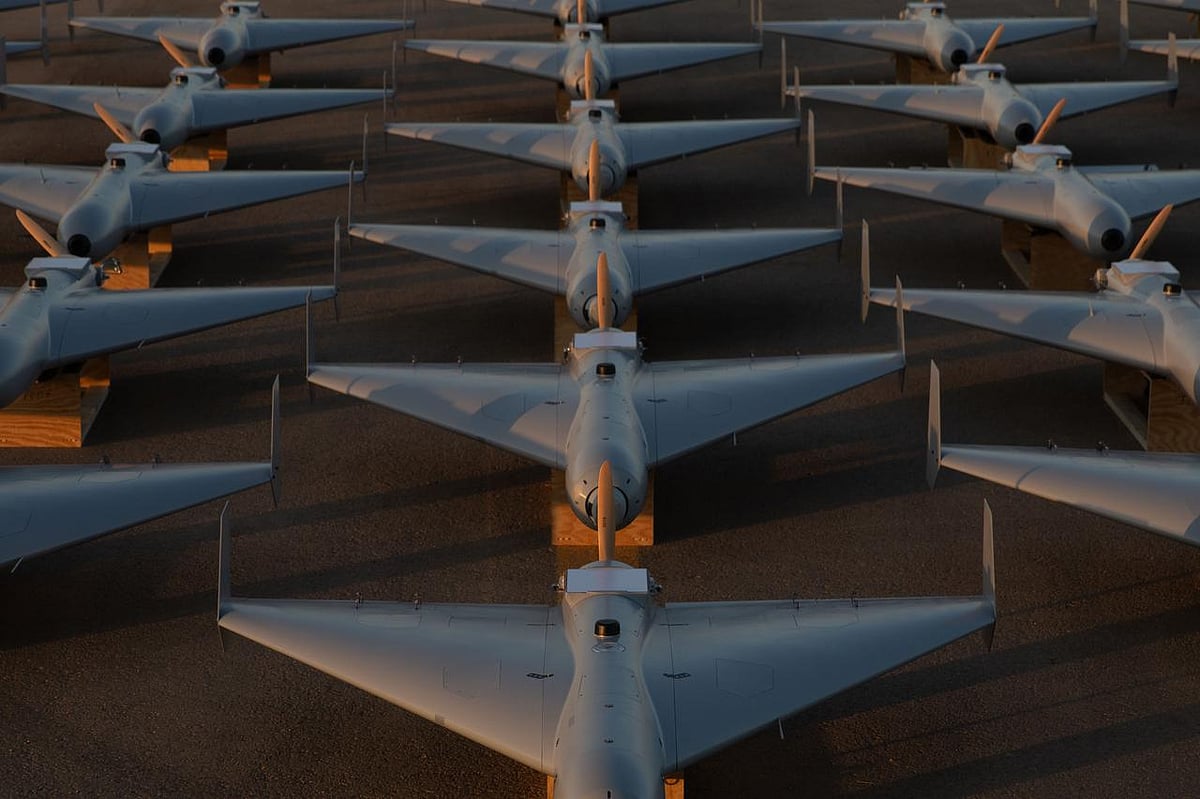
DRONE WAR? Low-cost Unmanned Combat Attack System (LUCAS) drones are positioned on the tarmac at a base in the US Central Command (CentCom) operating area. LUCAS is a clone of Iran's inexpensive Shahed-136 kamikaze drone. Photo published on Nov. 23, 2025.
US Department of War | CentCom
It's dubbed as a "low-cost weapon" for a new era of warfare. It's also named as such: Low-Cost Unmanned Combat Attack System, or LUCAS.
Turns out that America has turned the one-way Shahed drones, an Iran-developed "swarm" weapon system, on its head.
They cloned Shahed-136, upgraded it, now ready to deploy it back at its creator.
The Pentagon has announced its "kamikaze" drone unit is “ready to participate” in a potential war against Iran, showing new war tactics amid the escalating tensions, and no deal.
Shahed-136 drones have seen combat in Ukraine (via Russian use), Iranian strikes on Israel, in regional maritime attacks, along with transfers to Houthis in Yemen.
So far, five talks between the US and Iran have produced no deal on Iran's nuclear enrichment, storage, inspections and ballistic missiles.
On Friday, following the Thursday talks in Geneva, Iran's Foreign Minister Abbas Araghchi has said a deal, while possible, requires "seriousness and realism from the other side and avoidance of any miscalculation and excessive demands".
Aragchi is standing pat on Iran's “red lines,” while declaring “good progress,” a tactic seen in Washington as a delaying strategy that allows Tehran to preserve and expand its nuclear capabilities.
Meanwhile, the US military buildup in the region continues — raising concerns that diplomacy may be stalling and that pressure could have to shift back to coercive options to prevent Tehran from nearing weapons capability, as per The Guardian.
Task Force Scorpion
Now, with US President Donald Trump's patience wearing thin, the US military has openly declared that its first dedicated kamikaze drone squadron is "operationally ready".
Military analysts say they could see action if President Donald Trump orders strikes against Iran, according to US officials and defense analysts cited by Bloomberg.
Unmanned Combat Attack System (LUCAS) drones are positioned on the tarmac at an undisclosed base in the US Central Command operating area, on November 23, 2025. The LUCAS platforms are part of a one-way attack drone squadron that CENTCOM recently deployed to the Middle East.
Known as Task Force Scorpion, the unit has evolved from an experimental program into a fully operational squadron embedded within the largest American military buildup in the Middle East since the 2003 invasion of Iraq, a deployment Trump ordered to pressure Tehran into negotiations over its nuclear programme.
LUCAS one-way attack drone
The unit operates the Low-Cost Unmanned Combat Attack System, or LUCAS, a one-way attack drone produced by Arizona-based SpektreWorks that US Central Command estimates costs roughly $35,000 per unit.
The lightweight drones can be deployed for strike missions, reconnaissance and maritime operations, and are "designed to operate autonomously" with "an extensive range," according to a CENTCOM statement.
"We established the squadron last year to rapidly equip our warfighters with new combat drone capabilities that continue to evolve," CENTCOM spokesman Capt. Tim Hawkins said.
'Shahed' drone mass produced in Texas
The Pentagon has transformed Iran's own Shahed-136 kamikaze drone into a potent US weapon system, openly reverse-engineering it for deployment against its creators amid rising Middle East tensions.
Through Task Force Scorpion Strike (TFSS), the US Central Command (CENTCOM) now fields the Low-Cost Unmanned Combat Attack System (LUCAS), a cloned and upgraded version ready for sustained operations, as per Bloomberg.
Reverse-engineering process
Texas-based SpektreWorks seized a captured Shahed-136—familiar from Russia's thousands of Ukraine strikes—dissected it down to circuit boards, then rebuilt it with US tech: autonomous AI flight controls, GPS-denied inertial navigation, swarm coordination for 40-drone barrages, and enhanced range/payload.
The US Central Command (CentCom) activated TFSS four months after Secretary of War Pete Hegseth accelerated low-cost drone acquisition, basing a LUCAS squadron in the Middle East for rapid warfighter delivery.
At just $35,000 per unit, it undercuts pricier Tomahawks ($2M) and JDAMs ($25K–$40K), solving Pentagon ammo math where precision stocks last only 7–10 days in high-intensity campaigns., according to CentCom.
Operational edge
LUCAS mirrors Shahed's loitering munition design but surpasses it with superior autonomy, anti-jam resilience, and scalability, turning Iran's decades-old tech into America's attritable swarm weapon.
US officials confirm the unit stands "ready to participate" in potential strikes if President Trump greenlights action, extending short conventional "shock and awe" barrages into affordable, prolonged campaigns.
This mirrors Iran's history of copying US systems, now flipped as Washington deploys the tech — complete with original American-sourced GPS chips from Shaheds — back at Tehran.
Strategic timing
As Geneva talks stall — with Iran's Abbas Araghchi claiming "good progress" but no curbs on enrichment — Trump convenes parties Saturday deciding by 3 PM ET before markets close (12:00 AM | midnight Gulf Standard Time), priming for market ripples without weekend chaos.
With munitions reportedly depleted from prior Israel-Iran clashes (e.g., 25% THAAD stock used in 12 days), LUCAS fills the gap.
This could enable making wars against drone-heavy foes like Iran viable long-term.
Sign up for the Daily Briefing
Get the latest news and updates straight to your inbox
Network Links
GN StoreAbout Gulf NewsTerms & ConditionsReach by GNSitemapContact usPrivacy PolicyGN FocusHave your sayWork with usAdvertise with usGulf News epaperPrinting Services
Download our app
© Al Nisr Publishing LLC 2026. All rights reserved.