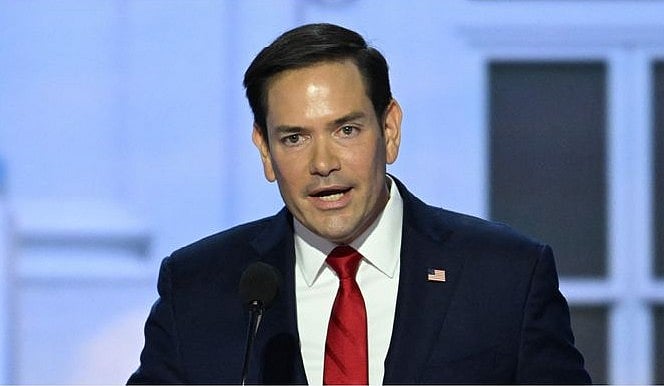
US Secretary of State Marco Rubio has rejected Iran’s demand for war reparations, saying Tehran should instead pay compensation because it had “destabilised the region.”
He made the remarks after a meeting of Group of Seven foreign ministers in Paris on Tuesday, Nov. 10.
“Iran is demanding reparations. They should be the ones paying reparations because they’re the ones that have destabilised the region for long periods of time,” Rubio told reporters.
“They’re demanding pallets of cash, which the president has made clear is not going to happen.”
Get it: Fast, verified news for FREE ... download the Gulf News app — simply click here
Rubio said Washington would not pay Iran for war damage.
His comments came after Iran set conditions for ending the conflict, including the lifting of the US naval blockade and sanctions, the release of frozen state assets and reparations for damage caused by US and Israeli strikes.
The big picture
Rubio told G7 ministers that US sanctions and the naval blockade were working well enough that President Donald Trump did not need to launch major combat operations against Iran “at this point.”
He said Washington had "options beyond war" or accepting what it considers unacceptable Iranian demands, Reuters reported.
The dispute over reparations is one of the main obstacles to a diplomatic settlement.
Rubio described Iran’s current conditions as “absurd” and “not serious,” while saying the United States was not close to a breakthrough, per CNBC.
Why it matters
The standoff keeps pressure on oil markets and global shipping, particularly around the Strait of Hormuz.
Oil prices fell to two-month lows on Tuesday as investors weighed the US signals of restraint against the continuing blockade and unresolved negotiations.
Crude oil rates slid further on Wednesday (Nov. 11, 2026) as Trump held off strikes on Iran.
For households and businesses, the immediate effect depends less on the reparations dispute than on whether the blockade eases and shipping through Hormuz normalises.
A durable agreement would need to resolve sanctions, frozen assets, military operations and financial compensation — issues that remain far apart.
What’s next
Rubio said the US would continue imposing “devastating” economic costs on Iran, while Trump signalled no immediate return to large-scale military action.
Iran, meanwhile, has accused Washington of manufacturing “fake news about imaginary talks,” underscoring the gap between the two sides.
Major General Mohsen Rezaei, the secretary of Iran’s Supreme National Security Council, has firmly denied that any negotiations or meetings are taking place between Tehran and Washington.
Rezaei called claims by Washington and Western media regarding ongoing talks or a planned meeting in Qatar a "pure lie" and "complete lies" designed to reduce economic pressure and lower global oil prices.
Rezaei stated that the Strait of Hormuz will remain "closed" until the US fully implements Iran's seven "non-negotiable conditions", adding that initial American responses have been insufficient or "deceptive".
The next test is whether either government shifts from public "red lines" to a workable negotiating framework.
Network Links
GN StoreDownload our app
© Al Nisr Publishing LLC 2026. All rights reserved.