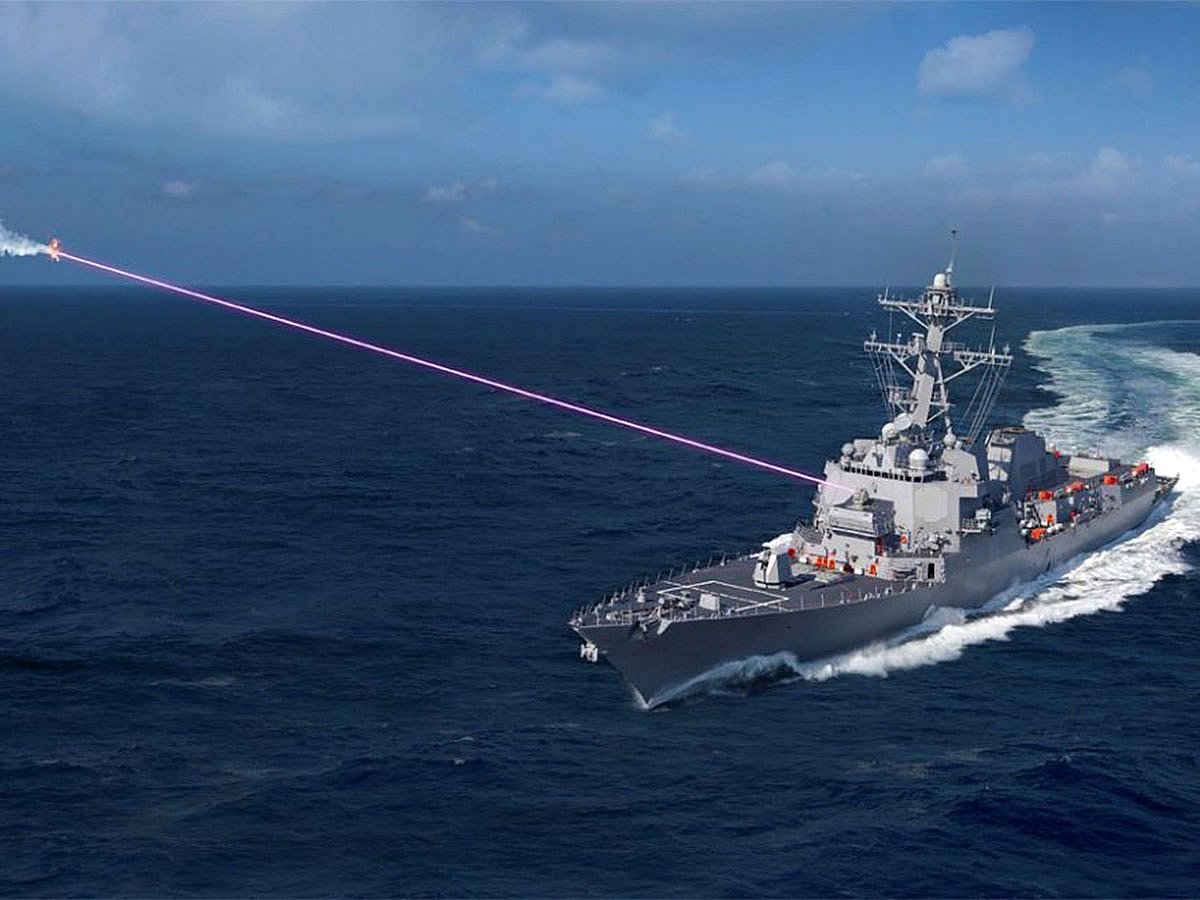
High-energy lasers are increasingly being viewed as a potential game-changer in defending oil facilities, military bases and critical infrastructure against the growing threat of drones and missiles in the Middle East.
Unlike traditional interceptor systems such as Patriot missiles — which can cost more than $3 million per shot — firing a laser may cost as little as $3.50, according to some estimates. The dramatic difference in cost is drawing renewed interest from the United States and its allies as Iran and its proxies expand the use of relatively cheap drones and missiles across the region.
President Donald Trump told reporters this week that laser technology could soon perform the same defensive role as missile interceptors — but at far lower cost.
“The laser technology that we have now is incredible,” he said. “It’s coming out pretty soon.”
Yet while the concept has been pursued for decades, experts say significant technical hurdles remain before lasers become a routine part of battlefield air defence, according to reporting by The New York Times.
How do high-energy laser weapons work?
High-energy lasers destroy drones or missiles by concentrating a powerful beam of light on vulnerable components of the target.
The focused energy heats and damages key parts of the drone — such as sensors, control electronics or structural components — until the system fails.
David Stoudt, executive director of the Directed Energy Professional Society, described the effect as similar to “a blowtorch at a distance.”
The concept resembles the way a magnifying glass can focus sunlight to start a fire. But in combat conditions the beam must stay locked onto the target for several seconds.
Under cloudy conditions, that can take three seconds or longer.
“This isn’t ‘Star Trek,’ where your target is disintegrated instantaneously,” said Jared Keller, author of the Laser Wars newsletter on military technology. “Lasers aren’t magic. They run headlong into physics wherever they are operating.”
Why are militaries interested in lasers now?
The main attraction is cost.
Drone warfare has created an imbalance in air defence economics. Adversaries can launch relatively cheap drones costing thousands of dollars, while defenders must respond with expensive interceptor missiles.
Laser weapons could reverse that equation.
Once the system is installed, each shot requires only electricity — making the cost per engagement extremely low compared with missile interceptors.
This makes lasers particularly attractive for defending fixed targets such as oil refineries, airports, naval vessels and military bases.
How effective are these laser systems?
Despite their promise, lasers remain far from perfect.
Weather conditions can significantly degrade their performance. Humidity can distort the beam, while fog or clouds can weaken it before it reaches the target.
Environmental factors also present problems in harsh operational environments.
Sea spray, dust and sand can damage sensitive optical components, making field deployment challenging — particularly in regions such as the Middle East.
A report by the Washington think tank Centre for a New American Security found that four 50-kilowatt lasers deployed to defend US bases in Iraq in 2024 proved “cumbersome and ineffective” for soldiers operating them.
Scott Keeney, chief executive and co-founder of laser manufacturer nLight, said the technology has improved significantly but should not be oversold.
“It is being used, and it will be used in more and more applications,” he said. “But lasers are not the solution in every environment at all times. No one should be saying that.”
How powerful are these weapons?
Laser power is measured in kilowatts.
A 100-kilowatt laser contains roughly half the horsepower of a typical car engine. But when concentrated into a narrow beam, that energy can cause serious damage.
Keeney said such a beam can be powerful enough to damage an aircraft engine if it remains focused long enough.
Are there risks to civilian aviation?
Laser technology can also pose hazards outside the battlefield.
Shining lasers at aircraft can temporarily blind pilots, posing a serious safety risk. Nearly 11,000 laser incidents involving aircraft were reported to the US Federal Aviation Administration last year.
One recent example involved the temporary closure of an airport in El Paso after a laser incident.
Are other countries developing laser weapons?
Several countries are actively pursuing laser air-defence technology.
Israel has been developing the Iron Beam system, manufactured by Rafael Advanced Defence Systems. The weapon has been described as a breakthrough in laser interception technology.
However, Israeli officials say the latest version — a 100-kilowatt system delivered in December — is not yet ready for deployment in the current war, according to The Jerusalem Post.
Elsewhere:
Australia’s Electro Optic Systems has agreed to supply a 100-kilowatt laser system to South Korea.
Ukrainian engineers have developed a compact laser system called Sunray that can fit in the trunk of a car.
China unveiled its own 180-kilowatt ship-mounted laser system, known as LY-1, last year.
How expensive are laser systems themselves?
While firing lasers is cheap, the systems that generate them can be extremely expensive.
Lockheed Martin received a $150 million contract in 2018 to build two prototypes for the US Navy.
The resulting system — known as HELIOS (High Energy Laser with Integrated Optical-dazzler and Surveillance) — is installed on the destroyer USS Preble, deployed in Japan.
However, the Navy is still evaluating how well the system’s sensitive optics perform after prolonged exposure to saltwater and humidity.
Some reports have confused HELIOS with another system called ODIN, which does not destroy drones but instead dazzles them with powerful light to disrupt sensors.
Can the US build lasers at scale?
Manufacturing may become a major bottleneck.
High-energy lasers rely on rare-earth metals such as ytterbium to amplify light. Much of the global supply of these materials is controlled by China.
Laser systems also depend on semiconductors made using gallium — another material heavily produced in China.
A 2024 report by the National Defence Industrial Association warned that manufacturers can currently produce only small numbers of laser systems with long lead times.
Scaling up production could face additional challenges, including the manufacture of mirrors, lenses, beam directors and specialized power systems.
Sign up for the Daily Briefing
Get the latest news and updates straight to your inbox
Network Links
GN StoreDownload our app
© Al Nisr Publishing LLC 2026. All rights reserved.