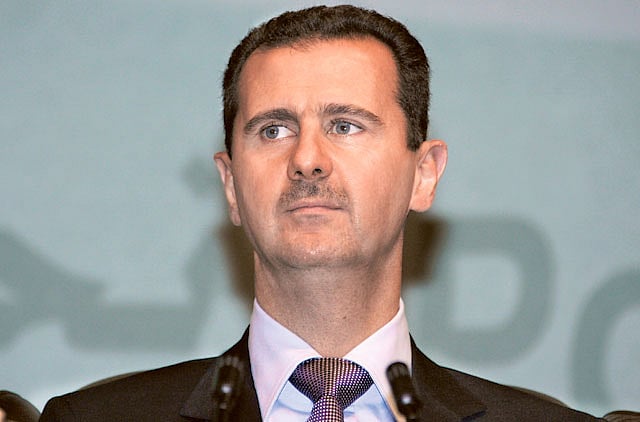
Beirut: Amid news of fresh massacres in Artouz, south-west of Damascus, and advances by Syrian forces on Qusayr near the border with Lebanon, Hezbollah confirmed that it committed an undetermined number of fighters to crush revolutionaries even if such interventions on the side of the Bashar Al Assad regime threatened both the party as well as the country. Observers wondered whether Hezbollah would sacrifice Lebanon to satisfy foreign interests at a time when Beirut confronted existential challenges. That Hezbollah stood by Iranian policies to back Al Assad was no longer a mystery nor in doubt.
Moreover, few hesitated to affirm the party’s capabilities, even if the price was high.
What many questioned, nevertheless, were the long-term implications of such devotion. Hezbollah now faces existential decisions which could effect its long-term interests. The decision to stick by Al Assad could forever taint relations with its neighbour should the Syrian opposition successfully overthrow the Al Assad regime. Such a miscalculation could also diminish its internal credibility as the party could forever become irrelevent in its own country.
A few days ago, Al Assad received the chairman of the foreign policy and national security committee of the Iranian parliament, Ala’a Al Deen Boroujerdi, who reasserted that Iran stood by the Syrian president. Unabashedly, Boroujerdi avowed that Iran would do whatever it took for Al Assad to stay in power until the 2014 elections. Hezbollah leaders, including the executive council deputy chairman Shaikh Nabeel Qaouq, affirmed that the party’s involvement in the fighting was “a national and moral duty in the defence of the Lebanese in border villages.”
Earlier, Hezbollah leader Hassan Nasrallah provided details, insisting that his group was sending its young men to defend Lebanese who were living across the borders inside Syria.
Naturally, Syrian opposition leaders were livid with these developments. The caretaker leader of the Syrian National Coalition, George Sabra, described Hezbollah’s role in fighting as a “declaration of war.”
“What is happening in Homs,” he said, “is a declaration of war against the Syrian people and the Arab League should deal with it on this basis.”
In an even bolder call, Sabra called on the Lebanese government to “realise the danger that [Hezbollah] poses to the lives of Syrians and the future relations between the two peoples and countries.”
Sabra accused Hezbollah of “occupying villages in Homs, terrorising the residents and preventing them from expressing their opinions”.
“Hezbollah’s fighters are terrorist fundamentalists who have crossed our border and the Lebanese government must deal firmly with them,” he said, which was the strongest such declaration made by a member of the Syrian opposition against Lebanon to date.
For their part, Lebanese officials were equally furious, even if the president, prime minister and speaker, refrained from making any public declarations.
It fell on Philangist Party leader Ameen Gemayel to accuse Hezbollah of breaching Lebanon’s disassociation policy by participating in the conflict. “Hezbollah has become more visible in its fight in Syria, which contradicts the Baabda Declaration [which stipulated that Beirut must remain impartial],” Gemayel said following his party’s weekly meeting.
Nazem Al Khair, a deputy in Lebanon’s Future party said that Hezbollah had opened the gates of hell to Lebanon through its military intervention in Syria.
Samir Geagea, the head of the Lebanese Forces, did not mince his words either. He told Al Liwaa newspaper: “The party is destroying the resistance, the Shiites and [all] Lebanon.”
Beyond political declarations, Sunni clerics reacted as well, though in far more ominous terms.
The controversial Shaikh Ahmad Al Assir, for example, urged Muslims and the Lebanese people to fight alongside the revolutionaries. He announced that he planned to create the Free Resistance Brigades in Saida to achieve this goal and urged “every Muslim in Lebanon and outside it” to “help the weak in Syria.”
Al Assir called on “fellow Christian, Druze and free Shiite [citizens]” to join the jihad.
For now, Al Assad’s mood is upbeat, as he demanded that Lebanon join Syria in the struggle against “terrorists” since Beirut could not possibly avoid Syria’s civil war. According to an account published in the Beirut daily Al Safir, Al Assad defined how he intended to win: “Our strategy is to keep Damascus and the other cities under army control,” he said.
He boldly declared: “The so-called Free [Syrian] Army is effectively undone. We are now fighting Al Qaida. Some 23 foreign nationalities are currently fighting on Syrian soil. Today, however, we are winning … [and though the] battle will be very long, our sole choice is to win it.”
Sign up for the Daily Briefing
Get the latest news and updates straight to your inbox
Network Links
GN StoreDownload our app
© Al Nisr Publishing LLC 2026. All rights reserved.