IRGC Navy's fast-attack boats modified to launch missiles. Six of such boats were knocked out by the US military on May 7, 2026.
Bait-and-switch: US tightens Iran oil squeeze, Tehran chokes global shipping via Hormuz — what's the end game?
Washington’s naval chokehold meets Tehran’s shipping clampdown in high-stakes standoff
Last updated:
5 MIN READ
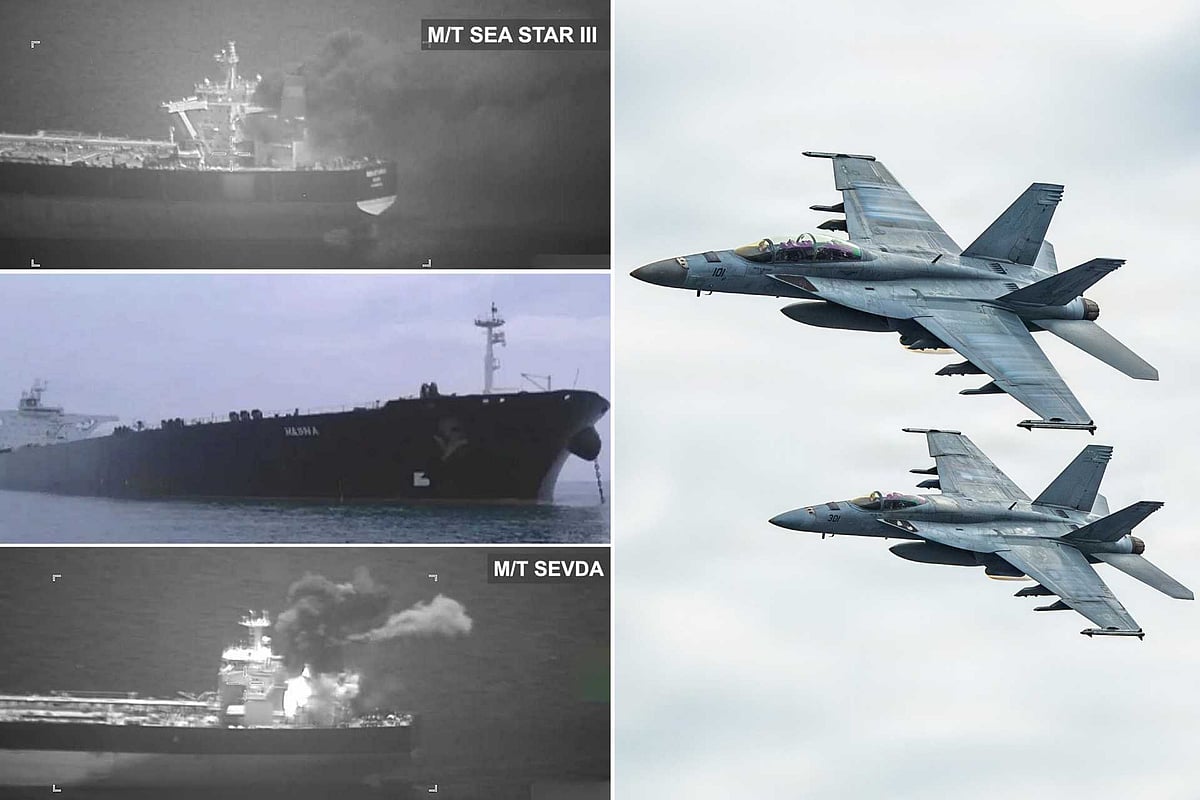
Three Iran-linked crude tankers attempting to breach the US naval blockade were stopped in the Gulf of Oman as US forces disabled them with strikes from F/A-18 Super Hornet jets before they could reach Iranian ports. US Navy aircraft fired precision munitions and cannon rounds to impair the vessels’ propulsion and steering systems, enforcing the maritime blockade.
CentCom | X
On May 7, 2026, the US Central Command reported that Iranian forces — including IRGC missiles, drones, and small fast boats — attacked three American guided-missile destroyers as they transited the Strait of Hormuz toward the Gulf of Oman.
The response was swift, overwhelming: CentCom said their forces "intercepted and neutralised" the threats and then unleashed retaliatory strikes on Iranian military facilities and launch sites in southern Iran, including:
Qeshm Island
Bandar Abbas (strategic ports)
Bandar Kargan (area near Minab).
Bait-and-switch
Some military observers argue that this operation (6 Iran fast-attack boats sunk) was less about direct confrontation and more about drawing Iran’s naval forces into the open.
The aim: reveal defensive positions, stockpiles and fortified sites, a tactic dubbed as a “bait-and-switch.”
Get updated faster and for FREE: Download the Gulf News app now - simply click here.
It's designed not only to "cancel" Iran's blockade of Hormuz but to "light up" — and expose — Iran's coastal missile and drone launchers, and knock them out.
According to this interpretation, the deployment of three US Navy destroyers in high-visibility sailing patterns closely monitored by Iranian coastal forces was intended to provoke Iran’s navy into responding from concealed positions.
Once Iranian units engaged or attempted to shadow the American vessels, those assets would effectively disclose the locations of silos, fortifications and other protective infrastructure that otherwise could remain hidden from satellite or distant reconnaissance.
Observers suggest the “bait” of US surface fleet movements achieved what military planners wanted: effectively coaxing the Iranian Navy to activate or reveal positions that would otherwise remain undetected.
This beefed up intelligence assessments at a relatively "low" operational cost.
'Self Defence'
US officials, including US Secretary of State Marco Rubio framed the May 7 operations as "self-defence" and not intended to drag the conflict back into full-scale war, amid a fragile truce that had been brokered earlier in April.
The broader backdrop, however, remained one in which the US blockade and periodic military actions were exerting intense pressure on Iran’s economy and ability to move oil and maintain its asymmetric control over the Strait of Hormuz.
This makes the dispute at once economic, logistical, and kinetic in character.
Iran chokes the world, US squeezes Iran's oil lifeline
As Iran chokes the global trade through Hormuz (an estimated 1,500 commercial ships stranded in the Gulf with up to 20,000 seafarers tapped, and running low on food and water), and tries to normalise a toll fee system, the US is choking Iran's oil lifeline, its crude tankers coming under threat.
The Iranians declared the period of tolerance is "over", warning that they would retaliate against US boats and facilities in the region if another Iran-linked tanker is hit.
This marks the hardening of battle lines amid the "dual blockade" — one being imposed by Iran's Navy on commercial vessels crossing Hormuz, and another being imposed by the US Navy on Iran-linked ships in the broader Gulf of Oman.
The latter targets Iran's oil exports, which fund over 50% of its revenue, primarily to China via a "shadow fleet" of obscure tankers using tactics like AIS spoofing, flag-hopping, and ship-to-ship transfers.
Blockade mechanics
Unlike past sanctions, US forces actively hail, turn back, or disable vessels— especially empty "ballast" tankers inbound to ports like Kharg Island—creating a logistics stranglehold.
Without empties to load crude, onshore storage overflows rapidly (capacity ~20-30 million barrels), forcing costly floating storage and risking production shutdowns.
Reports indicate exports have plummeted, costing Iran $200-500 million daily, though some shadow vessels evade via distant manoeuvres.
This approach harnesses America's naval superiority, by attempting to keep broader Hormuz traffic open with escorts, but impartially hits Iran-bound ships.
Tehran, meanwhile, has reportedly slipped 20+ vessels through early enforcement gaps, relies on resilient shadow fleets, and threatens retaliation like seizures.
Storage buffers weeks of output, but sustained blockade could force well "shut-ins".
Oil industry experts explain that prolonged shutdowns of mature oil fields increase the risk of "water coning," where water from beneath the reservoir intrudes into the well, trapping oil within rock pores. This can render some oil reservoirs permanently incapable of returning to pre-crisis production levels
There had been reports of deliberate dumping of oil in the Arabian Gulf, near Iran's Kharg island.
Prolonged squeeze?
In a wide-ranging interview with podcaster Mario Nawfal, Norwegian political scientist Glenn Diesen laid out a stark interpretation of Washington’s strategy toward Iran: not a decisive war, but a prolonged squeeze.
“The US is trying to slowly suffocate Iran, which could only harm the global economy,” Diesen said, describing what he sees as a campaign designed less to win quickly than to weaken steadily.
In his view, attacks on infrastructure, pressure on ports and a blockade on exports are all meant to erode Iran’s economic capacity over time.
“The war is weakening Iran now as well,” he said. “You can’t bomb its cities in this way, attack its infrastructure, destroy its ports, put a blockade on its exports without hurting Iran. In many ways, they are being weakened.”
Limits of US strategy
But Diesen argues the strategy comes with limits. If the United States disengages before achieving its objectives, and Iran retains control over the Strait of Hormuz, Tehran could regain leverage quickly.
He suggests Iranian leaders are determined to avoid the fate of countries like Syria and Iraq, where sanctions and intermittent airstrikes created long-term economic instability without regime change.
At the same time, Diesen contends that Iran is not allowing Washington to fight on predictable terms.
High-intensity war vs 'slow-burn'
A short, high-intensity strike aimed at toppling the government could be attempted, he said, but if that failed, the conflict would likely revert to what he calls a “slow-burn” phase.
He places the confrontation in a broader geopolitical frame. If the US walks away without clear success, he argues, it accelerates a shift away from American "unipolar" dominance.
He draws parallels to the war in Ukraine, saying efforts to weaken Russia there instead pushed Moscow closer to Beijing — a pattern he expects to repeat with Iran.
Diesen also questions whether a military victory is realistically attainable.
Iran, he notes, does not need a superior navy to create disruption.
“All they need is enough missiles, enough drones to shut down the Strait of Hormuz,” he said, pointing to the geography of a mountainous country with dispersed production and regional partnerships that complicate any invasion scenario.
A full-scale ground invasion, he suggests, would be far more difficult than past campaigns in Iraq — and therefore unlikely.
Sign up for the Daily Briefing
Get the latest news and updates straight to your inbox
Network Links
GN StoreAbout Gulf NewsTerms & ConditionsReach by GNSitemapContact usPrivacy PolicyGN FocusHave your sayWork with usAdvertise with usGulf News epaperPrinting Services
Download our app
© Al Nisr Publishing LLC 2026. All rights reserved.