1,000 ships pass through Hormuz as US blockade on Iran tightens: CentCom
Layered US naval ‘kill web’ seeks to choke Iran’s port traffic, avoid wider war
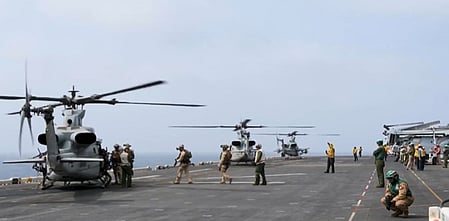
US Central Command, now actively enforcing a naval blockade against Iranian ports, has pushed back against Tehran's claims, noting that the US military have facilitated the safe passage of approximately 1,000 vessels and 500 million barrels of crude oil since early May.
Up to 10,000 soldiers are involved in operations to redirect commercial vessels attempting to enter or exit Iranian waters as part of an ongoing blockade to pressure Tehran amid heightened tensions in the Gulf.
In a statement on X, CentCom stressed that the IRGC has no authority to dictate shipping routes, and reported that, as of July 29, its forces had redirected 20 commercial vessels, disabled two and boarded two others.
The update details the assets involved.
Get it: Fast, verified news for FREE ... download the Gulf News app — simply click here
The "Iron Wall" targets only traffic to or from Iranian ports while preserving freedom of navigation through the Strait of Hormuz for other vessels.
The operation remains dynamic, the situation fluid, with potential for further incidents involving commercial shipping or direct military exchanges.
How they work together
The blockade functions as a layered "kill web" emphasising persistence and graduated response:
Surveillance layer: intelligence-surveillance-reconnaissance (ISR) drones, P-8s, ship radars, satellites, and open-source AIS tracking monitor vast areas. Suspicious vessels (heading to/from Iranian ports) are identified early, often far from the coast to reduce risk.
Warning and deterrence: Destroyers or patrol aircraft hail vessels via radio, backed by the visible presence of carriers and fighters. Most comply and redirect.
Interception: If ignored, surface ships close in, supported by overhead aircraft. Helicopters deploy Marines for boarding, or precision fires (guns, Hellfires, cannons) disable propulsion without sinking (e.g., engine room shots).
Escalation control: Actions occur primarily in international waters.
Force is calibrated — redirect > disable > board/seize. Humanitarian exceptions apply.
Allies provide intelligence but the US leads enforcement.
This integration leverages US strengths in joint operations: Navy for sea control, Marines for boarding, Air Force/Navy aviation for reach and precision.
The result: a choke on Iranian port traffic with relatively low kinetic activity (preference for redirection), though incidents like boardings and disablements demonstrate resolve.
Tensions remain high
As of late July, the US has conducted multiple rounds of strikes on Iranian targets throughout the month, with reports of continued operations even after pauses were considered.
Iran has responded with missile launches and other actions, including reported incidents involving US-linked facilities.
On July 29–30, CENTCOM announced new strikes in response to attempted Iranian attacks on US forces in the region.
The blockade enforcement continues alongside these operations, with U.S. naval and air assets patrolling the area.
The economic stakes are significant.
Disruptions in the Strait of Hormuz have ripple effects on global energy markets, insurance rates for shipping and oil prices.
Previous phases of the blockade and conflict led to reduced traffic and heightened war-risk premiums.
Sustained military pressure
]The US action reflects a strategy of "peace through strength," with officials arguing that sustained military pressure is necessary to prevent Iran from reconstituting its capabilities or disrupting global energy flows.
Critics, including some regional voices, have raised concerns about escalation risks, humanitarian impacts and the legality of the blockade under international law, though the US maintains its actions are defensive and proportionate.
Iran has denounced the measures as aggressive and vowed to defend its interests.
This underscores the military's effort to project resolve and transparency in real time while managing a complex maritime operation in one of the world's most volatile regions.
As diplomatic avenues appear limited, the blockade serves as both a tool of coercion and a safeguard for international navigation.
Hormuz: Global economic impact
The US maintains a layered, multi-domain "iron wall" around Iranian ports through a naval blockade reimposed in mid-July 2026 (after an earlier phase from April to June). This targets only vessels entering or exiting Iranian ports and coastal areas, while allowing free transit through the Strait of Hormuz for ships not bound for Iran.
CENTCOM prefers redirection through warnings and compliance.
Non-compliant vessels face disablement (e.g., precision strikes on propulsion) or boarding/seizure. This approach minimizes escalation while enforcing the restriction impartially across all nations.
Key Military equipment and naval assets
CENTCOM deploys a combination of naval, air, and ground (Marine) assets for persistent surveillance, deterrence, interception, and enforcement:
Aircraft Carriers (e.g., USS Abraham Lincoln, USS George H.W. Bush): Serve as mobile air bases with dozens of fighter/attack aircraft (F/A-18 Super Hornets, F-35s). They provide air superiority, close air support for interdictions, and launch platforms for strikes. Multiple carriers ensure sustained 24/7 coverage.
Guided-Missile Destroyers (e.g., Arleigh Burke-class like USS Spruance): Core surface combatants for patrols, radar surveillance, and direct action. Armed with 5-inch Mk 45 guns for disabling shots, missiles, and helicopters. They issue radio warnings, fire warning shots, or conduct precision disabling fire on engines.
ISR aircraft and drones: Includes MQ-9 Reapers, P-8 Poseidon maritime patrol planes, and other reconnaissance platforms. These provide wide-area surveillance, track vessels via radar/optics/AIS, and relay real-time intelligence for intercepts.
Fixed- and Rotary-Wing Aircraft: Land- and sea-based fighters (F-15s, F-35s, F/A-18s) for overwatch and strikes (e.g., AGM-114 Hellfire missiles from aircraft to disable tankers). Helicopters (from carriers, destroyers, or amphibious ships) transport Marines for boarding and provide close support.
Amphibious Ships and Embarked Marines: Units like the 31st Marine Expeditionary Unit (MEU) on ships such as USS Tripoli. These enable visit-board-search-seizure (VBSS) operations using rigid-hull inflatable boats (RHIBs), fast-roping from helicopters, and small arms for ship seizures.
Supporting Elements: Submarines for underwater domain awareness, electronic warfare aircraft, additional surface ships (20+ warships reported in theater), and mine-clearing assets if needed. Over 200 aircraft and warships have supported operations in earlier phases.
thehill.com
Personnel involved
Tens of thousands of U.S. personnel participate, centered on Navy sailors, Air Force aviators, and Marines:
Navy: Ship crews, aviators, and operators for surface and air assets. They handle patrols, warnings, and fires.
Marines (especially from MEUs): Specialized in maritime interdiction and boarding. They conduct VBSS to search vessels, detain crews if necessary, and ensure compliance.
Air Force and joint aviation units: Pilots and sensor operators for land-based aircraft and drones.
Command and Support: CENTCOM (led by Adm. Brad Cooper) oversees from Tampa, with on-scene coordination via carrier strike groups and joint task forces. Intelligence analysts, linguists, and lawyers support rules-of-engagement decisions.
Sign up for the Daily Briefing
Get the latest news and updates straight to your inbox
Network Links
GN StoreDownload our app
© Al Nisr Publishing LLC 2026. All rights reserved.