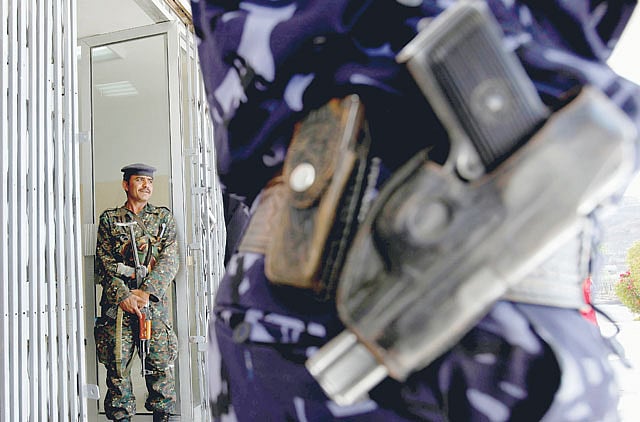
Sana'a: Yemen, hunting Al Qaida within its borders, believes its own security forces must fight militants on its territory and rejects any direct US intervention, the foreign minister said.
Yemen, the poorest Arab country, was thrust into the foreground of the US-led war against Islamist after a Yemen-based wing of Al Qaida said it was behind a Christmas Day attempt to bomb a US-bound plane.
Asked by CNN whether Yemen would accept direct US intervention, Foreign Minister Abu Bakr Al Qirbi said: "No, I don't think we will accept that. I think the US, as well, have learned from Afghanistan and Iraq and other places that direct intervention can be self-defeating.
"We think this is the priority and the responsibility of our security forces and the army," Al Qirbi told the US news channel.
Yemeni authorities launched an operation this week to root out Al Qaida militants who they said were behind threats that forced Western embassies to close.
The raid, which killed two militants, allayed US concerns and allowing its heavily fortified mission to reopen.
"What we need from the United States and other partners is to build our capability to provide us with the technical know-how, with the equipment, with the intelligence information and with the firepower," Al Qirbi said.
Campaign
Yemen has sent troops to take part in a campaign against Al Qaida in three provinces over the past four days. One security source said forces had set up extra checkpoints on main roads.
Yemeni forces surrounded a suspected Al Qaida regional leader near the capital on Wednesday, and have captured eight rank-and-file Al Qaida militants in recent days, including three wounded in Monday's raid, security sources said.
Placed strategically on the Arabian Peninsula's southern rim, Yemen is trying to fight a threat from resurgent Al Qaida fighters while a Shiite revolt rages in the north and separatist sentiment simmers in the south.
"I think our thought was that maybe we should spare Al Qaida in the last year because of the confrontation in the south and with the Houthis [rebels]. But Al Qaida took advantage of that," Al Qirbi said, adding that the militant network had tried to make inroads with northern rebels and southern separatists.
"Then they went even further to arrange for some suicide attacks in Sana'a. And this is why it was important that our security forces should take action against them," he added.
The West and Saudi Arabia fear Al Qaida will take advantage of Yemen's instability to spread its operations to the neighbouring kingdom, the world's biggest oil exporter, and beyond. Yemen is a small oil producer.
Yemen, with shrinking oil reserves, a water crisis and fast-growing population, has stepped up security on its coast to block militants from reaching its shores from Somalia. Al Qirbi said there were about 200 to 300 Al Qaida operatives in Yemen.
"How many of them are going to entertain terrorist attacks is something that is obviously of concern to us. This is why we always stress the importance of cooperation with United States and other countries in the region," he said.
Yemeni officials acknowledge the need for US help with counter-terrorism, but say the government also lacks resources to tackle the poverty that widens al Qaida's recruiting pool.
Defence and counter-terrorism officials say Washington has been quietly supplying military equipment, intelligence and training to Yemen to root out suspected Al Qaida hideouts.
Terrorism conference
UN Secretary-General Ban Ki-moon said on Wednesday the upcoming international conference on Yemen will focus on fighting terrorism and helping over 150,000 internal refugees fleeing an escalating conflict in the north.
The UN chief expressed "great concern" at the deteriorating humanitarian and security situation in the impoverished Arabian Peninsula country and said "there is a serious question of how we can fight against international terrorism".
At the January 27 conference, Ban said, "we will have a comprehensive review on how the international community (will) address these issues."
British Prime Minister Gordon Brown called for the high-level meeting to devise ways to counter radicalisation in Yemen, saying an international approach is needed to combat the rising influence of Al Qaida in the country. The conference will take place in London a day before an international conference on Afghanistan co-chaired by Brown, Ban and Afghan President Hamid Karzai.
"This situation in Yemen has much broader regional implications in our common struggle to fight against international terrorism," Ban said.
Sign up for the Daily Briefing
Get the latest news and updates straight to your inbox
Network Links
GN StoreDownload our app
© Al Nisr Publishing LLC 2026. All rights reserved.