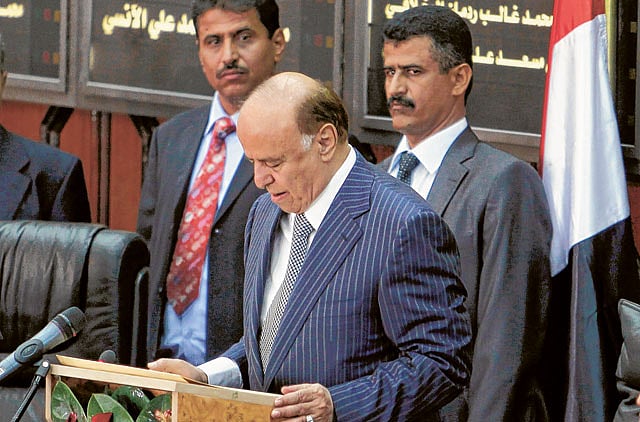
Sana'a: Abd Rabbo Mansour Hadi became Yemen's new president on Saturday, formally removing Ali Abdullah Saleh from power, as a car bombing in the south of the country underscored the violence that will be the new leader's greatest challenge.
The car loaded with explosives killed at least 26 people and injured dozens when it was driven towards a presidential palace in the southern Yemeni city of Hadramout.
A former Army general, Hadi stood as the sole candidate to replace Saleh in a power transfer deal brokered by Gulf neighbours and backed by Western powers. He was elected after more than 60 per cent of eligible voters took part in an election this week.
Hadi said in a speech that Yemen must draw a line under a year of protests and violence and tackle pressing issues such as its economic problems and bringing those displaced by the crisis back to their homes.
"I stand here in a historic moment... I look to the Yemeni people and give them thanks. The crisis reached every city and village and house, but Yemen will continue to go forward," Hadi said. "If we don't deal with challenges practically, then chaos will reign."
After his speech, protesters in the southern city of Aden clashed with security forces, injuring four people, medics said.
Power transfer deal
Yemen's richer neighbours, led by Saudi Arabia, crafted the power transfer, also backed by Washington and a UN Security Council resolution, to ease out Saleh.
One of the poorest countries in the Middle East, Yemen had already been fractured before the revolt against Saleh's rule, with separatists in the south, Shiite rebels in the north and an active wing of Al Qaida.
There are fears that chaos in Yemen could empower the country's branch of Al Qaida.
Hadi is now tasked with overseeing a proposed two-year political transition that envisions parliamentary elections, a new constitution and restructuring the military in which Saleh's son and nephew still hold power.
Hadi made a point to single out Al Qaida as a top priority for his new administration: "Continuing the war against Al Qaida is a national and religious duty."
The international community described the oath as a key step forward.
"Yemenis want an end to the crisis, and to turn a new page. Now, it's time to rebuild, for consensus and concord... and to bring people into an inclusive political process," Jamal Benomar, UN envoy to Yemen, said.
The US ambassador to Yemen, Gerald Feierstein, said: "We are seeing the beginning of a process that I believe will deliver great results over the next two years."
Hadi's inauguration ceremony is scheduled for tomorrow, which Saleh is to attend.
Sign up for the Daily Briefing
Get the latest news and updates straight to your inbox
Network Links
GN StoreDownload our app
© Al Nisr Publishing LLC 2026. All rights reserved.